


Delegates to a climate change conference rushed yesterday to finish a report mapping out measures to combat global warming, confident they can overcome China's objections about the cost and urgency of acting quickly, delegates said.
A report from the Intergovernmental Panel on Climate Change -- the UN network of 2,000 scientists -- on how the world should cope with global warming was being debated in secret this week by delegates from more than 120 governments.
A final version expected today will warn of catastrophe unless the world acts quickly to stem climate change.
The report is expected to urge countries to deploy various measures -- including energy-efficient technologies, a shift away from coal, and agricultural reforms -- to keep world temperatures from rising more than 2oC, thereby limiting the impact of global warming.
China, the world's second biggest emitter of greenhouse gases after the US, has indicated it wants the report to better reflect its belief that richer countries are responsible for global warming and should take the lead in cleaning up the problem, delegates said.
A member for the Chinese delegation refused to discuss specifics of their demands, other than to say they wanted the "truth of the science" to be reflected in the document.
It has also joined up with the US, according to comments submitted ahead of the meeting, to suggest the proposed cap on greenhouse gas levels is too low and reaching the target would be too expensive.
The two countries are expected to attempt to insert language into the final report that would weaken the conclusion that quick action can stabilize greenhouse gas levels.
India, for its part, has raised objections to language in the report that says significant emission cuts can be made in developing countries, delegates said. Instead, it has argued to strike such language as part of its demands that development must come ahead of caps on emissions.
Delegates, though, said most of the objections from India and China -- often efforts to strike language altogether versus amending it -- have been overcome so far as scientists provided proof on such basic issues as how mitigation measures corresponded to various emission levels.
"It's going more smoothly than we anticipated," said Michel Petit, a French delegate who expected the report to be completed early today.
Delegates also are debating different categories of energy use and ways to cut emissions as they went through a draft of the report summary, and were working into the night so negotiations could be wrapped up yesterday.
One contentious issue has been whether and how to refer to nuclear power in the final summary. The US, for instance, is pushing for a strong reference to atomic energy as a clean source of electricity.
Many environmentalists consider atomic energy too dangerous and costly.
"We don't believe that nuclear is a solution," Stephan Singer of the World Wildlife Fund said.

Republican US lawmakers on Friday criticized US President Joe Biden’s administration after sanctioned Chinese telecoms equipment giant Huawei unveiled a laptop this week powered by an Intel artificial intelligence (AI) chip. The US placed Huawei on a trade restriction list in 2019 for contravening Iran sanctions, part of a broader effort to hobble Beijing’s technological advances. Placement on the list means the company’s suppliers have to seek a special, difficult-to-obtain license before shipping to it. One such license, issued by then-US president Donald Trump’s administration, has allowed Intel to ship central processors to Huawei for use in laptops since 2020. China hardliners
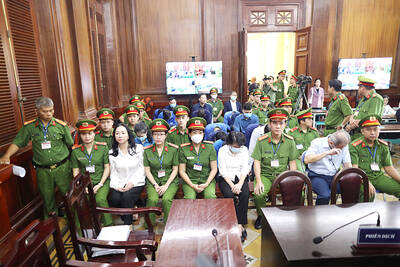
A top Vietnamese property tycoon was on Thursday sentenced to death in one of the biggest corruption cases in history, with an estimated US$27 billion in damages. A panel of three hand-picked jurors and two judges rejected all defense arguments by Truong My Lan, chair of major developer Van Thinh Phat, who was found guilty of swindling cash from Saigon Commercial Bank (SCB) over a decade. “The defendant’s actions ... eroded people’s trust in the leadership of the [Communist] Party and state,” read the verdict at the trial in Ho Chi Minh City. After the five-week trial, 85 others were also sentenced on

Conjoined twins Lori and George Schappell, who pursued separate careers, interests and relationships during lives that defied medical expectations, died this month in Pennsylvania, funeral home officials said. They were 62. The twins, listed by Guinness World Records as the oldest living conjoined twins, died on April 7 at the Hospital of the University of Pennsylvania, obituaries posted by Leibensperger Funeral Homes of Hamburg said. The cause of death was not detailed. “When we were born, the doctors didn’t think we’d make 30, but we proved them wrong,” Lori said in an interview when they turned 50, the Philadelphia Inquirer reported. The

RAMPAGE: A Palestinian man was left dead after dozens of Israeli settlers searching for a missing 14-year-old boy stormed a village in the Israeli-occupied West Bank US President Joe Biden on Friday said he expected Iran to attack Israel “sooner, rather than later” and warned Tehran not to proceed. Asked by reporters about his message to Iran, Biden simply said: “Don’t,” underscoring Washington’s commitment to defend Israel. “We are devoted to the defense of Israel. We will support Israel. We will help defend Israel and Iran will not succeed,” he said. Biden said he would not divulge secure information, but said his expectation was that an attack could come “sooner, rather than later.” Israel braced on Friday for an attack by Iran or its proxies as warnings grew of


 RSS
RSS