


Terrorist attacks against noncombatants nearly doubled in Iraq from 2005 to last year and were up sharply in Afghanistan, with those two countries alone accounting for a 29 percent increase in terrorism worldwide, a report released on Monday by the State Department showed.
The report shows that the two countries where large numbers of US combat troops are deployed are also where terrorism is rising fastest. Terrorist attacks are up 91 percent in Iraq and 53 percent in Afghanistan, according to statistics compiled by the National Counterterrorism Center. In the rest of the world, total terrorist attacks declined by 3 percent.
The new statistics record a rise in terrorist attacks on nonmilitary targets globally to 14,338 last year from 11,153 in 2005, with an increase in deaths to 20,498 from 14,618. But Iraq alone accounted for nearly half of all attacks and about two-thirds of fatalities, according to the report, Country Reports on Terrorism, 2006, posted on Monday on the State Department's Web site.
The numbers underscore the ineffectiveness of battling terrorism with conventional military means, said John Arquilla, who studies terrorism at the Naval Postgraduate School.
"It is most curious that the areas where we have military operations have the most attacks," Arquilla said. "These statistics suggest that our war on global terrorism is not going very well. It suggests we need to try a new approach."
The State Department report said that the invasion of Iraq "has been used by terrorists as a rallying cry for radicalization and extremist activity that has contributed to instability in neighboring countries."
At a news briefing to release the report, Frank Urbancic, the State Department's acting coordinator for counterterrorism, said the statistics reflected the viral spread of terrorists' methods.
In Afghanistan, there has been a rapid rise in suicide attacks mimicking those in Iraq, and methods for making improvised explosive devices have evolved in the face of American moves to counter them.
"The terrorists, there's no question, are intelligent people, and they learn from each other," Urbancic said. "The people in Afghanistan are watching the people in Iraq, the people in Iraq are watching the people elsewhere."
The annual report is the second to follow a controversy over the government's count of terrorist attacks in 2004, when the secretary of state at the time, Colin Powell, acknowledged that the numbers publicly announced were artificially low.
The admission followed a critique from two academic experts, Alan Krueger of Princeton and David Laitin of Stanford.
With two years of data compiled using the same definitions and methodology, this year's State Department report allows a meaningful comparison.
Krueger, an economist who has advised the government on the statistical questions since 2004, said the new methodology has cleared up some confusion.
"I'd give it a B+," said Krueger, who is writing a book on the causes of terrorism.
He said he believes the definition of terrorism used by the National Counterterrorism Center is still too broad, including some assassinations of particular individuals rather than random attacks intended to spread fear.
The report lists five countries as "state sponsors of terrorism": Iran, Syria, Sudan, Cuba, and North Korea.
Libya was dropped after more than two decades on the list.

Republican US lawmakers on Friday criticized US President Joe Biden’s administration after sanctioned Chinese telecoms equipment giant Huawei unveiled a laptop this week powered by an Intel artificial intelligence (AI) chip. The US placed Huawei on a trade restriction list in 2019 for contravening Iran sanctions, part of a broader effort to hobble Beijing’s technological advances. Placement on the list means the company’s suppliers have to seek a special, difficult-to-obtain license before shipping to it. One such license, issued by then-US president Donald Trump’s administration, has allowed Intel to ship central processors to Huawei for use in laptops since 2020. China hardliners
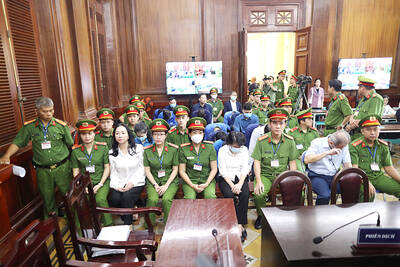
A top Vietnamese property tycoon was on Thursday sentenced to death in one of the biggest corruption cases in history, with an estimated US$27 billion in damages. A panel of three hand-picked jurors and two judges rejected all defense arguments by Truong My Lan, chair of major developer Van Thinh Phat, who was found guilty of swindling cash from Saigon Commercial Bank (SCB) over a decade. “The defendant’s actions ... eroded people’s trust in the leadership of the [Communist] Party and state,” read the verdict at the trial in Ho Chi Minh City. After the five-week trial, 85 others were also sentenced on

Conjoined twins Lori and George Schappell, who pursued separate careers, interests and relationships during lives that defied medical expectations, died this month in Pennsylvania, funeral home officials said. They were 62. The twins, listed by Guinness World Records as the oldest living conjoined twins, died on April 7 at the Hospital of the University of Pennsylvania, obituaries posted by Leibensperger Funeral Homes of Hamburg said. The cause of death was not detailed. “When we were born, the doctors didn’t think we’d make 30, but we proved them wrong,” Lori said in an interview when they turned 50, the Philadelphia Inquirer reported. The
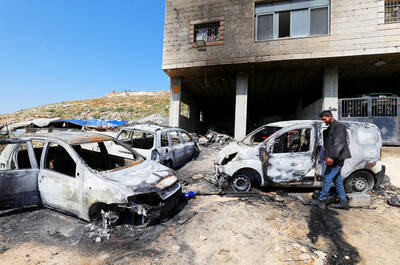
RAMPAGE: A Palestinian man was left dead after dozens of Israeli settlers searching for a missing 14-year-old boy stormed a village in the Israeli-occupied West Bank US President Joe Biden on Friday said he expected Iran to attack Israel “sooner, rather than later” and warned Tehran not to proceed. Asked by reporters about his message to Iran, Biden simply said: “Don’t,” underscoring Washington’s commitment to defend Israel. “We are devoted to the defense of Israel. We will support Israel. We will help defend Israel and Iran will not succeed,” he said. Biden said he would not divulge secure information, but said his expectation was that an attack could come “sooner, rather than later.” Israel braced on Friday for an attack by Iran or its proxies as warnings grew of


 RSS
RSS