


Press freedom around the world deteriorated last year because of coups and attempts to stifle political opposition and regulate use of the Internet, a leading watchdog said in a report yesterday.
US-based Freedom House outlined what it said were particularly troubling trends in Asia, the former Soviet Union and Latin America, in a report that warned that democracy as a whole would likely suffer.
"Press freedom is like the canary in the coal mine," executive director Jennifer Windsor said in a statement. "Assaults on the media are inevitably followed by assaults on other democratic institutions. The fact that press freedom is in retreat is a deeply troubling sign that democracy itself will come under further assault."
The report, released ahead of World Press Freedom Day tomorrow, said that coups, insurgency and states of emergency in Thailand, Sri Lanka, Pakistan, the Philippines and Fiji had taken their toll on press freedom.
The study said Myanmar, Cuba, Libya, North Korea, and Turkmenistan were the worst countries for press freedom. In North Korea, for example, radios must be registered with police and all foreign Web sites are blocked.
Freedom House pointed to recent improvements in Nepal, Cambodia and Indonesia.
China, Vietnam and Iran were continuing to jail journalists and cyber-dissidents, while Russia was aggressively trying to marginalize independent media and planning to regulate use of the Internet, it said.
In Iran YouTube and the English version of Wikipedia were banned in December.
The study, entitled Freedom of the Press 2007, also noted a deterioration in Venezuela, Argentina and Brazil either because of state action or deteriorating security environments.
"The records of Venezuela and Russia are appalling, all the more so because of those countries' impact on their regions," Karin Karlekar, managing editor of the survey, said.
The group blamed the decline on coups, drives to neutralize political opposition, violence against journalists and laws brought in to enable governments to punish the press for critical reports.
The group also expressed alarm about the situation in the Middle East, where recent progress had stagnated, it said. Libya, Syria, Tunisia and the Palestinian Authority were singled out for their "extremely restricted" media.
But the organization also noted improvements in Italy, Nepal, Colombia, Haiti, and other countries, because of greater political openness and an improved security environment.
Not even the US, called "one of the better performers," escaped criticism for cases in which journalists face legal pressure, including imprisonment, to reveal confidential sources.
The survey gives countries a score out of 100 to reflect restrictions on their media. Iceland and Finland shared the top spot.
The survey gave 74 countries out of the 195 included the "free" rating and 63 the "not free" label. The remainder were "partly free."
"We are also disturbed by the level of press freedom decline in what we had assumed were established democracies," Karlekar said.
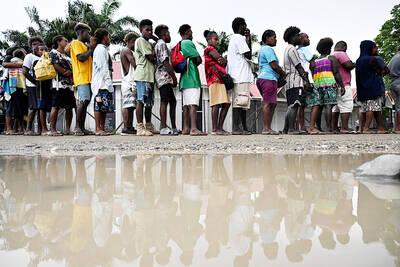
SEEKING CHANGE: A hospital worker said she did not vote in previous elections, but ‘now I can see that maybe my vote can change the system and the country’ Voting closed yesterday across the Solomon Islands in the south Pacific nation’s first general election since the government switched diplomatic allegiance from Taiwan to Beijing and struck a secret security pact that has raised fears of the Chinese navy gaining a foothold in the region. The Solomon Islands’ closer relationship with China and a troubled domestic economy weighed on voters’ minds as they cast their ballots. As many as 420,000 registered voters had their say across 50 national seats. For the first time, the national vote also coincided with elections for eight of the 10 local governments. Esther Maeluma cast her vote in the
Nearly half of China’s major cities are suffering “moderate to severe” levels of subsidence, putting millions of people at risk of flooding, especially as sea levels rise, according to a study of nationwide satellite data released yesterday. The authors of the paper, published by the journal Science, found that 45 percent of China’s urban land was sinking faster than 3mm per year, with 16 percent at more than 10mm per year, driven not only by declining water tables, but also the sheer weight of the built environment. With China’s urban population already in excess of 900 million people, “even a small portion

UNSETTLING IMAGES: The scene took place in front of TV crews covering the Trump trial, with a CNN anchor calling it an ‘emotional and unbelievably disturbing moment’ A man who doused himself in an accelerant and set himself on fire outside the courthouse where former US president Donald Trump is on trial has died, police said yesterday. The New York City Police Department (NYPD) said the man was declared dead by staff at an area hospital. The man was in Collect Pond Park at about 1:30pm on Friday when he took out pamphlets espousing conspiracy theories, tossed them around, then doused himself in an accelerant and set himself on fire, officials and witnesses said. A large number of police officers were nearby when it happened. Some officers and bystanders rushed

HYPOCRISY? The Chinese Ministry of Foreign Affairs yesterday asked whether Biden was talking about China or the US when he used the word ‘xenophobic’ US President Joe Biden on Wednesday called for a hike in steel tariffs on China, accusing Beijing of cheating as he spoke at a campaign event in Pennsylvania. Biden accused China of xenophobia, too, in a speech to union members in Pittsburgh. “They’re not competing, they’re cheating. They’re cheating and we’ve seen the damage here in America,” Biden said. Chinese steel companies “don’t need to worry about making a profit because the Chinese government is subsidizing them so heavily,” he said. Biden said he had called for the US Trade Representative to triple the tariff rates for Chinese steel and aluminum if Beijing was


 RSS
RSS