


Parents are being warned to think long and hard when choosing names for their babies as research has discovered that girls who are given what researchers say are very feminine names, such as Anna, Emma or Elizabeth, are less likely to study math or science after the age of 16, a study has found.
Both subjects, which are traditionally seen as predominantly male, are far more popular among girls with names such as Abigail, Lauren and Ashley, which were judged as less feminine in a linguistic test.
The effect is so strong that parents can set twin daughters off on completely different career paths simply by calling them Isabella and Alex, names at either end of the spectrum, the study said.
A study of 1,000 pairs of sisters in the US found that Alex was twice as likely as her twin to take math or science at a higher level.
Part of the reason is that names provide a powerful image of a person and influence people's reactions to them. An Isabella is less likely to study math, the study said, because people would not expect her to.
"There are plenty of exceptions but, on average, people treat Isabellas differently to Alexes," said David Figlio, professor of economics at the University of Florida and the author of the report. "Girls with feminine names were often typecast."
Figlio pointed to the controversy that arose over the first talking Barbie's phrase, "math is hard."
"It is a stereotype, and girls with particularly feminine names may feel more pressure to avoid technical subjects," he said.
Not that they were any less capable. When the Isabellas, Annas and Elizabeths took on their tougher-named peers in science, they performed just as well.
To carry out the study, to be published in the Journal of Human Resources, Figlio calculated a linguistic "femininity" score for each name. It was determined by using 1,700 letter and sound combinations that could be associated as either female or male and matching them against the names on 1.4 million birth certificates.

Republican US lawmakers on Friday criticized US President Joe Biden’s administration after sanctioned Chinese telecoms equipment giant Huawei unveiled a laptop this week powered by an Intel artificial intelligence (AI) chip. The US placed Huawei on a trade restriction list in 2019 for contravening Iran sanctions, part of a broader effort to hobble Beijing’s technological advances. Placement on the list means the company’s suppliers have to seek a special, difficult-to-obtain license before shipping to it. One such license, issued by then-US president Donald Trump’s administration, has allowed Intel to ship central processors to Huawei for use in laptops since 2020. China hardliners
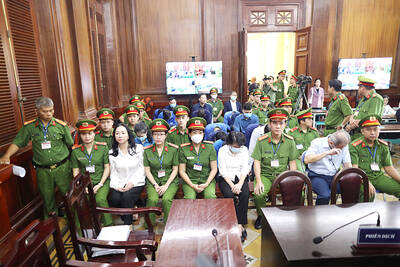
A top Vietnamese property tycoon was on Thursday sentenced to death in one of the biggest corruption cases in history, with an estimated US$27 billion in damages. A panel of three hand-picked jurors and two judges rejected all defense arguments by Truong My Lan, chair of major developer Van Thinh Phat, who was found guilty of swindling cash from Saigon Commercial Bank (SCB) over a decade. “The defendant’s actions ... eroded people’s trust in the leadership of the [Communist] Party and state,” read the verdict at the trial in Ho Chi Minh City. After the five-week trial, 85 others were also sentenced on

Conjoined twins Lori and George Schappell, who pursued separate careers, interests and relationships during lives that defied medical expectations, died this month in Pennsylvania, funeral home officials said. They were 62. The twins, listed by Guinness World Records as the oldest living conjoined twins, died on April 7 at the Hospital of the University of Pennsylvania, obituaries posted by Leibensperger Funeral Homes of Hamburg said. The cause of death was not detailed. “When we were born, the doctors didn’t think we’d make 30, but we proved them wrong,” Lori said in an interview when they turned 50, the Philadelphia Inquirer reported. The

RAMPAGE: A Palestinian man was left dead after dozens of Israeli settlers searching for a missing 14-year-old boy stormed a village in the Israeli-occupied West Bank US President Joe Biden on Friday said he expected Iran to attack Israel “sooner, rather than later” and warned Tehran not to proceed. Asked by reporters about his message to Iran, Biden simply said: “Don’t,” underscoring Washington’s commitment to defend Israel. “We are devoted to the defense of Israel. We will support Israel. We will help defend Israel and Iran will not succeed,” he said. Biden said he would not divulge secure information, but said his expectation was that an attack could come “sooner, rather than later.” Israel braced on Friday for an attack by Iran or its proxies as warnings grew of


 RSS
RSS