


Mexico City lawmakers voted on Tuesday to legalize abortion, making the Mexican capital one of the few places in Latin America where women can terminate early pregnancies without restrictions.
The vote came despite strong opposition from Mexican President Felipe Calderon's conservative National Action Party (PAN) and the powerful Mexican Catholic church, with Calderon's wife having taken part on Sunday in an anti-abortion protest.
After seven hours of fierce debate, the vote was 46 in favor, 19 against and one abstention in the city legislature, which is dominated by the leftist Party of the Democratic Revolution.
Backers and opponents of the bill had demonstrated outside the legislature as the 66 lawmakers debated, with police deployed as the two sides traded bitter insults which mirrored the emotional nature of the abortion debate in this socially conservative country.
"Damn fascists," one man yelled out at the anti-abortion protesters, to which a rival demonstrator answered "they should have aborted you, bloody murderer."
Placards stating "yes for life" were countered by those calling "for the right to decide."
The law made the megalopolis one of the rare parts of Latin America where abortion is legal without restrictions in the first three months of pregnancy. Cuba, Guyana and Puerto Rico, a US territory, have similar legislation.
The bill makes first trimester abortions legal in the capital, even though they remain generally illegal in the rest of the country.
Until now abortions in Mexico were only legal in cases of rape or if the pregnancy entailed serious health risks.
Tuesday's debate followed months of controversy, with Roman Catholic Pope Benedict XVI urging Mexicans to reject the bill and local Catholic officials threatening to excommunicate anyone supporting it.
The Catholic bishop of Chiapas state compared the legislators who drafted the text with Adolf Hitler, though he also condemned the fact some of them received death threats.
Supporters of the bill said a prohibition on all abortion only accentuates social inequalities, with impoverished women getting clandestine abortions in unhygienic backstreet clinics, and Mexicans who can afford to pay about 1,000 dollars undergoing the procedure in well-appointed, though still-illegal, facilities.
About 100,000 women have abortions every year in Mexico, according to official figures, though some non-governmental organizations say the figure is as high as 500,000.
According to the leftist Alternative party, clandestine abortions have killed more than 1,500 women over 10 years.
Opinion polls ahead of the vote indicated Mexicans are sharply divided over the issue.
Outside the city legislative assembly building on Tuesday, protesters chanted "No to abortion, yes to life" and waved religious pictures, while supporters of the bill held banners proclaiming "the right to decide."
"Women have the right to decide before conceiving a child, not after," said Christina Benaviles, 43, a home maker who demonstrated outside the city's legislative assembly.
Bank employee Rebecca Var, 52, who stood on the other side of the fence, insisted that legalizing abortion "is a question of public health, not a moral issue."
In almost all of Latin America, conservative societies backed by the dominant Catholic church have prevented the legalization of abortion, unless the pregnancy was the result of rape or incest or endangers the mother's life.

Republican US lawmakers on Friday criticized US President Joe Biden’s administration after sanctioned Chinese telecoms equipment giant Huawei unveiled a laptop this week powered by an Intel artificial intelligence (AI) chip. The US placed Huawei on a trade restriction list in 2019 for contravening Iran sanctions, part of a broader effort to hobble Beijing’s technological advances. Placement on the list means the company’s suppliers have to seek a special, difficult-to-obtain license before shipping to it. One such license, issued by then-US president Donald Trump’s administration, has allowed Intel to ship central processors to Huawei for use in laptops since 2020. China hardliners
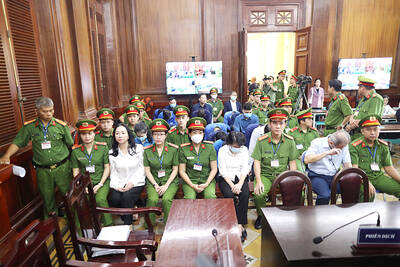
A top Vietnamese property tycoon was on Thursday sentenced to death in one of the biggest corruption cases in history, with an estimated US$27 billion in damages. A panel of three hand-picked jurors and two judges rejected all defense arguments by Truong My Lan, chair of major developer Van Thinh Phat, who was found guilty of swindling cash from Saigon Commercial Bank (SCB) over a decade. “The defendant’s actions ... eroded people’s trust in the leadership of the [Communist] Party and state,” read the verdict at the trial in Ho Chi Minh City. After the five-week trial, 85 others were also sentenced on

‘DELUSIONAL’: Targeting the families of Hamas’ leaders would not push the group to change its position or to give up its demands for Palestinians, Ismail Haniyeh said Israeli aircraft on Wednesday killed three sons of Hamas’ top political leader in the Gaza Strip, striking high-stakes targets at a time when Israel is holding delicate ceasefire negotiations with the militant group. Hamas said four of the leader’s grandchildren were also killed. Ismail Haniyeh’s sons are among the highest-profile figures to be killed in the war so far. Israel said they were Hamas operatives, and Haniyeh accused Israel of acting in “the spirit of revenge and murder.” The deaths threatened to strain the internationally mediated ceasefire talks, which appeared to gain steam in recent days even as the sides remain far
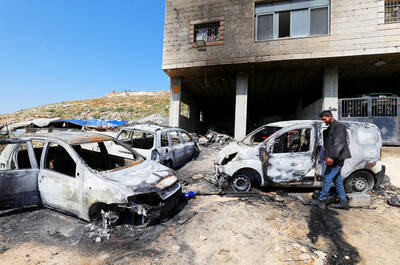
RAMPAGE: A Palestinian man was left dead after dozens of Israeli settlers searching for a missing 14-year-old boy stormed a village in the Israeli-occupied West Bank US President Joe Biden on Friday said he expected Iran to attack Israel “sooner, rather than later” and warned Tehran not to proceed. Asked by reporters about his message to Iran, Biden simply said: “Don’t,” underscoring Washington’s commitment to defend Israel. “We are devoted to the defense of Israel. We will support Israel. We will help defend Israel and Iran will not succeed,” he said. Biden said he would not divulge secure information, but said his expectation was that an attack could come “sooner, rather than later.” Israel braced on Friday for an attack by Iran or its proxies as warnings grew of


 RSS
RSS