


Nigerian President-elect Umaru Yar'Adua yesterday faced a growing tide of discontent after being declared winner of a disputed poll which even the outgoing head of state admitted was far from perfect.
In his first press briefing late Monday, Yar'Adua issued an appeal for national unity, amid opposition threats to challenge his victory in court and sharp criticism of the lecture from foreign and domestic monitors.
"The contest has come and gone," said the leader-to-be of the world's sixth largest oil-exporting nation. "So must our differences, in the interest of the greater good."
Yar'Adua, a mild-mannered 55-year-old governor of one of Nigeria's northern Shariah law states, ran for election with the backing of mentor President Olusegun Obasanjo and his ruling party.
The national election commission said Yar'Adua won Saturday's ballot with 24.6 million votes, well ahead of his two main rivals.
But foreign observers slammed the credibility of the poll that -- along with state polls the week before -- claimed at least 200 lives, and opposition parties rejected the result.
"The just-ended elections in Nigeria, while they produced a new government, also produced a highly questionable democracy," said Sebastian Spio-Garbrah, an analyst with the New York-based Eurasia group.
Heralded as a showcase election marking the first peaceful civilian-to-civilian handover since independence in 1960 in violence-prone Nigeria, the vote was marred by fraud, electoral delays and political thuggery.
The country's largest observer group demanded the annulment of the vote and described the election as "a charade" set up in a deal rigged by the government and the national election commission.
"We call on the international community not to recognize these discredited elections and not to confer legitimacy on any government that emerges therefrom," said Innocent Chukwuma, head of the Nigerian monitors.
The US said it was "deeply troubled" by the violence and voting irregularities and the European Union said the vote was "not credible" and fell short of international democratic standards.
Even Obasanjo admitted the polls had been far from perfect and called on the country to do better next time.
Seeking a way forward, the president urged voters and parties to take complaints to the courts and called on the electoral commission and the judiciary to put wrongs right within the next five weeks before he steps down on May 29.
"After all, in another four years, there will be an opportunity for a fresh contest which I hope will take care of ballot paper and ballot box malpractices," he said.
Former US secretary of state Madeleine Albright, in Nigeria as the head of an observer team, said the handling of the election had marked "a step backward," but voiced hope that voter frustrations would be resolved peacefully.
"There is a delicate five weeks period where everything should go properly," Albright said.
Yar'Adua has a track record of financial prudence, public service and accountability and is among the few governors recently absolved of corruption by the country's anti-graft agency. On being elected governor of Katsina in 1999, Yar'Adua immediately made public his assets.
He has promised to tackle corruption, a major issue in a country regularly ranked among the most corrupt on the planet by global watchdog Transparency International.
Turnout was low for Saturday's presidential and legislative elections after ballot papers printed at the last minute arrived hours late, or not at all, in many of the 120,000 voting stations of Africa's most populous nation.

Republican US lawmakers on Friday criticized US President Joe Biden’s administration after sanctioned Chinese telecoms equipment giant Huawei unveiled a laptop this week powered by an Intel artificial intelligence (AI) chip. The US placed Huawei on a trade restriction list in 2019 for contravening Iran sanctions, part of a broader effort to hobble Beijing’s technological advances. Placement on the list means the company’s suppliers have to seek a special, difficult-to-obtain license before shipping to it. One such license, issued by then-US president Donald Trump’s administration, has allowed Intel to ship central processors to Huawei for use in laptops since 2020. China hardliners
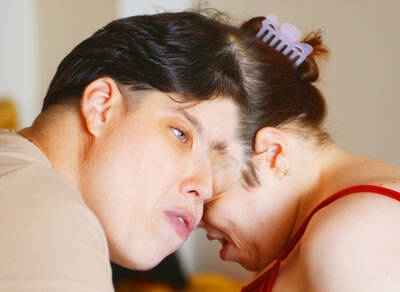
Conjoined twins Lori and George Schappell, who pursued separate careers, interests and relationships during lives that defied medical expectations, died this month in Pennsylvania, funeral home officials said. They were 62. The twins, listed by Guinness World Records as the oldest living conjoined twins, died on April 7 at the Hospital of the University of Pennsylvania, obituaries posted by Leibensperger Funeral Homes of Hamburg said. The cause of death was not detailed. “When we were born, the doctors didn’t think we’d make 30, but we proved them wrong,” Lori said in an interview when they turned 50, the Philadelphia Inquirer reported. The
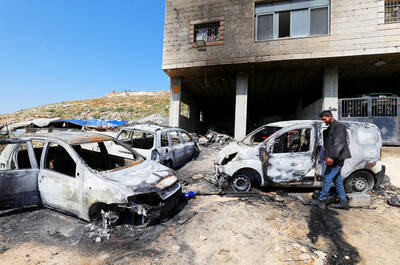
RAMPAGE: A Palestinian man was left dead after dozens of Israeli settlers searching for a missing 14-year-old boy stormed a village in the Israeli-occupied West Bank US President Joe Biden on Friday said he expected Iran to attack Israel “sooner, rather than later” and warned Tehran not to proceed. Asked by reporters about his message to Iran, Biden simply said: “Don’t,” underscoring Washington’s commitment to defend Israel. “We are devoted to the defense of Israel. We will support Israel. We will help defend Israel and Iran will not succeed,” he said. Biden said he would not divulge secure information, but said his expectation was that an attack could come “sooner, rather than later.” Israel braced on Friday for an attack by Iran or its proxies as warnings grew of
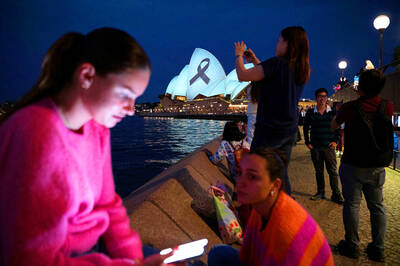
A prominent Christian leader has allegedly been stabbed at the altar during a Mass yesterday in southwest Sydney. Bishop Mar Mari Emmanuel was saying Mass at Christ The Good Shepherd Church in Wakeley just after 7pm when a man approached him at the altar and allegedly stabbed toward his head multiple times. A live stream of the Mass shows the congregation swarm forward toward Emmanuel before it was cut off. The church leader gained prominence during the COVID-19 pandemic, amassing a large online following, Officers attached to Fairfield City police area command attended a location on Welcome Street, Wakeley following reports a number


 RSS
RSS