


Russians yesterday mourned their first post-Soviet leader, Boris Yeltsin, preparing a grandiose state funeral for the flamboyant ex-president while at the same time debating the way he oversaw the painful birth of a new Russia.
Yeltsin, who died on Monday aged 76 from a heart attack, will be buried at Moscow's historic Novodevichy cemetery today following a memorial service in the golden-domed Christ the Savior cathedral.
A national day of mourning will be observed and President Vladimir Putin has postponed his annual state of the nation speech from today to tomorrow, a Kremlin spokesman said.
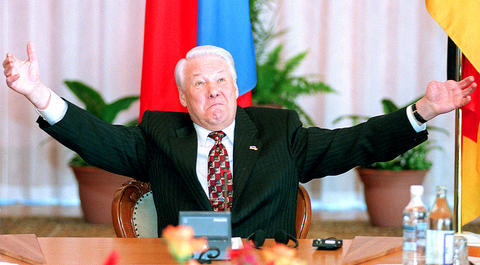
PHOTO: AP
The solemn farewell to the man who brought down the Soviet Union in 1991 and transformed Russia into a capitalist democracy prompted soul-searching across the world's biggest country.
News of his death and retrospectives on his epic political career filled the airwaves and dominated newspapers.
"Yeltsin was the last hero. Now we just have people," the independent daily Vremya Novostei said.
"The main quality of a hero is not his historical good or bad points or the number of his mistakes, his victories or defeats. What is important for a hero is greatness, even if it is frightening."
Tributes also poured in from Western leaders who see Yeltsin as a champion of freedom. President Vladimir Putin said that under Yeltsin "a newly democratic Russia was born, and a free nation opened to the world."
However, millions of ordinary Russians nostalgic for Soviet power blame Yeltsin for losing a vast empire and plunging his country into years of economic and political turmoil.
Liberal critics underline Yeltsin's launch of two Chechen wars, his alliance with corrupt business tycoons, and the handover of power in 1999 to Putin, an ex-KGB officer who restored national pride but has restricted political freedoms.
Mikhail Gorbachev, the last Soviet leader and the man brought down by Yeltsin's pro-democracy crusade, gave a mixed appraisal.
"I offer my deepest condolences to the family of a man on whose shoulders rested many great deeds for the good of the country and serious mistakes -- a tragic fate," Gorbachev said.
Western leaders, who pushed the boundaries of NATO and the EU deep into Russia's former sphere of influence during the 1990s, were effusive in praise.
US President George W. Bush hailed a "historic figure who served his country during a time of momentous change." British Prime Minister Tony Blair applauded a "remarkable man who... played a vital role at a crucial time."
UN Secretary-General Ban Ki-moon lauded Yeltsin for "fostering rapprochement between East and West."
A bear-like figure with a penchant for flamboyant gestures, Yeltsin will be best remembered for bravely clambering onto a tank sent into Moscow in 1991 by communist hardliners attempting a coup in the dying days of the Soviet Union.
His defiance galvanized pro-democracy supporters, ushered in the Soviet collapse in December 1991 and eight years of turbulent, historic rule.
Yeltsin then sought to drag Russia into the modern age. He forced the bankrupt communist economy to adopt capitalism, unleashed political pluralism, and allowed a vibrant, freewheeling media.
The mass circulation pro-government daily Izvestia yesterday praised Yeltsin for not clinging on to power at the close of his second term.
"In power many people cursed him, but in leaving the Kremlin he showed his critics and his supporters that there is something more important than hunger for power," Izvestia said.
"There is such a thing as law and democracy and it was under Yeltsin that this began to be understood. In the end it was for him about self-respect and reputation and now he has left us in the same way," Izvestia said.
A poll by the Levada Analytical Centre in December found 70 percent think the Yeltsin era did more harm than good. Half thought he should be prosecuted.
Friends said history would judge Yeltsin more favorably as the father -- however flawed -- of Russian democracy.
"I consider that [he] did the absolute impossible. He brought us from no freedom to liberty," said Anatoly Chubais, one of the architects of liberal economic reforms under Yeltsin.

Republican US lawmakers on Friday criticized US President Joe Biden’s administration after sanctioned Chinese telecoms equipment giant Huawei unveiled a laptop this week powered by an Intel artificial intelligence (AI) chip. The US placed Huawei on a trade restriction list in 2019 for contravening Iran sanctions, part of a broader effort to hobble Beijing’s technological advances. Placement on the list means the company’s suppliers have to seek a special, difficult-to-obtain license before shipping to it. One such license, issued by then-US president Donald Trump’s administration, has allowed Intel to ship central processors to Huawei for use in laptops since 2020. China hardliners
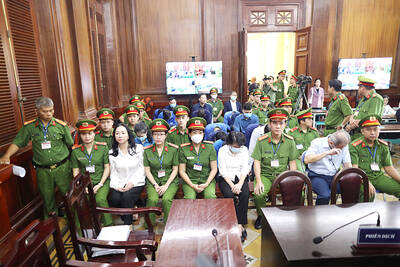
A top Vietnamese property tycoon was on Thursday sentenced to death in one of the biggest corruption cases in history, with an estimated US$27 billion in damages. A panel of three hand-picked jurors and two judges rejected all defense arguments by Truong My Lan, chair of major developer Van Thinh Phat, who was found guilty of swindling cash from Saigon Commercial Bank (SCB) over a decade. “The defendant’s actions ... eroded people’s trust in the leadership of the [Communist] Party and state,” read the verdict at the trial in Ho Chi Minh City. After the five-week trial, 85 others were also sentenced on

‘DELUSIONAL’: Targeting the families of Hamas’ leaders would not push the group to change its position or to give up its demands for Palestinians, Ismail Haniyeh said Israeli aircraft on Wednesday killed three sons of Hamas’ top political leader in the Gaza Strip, striking high-stakes targets at a time when Israel is holding delicate ceasefire negotiations with the militant group. Hamas said four of the leader’s grandchildren were also killed. Ismail Haniyeh’s sons are among the highest-profile figures to be killed in the war so far. Israel said they were Hamas operatives, and Haniyeh accused Israel of acting in “the spirit of revenge and murder.” The deaths threatened to strain the internationally mediated ceasefire talks, which appeared to gain steam in recent days even as the sides remain far

Conjoined twins Lori and George Schappell, who pursued separate careers, interests and relationships during lives that defied medical expectations, died this month in Pennsylvania, funeral home officials said. They were 62. The twins, listed by Guinness World Records as the oldest living conjoined twins, died on April 7 at the Hospital of the University of Pennsylvania, obituaries posted by Leibensperger Funeral Homes of Hamburg said. The cause of death was not detailed. “When we were born, the doctors didn’t think we’d make 30, but we proved them wrong,” Lori said in an interview when they turned 50, the Philadelphia Inquirer reported. The


 RSS
RSS