


The people of the remote Himalayan kingdom of Bhutan cast their vote for tradition and the monarchy, officials said yesterday, as results came in from a mock election designed as a dress rehearsal for the country's first truly democratic polls next year.
The poll was a big step towards ending a century of royal rule and ushering in a new era of parliamentary democracy in the conservative, mainly Buddhist nation, a prospect which many Bhutanese view with a mixture of anticipation and trepidation.
People were asked to choose between four dummy parties with imaginary manifestos, each represented by a different color, and emphasizing fairness and accountability, the environment, industrial development and traditional values.
"The first of the two-phased mock elections was a great success and we are now ready to usher in democracy," Dasho Kunzang Wangdi, Bhutan's chief election commissioner, said by telephone from the capital Thimphu.
Saturday's dummy elections were designed to familiarize residents of the "Land of the Thunder Dragon" with the workings of parliamentary democracy.
The exercise is part of a plan by former king Jigme Singye Wangchuck -- who handed his crown in December to his young Oxford-educated son, Jigme Khesar Namgyel Wangchuck -- to change with the times and assume a more ceremonial role.
An estimated 400,000 people were eligible to vote in the tiny Buddhist nation, which is about the size of Switzerland and sits sandwiched between India and China.
But turnout appeared low at about 30 percent, with just 124,747 votes cast in the 47 constituencies.
Voters were given a choice of four fictional parties -- the Blue, Green, Red and Yellow Druk parties. The Druk, or Thunder Dragon, is the national symbol.
Each party had a fictional platform: the Blue party stood for industrial development, the Greens for environmental protection, and the Red Druks for free and fair government.
But it was the Yellow Druk party, which stood for "ensuring unity of the country through preservation of traditions, culture and values" that appeared to be ahead in preliminary results, Wangdi said.
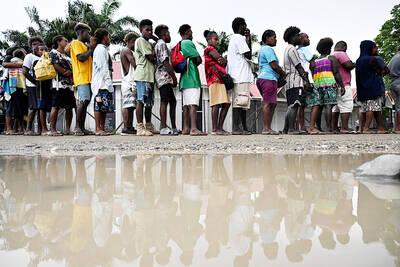
SEEKING CHANGE: A hospital worker said she did not vote in previous elections, but ‘now I can see that maybe my vote can change the system and the country’ Voting closed yesterday across the Solomon Islands in the south Pacific nation’s first general election since the government switched diplomatic allegiance from Taiwan to Beijing and struck a secret security pact that has raised fears of the Chinese navy gaining a foothold in the region. The Solomon Islands’ closer relationship with China and a troubled domestic economy weighed on voters’ minds as they cast their ballots. As many as 420,000 registered voters had their say across 50 national seats. For the first time, the national vote also coincided with elections for eight of the 10 local governments. Esther Maeluma cast her vote in the
Nearly half of China’s major cities are suffering “moderate to severe” levels of subsidence, putting millions of people at risk of flooding, especially as sea levels rise, according to a study of nationwide satellite data released yesterday. The authors of the paper, published by the journal Science, found that 45 percent of China’s urban land was sinking faster than 3mm per year, with 16 percent at more than 10mm per year, driven not only by declining water tables, but also the sheer weight of the built environment. With China’s urban population already in excess of 900 million people, “even a small portion

UNSETTLING IMAGES: The scene took place in front of TV crews covering the Trump trial, with a CNN anchor calling it an ‘emotional and unbelievably disturbing moment’ A man who doused himself in an accelerant and set himself on fire outside the courthouse where former US president Donald Trump is on trial has died, police said yesterday. The New York City Police Department (NYPD) said the man was declared dead by staff at an area hospital. The man was in Collect Pond Park at about 1:30pm on Friday when he took out pamphlets espousing conspiracy theories, tossed them around, then doused himself in an accelerant and set himself on fire, officials and witnesses said. A large number of police officers were nearby when it happened. Some officers and bystanders rushed

HYPOCRISY? The Chinese Ministry of Foreign Affairs yesterday asked whether Biden was talking about China or the US when he used the word ‘xenophobic’ US President Joe Biden on Wednesday called for a hike in steel tariffs on China, accusing Beijing of cheating as he spoke at a campaign event in Pennsylvania. Biden accused China of xenophobia, too, in a speech to union members in Pittsburgh. “They’re not competing, they’re cheating. They’re cheating and we’ve seen the damage here in America,” Biden said. Chinese steel companies “don’t need to worry about making a profit because the Chinese government is subsidizing them so heavily,” he said. Biden said he had called for the US Trade Representative to triple the tariff rates for Chinese steel and aluminum if Beijing was


 RSS
RSS