


The ancient Central Asian sport of kok-boru, in which horsemen wrestle over a headless goat, may not have caught on in the West, but here it is a source of national pride -- and a wildcard in national politics.
"Why does the United States promote football everywhere? Because through football they spread American values, the American way of life. Here it's the same with kok-boru," said Kemir Dyushekeyev, assistant director of Kyrgyzstan's National Kok-Boru Federation.
Exactly what are the values spread by a sport where the ball is a gutted goat carcass with its head removed and legs cut off at the knees?

PHOTO: AFP
"Strength, bravery, competition and camaraderie. There can be no kok-boru without camaraderie," Dyushekeyev said.
Or without strength. At the start of the game, eight players on horseback race to get their hands on a goat carcass that weighs between 30kg and 40kg, which they usually haul up by one of its truncated limbs.
They whip and punch each other for control of the goat, sometimes passing it to teammates, until one player breaks away and gallops across a 200m field to toss it into a stone ring.
"It's in our blood to play, it's in our genes," said Bakyt Tabakriyev, one of the organizers of a recent tournament in Nizhny Orok, a village 15km from the capital Bishkek.
"This game didn't start yesterday, it started 2,000 [to] 3,000 years ago," he said.
And it's not as singular as it might sound. Kok-boru is played under various names throughout Central Asia.
Regional tournaments bring in national teams from Afghanistan, China, Kazakhstan, Russia, Tajikistan and Uzbekistan.
It almost made the jump to the US in 2001 after a group of US rodeo riders travelled to Kyrgyzstan to display their skills.
Kyrgyz horsemen were set to reciprocate with a kok-boru exhibition, but were denied US visas after the Sept. 11, 2001, terror attacks, Dyushekeyev said.
"Americans would have loved it," he said. "It's a harsh sport, but so is football."
One difference is protective gear -- or the lack of it. Most kok-boru players are shielded from their competitors' whips and fists -- not to mention horses' hooves when they fall from the saddle -- only by World War II-era Soviet tank helmets.
Play is supposed to stop if a fallen player is in danger of being trampled, but "there are serious injuries all the time."
It was hard to find any trace of religiosity as the players spat curses in Russian and thrashed everything within whip's length amid a huge cloud of dust.
The game's political element, however, was far clearer.
The week-long Nizhny Orok tournament was sponsored by the Ata Meken opposition political party, and was timed to match opposition rallies in nearby Bishkek that were aimed at bringing down Kyrgyz President Kurmanbek Bakiyev.
If police tried to break up the rally, hundreds of kok-boru players from Nizhny Orok and other villages would gallop into Bishkek to take them on, said Tabakriyev, also a member of Atam Bek.
Nearly half of China’s major cities are suffering “moderate to severe” levels of subsidence, putting millions of people at risk of flooding, especially as sea levels rise, according to a study of nationwide satellite data released yesterday. The authors of the paper, published by the journal Science, found that 45 percent of China’s urban land was sinking faster than 3mm per year, with 16 percent at more than 10mm per year, driven not only by declining water tables, but also the sheer weight of the built environment. With China’s urban population already in excess of 900 million people, “even a small portion

UNSETTLING IMAGES: The scene took place in front of TV crews covering the Trump trial, with a CNN anchor calling it an ‘emotional and unbelievably disturbing moment’ A man who doused himself in an accelerant and set himself on fire outside the courthouse where former US president Donald Trump is on trial has died, police said yesterday. The New York City Police Department (NYPD) said the man was declared dead by staff at an area hospital. The man was in Collect Pond Park at about 1:30pm on Friday when he took out pamphlets espousing conspiracy theories, tossed them around, then doused himself in an accelerant and set himself on fire, officials and witnesses said. A large number of police officers were nearby when it happened. Some officers and bystanders rushed

HYPOCRISY? The Chinese Ministry of Foreign Affairs yesterday asked whether Biden was talking about China or the US when he used the word ‘xenophobic’ US President Joe Biden on Wednesday called for a hike in steel tariffs on China, accusing Beijing of cheating as he spoke at a campaign event in Pennsylvania. Biden accused China of xenophobia, too, in a speech to union members in Pittsburgh. “They’re not competing, they’re cheating. They’re cheating and we’ve seen the damage here in America,” Biden said. Chinese steel companies “don’t need to worry about making a profit because the Chinese government is subsidizing them so heavily,” he said. Biden said he had called for the US Trade Representative to triple the tariff rates for Chinese steel and aluminum if Beijing was
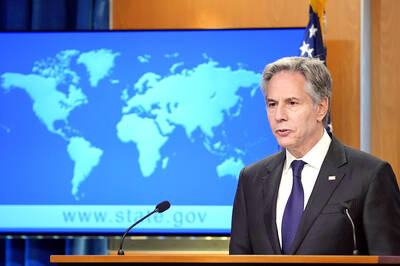
Beijing is continuing to commit genocide and crimes against humanity against Uyghurs and other Muslim minorities in its western Xinjiang province, U.S. Secretary of State Antony Blinken said in a report published on Monday, ahead of his planned visit to China this week. The State Department’s annual human rights report, which documents abuses recorded all over the world during the previous calendar year, repeated language from previous years on the treatment of Muslims in Xinjiang, but the publication raises the issue ahead of delicate talks, including on the war in Ukraine and global trade, between the top U.S. diplomat and Chinese


 RSS
RSS