


Thousands of hours of broadcasting history, some of which have never been transmitted, are to be made available to the public online as part of a plan to open up the BBC's entire archive free of charge.
The footage includes an interview with US civil rights activist Martin Luther King Jr, filmed shortly before he was assassinated, and another with musicians John Lennon and Yoko Ono in which the former Beatle talks candidly about the impact their relationship had on the band.
Other programs include a 1956 episode of the nature series Zoo Quest in which a young David Attenborough captures the komodo dragon on film for the first time. The episode could soon be available online as part of the ambitious project, headed by the BBC's director of future media and technology, Ashley Highfield.
The BBC wants to put nearly 1 million hours of material on the internet for viewers to watch, listen to and download and has already begun the long process of retrieving and transferring programs. A trial involving 20,000 users will begin next month, and the service could be available more widely in a year's time. Highfield will announce details of the scheme in a speech this week.
A 1968 Woman's Hour radio program marking the 50th anniversary of women gaining the vote features interviews with suffragettes.
Other material includes a dramatic government appeal, from May 1940, asking for volunteers to sail to Dunkirk to help rescue the 330,000 French and British troops stranded there.
Most of the programs have never been repeated because the BBC does not own the rights to part of the material used in each broadcast.
The corporation is currently trying to clear the material so it can place it online, although the negotiations are proving more complicated than expected. Although it owns the copyright to most shows, it does not have the right to repeat many of them. Actors, agents, composers and presenters have to be contacted.
Ultimately, however, it wants to make every program available, no matter how obscure.
"Lots of it might not be of wider interest, but if your mum was on a daytime quiz show, it will still be of interest to you," Highfield says.
The BBC also plans to make a huge amount of supporting material available, including scripts. If it can secure permission to use them, they will make up a huge database of documents.
The corporation has been planning to exploit its valuable archive for some time.
New technology means it is far cheaper to store and distribute video and audio streams, and the growth of broadband has boosted demand for high-quality content.
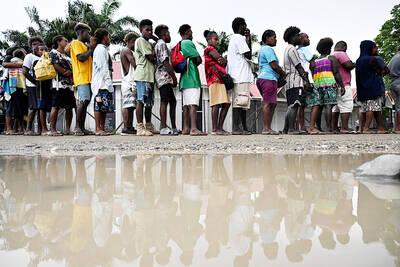
SEEKING CHANGE: A hospital worker said she did not vote in previous elections, but ‘now I can see that maybe my vote can change the system and the country’ Voting closed yesterday across the Solomon Islands in the south Pacific nation’s first general election since the government switched diplomatic allegiance from Taiwan to Beijing and struck a secret security pact that has raised fears of the Chinese navy gaining a foothold in the region. The Solomon Islands’ closer relationship with China and a troubled domestic economy weighed on voters’ minds as they cast their ballots. As many as 420,000 registered voters had their say across 50 national seats. For the first time, the national vote also coincided with elections for eight of the 10 local governments. Esther Maeluma cast her vote in the
Nearly half of China’s major cities are suffering “moderate to severe” levels of subsidence, putting millions of people at risk of flooding, especially as sea levels rise, according to a study of nationwide satellite data released yesterday. The authors of the paper, published by the journal Science, found that 45 percent of China’s urban land was sinking faster than 3mm per year, with 16 percent at more than 10mm per year, driven not only by declining water tables, but also the sheer weight of the built environment. With China’s urban population already in excess of 900 million people, “even a small portion

UNSETTLING IMAGES: The scene took place in front of TV crews covering the Trump trial, with a CNN anchor calling it an ‘emotional and unbelievably disturbing moment’ A man who doused himself in an accelerant and set himself on fire outside the courthouse where former US president Donald Trump is on trial has died, police said yesterday. The New York City Police Department (NYPD) said the man was declared dead by staff at an area hospital. The man was in Collect Pond Park at about 1:30pm on Friday when he took out pamphlets espousing conspiracy theories, tossed them around, then doused himself in an accelerant and set himself on fire, officials and witnesses said. A large number of police officers were nearby when it happened. Some officers and bystanders rushed

HYPOCRISY? The Chinese Ministry of Foreign Affairs yesterday asked whether Biden was talking about China or the US when he used the word ‘xenophobic’ US President Joe Biden on Wednesday called for a hike in steel tariffs on China, accusing Beijing of cheating as he spoke at a campaign event in Pennsylvania. Biden accused China of xenophobia, too, in a speech to union members in Pittsburgh. “They’re not competing, they’re cheating. They’re cheating and we’ve seen the damage here in America,” Biden said. Chinese steel companies “don’t need to worry about making a profit because the Chinese government is subsidizing them so heavily,” he said. Biden said he had called for the US Trade Representative to triple the tariff rates for Chinese steel and aluminum if Beijing was


 RSS
RSS