


Rising global temperatures could make Latin America's melting glaciers completely disappear within 15 years, send hurricanes crashing into places that have never seen them, stop wheat from growing in Africa and change the global face of tourism, a UN report released on Tuesday said.
The report, written and reviewed by hundreds of scientists, outlined dramatic effects of climate change, including rising oceans, food and water shortages, the disappearance of species, and intensifying natural disasters. It said 30 percent of the world's coastlines could be lost by 2080.
Scientists with the Intergovernmental Panel on Climate Change (IPCC) provided details of the report in news conferences around the world on Tuesday, four days after releasing a written summary of their findings.
The report was the second of three issued this year; the first dealt with the physical science of climate change and the third will deal with responses to it.
In Mexico City, scientists said that global warming could cost the Brazilian rainforest up to 30 percent of its species and turn large swaths into savannah.
They said ocean levels worldwide will creep up each year, rising 1.3m along Latin American coastlines by 2080 and flooding low-lying cities such as Rio de Janeiro and Buenos Aires.
Polar ice caps will likely melt, opening a waterway at the North Pole that could make the Panama Canal obsolete, IPCC member Edmundo de Alba said.
Tropical storm seasons will spawn bigger and more dangerous hurricanes that will threaten coastlines not traditionally affected by them, like in 2005, when an unusually strong tropical cyclone formed off Brazil's southern Atlantic coast.
Its 110kph winds prompted many meteorologists to classify it as a hurricane, even though hurricanes are not supposed to occur in the southern Atlantic Ocean.
Latin America's diverse ecosystems will struggle with intense droughts and flooding and as many as 70 million people in the region will be left without enough water, the report said.
By 2080, water shortages could threaten 1.1 billion to 3.2 billion people, depending on the level of greenhouse gases that cars and industry spew into the air.
Water supplies will be most diminished in areas relying on meltdown from mountain ranges, where one-sixth of the world's population lives.
That's especially true in the Andean mountains of Peru, Bolivia, Ecuador, Colombia and Venezuela, where glaciers are already retreating rapidly and are expected to disappear within 15 years.
"What's clear is [that] places suffering from drought are going to become drier and places with a large amount of precipitation are going to see an increase in precipitation," de Alba said.
Many Latin American farmers will have to abandon traditional crops such as corn, rice, wheat and sugar as their soil becomes increasingly saline, and ranchers will have to find new ways to feed their livestock, scientists said. They warned that governments are doing too little to prepare for the changes.
"We don't have medium or long-term plans in Latin America. Governments look the other way," IPCC member Osvaldo Canziani said in Buenos Aires.
The panel said that Africa is the continent most vulnerable to the effects of climate change. The fallout from a swiftly warming planet -- extreme weather, flooding, outbreaks of disease -- will exacerbate troubles in the world's poorest continent, said Anthony Nyong, one of the lead authors.
Wheat, a staple in Africa, could disappear from the continent by the 2080s.
Also see story:
The growing climate of censorship in climate change

Republican US lawmakers on Friday criticized US President Joe Biden’s administration after sanctioned Chinese telecoms equipment giant Huawei unveiled a laptop this week powered by an Intel artificial intelligence (AI) chip. The US placed Huawei on a trade restriction list in 2019 for contravening Iran sanctions, part of a broader effort to hobble Beijing’s technological advances. Placement on the list means the company’s suppliers have to seek a special, difficult-to-obtain license before shipping to it. One such license, issued by then-US president Donald Trump’s administration, has allowed Intel to ship central processors to Huawei for use in laptops since 2020. China hardliners

DISADVANTAGE: Erin O’Toole, who led the Conservatives during the election campaign in 2021, estimated that the interference cost his party as many as nine legislative seats Canada’s domestic spy agency on Monday concluded that China interfered in the past two elections, an official probe heard, the firmest evidence so far of suspected Chinese meddling in Canadian politics. Canadian Prime Minister Justin Trudeau’s Liberal Party won both the elections, held in 2019 and 2021. Under pressure from opposition lawmakers unhappy about media reports on China’s possible role, Trudeau set up a commission into foreign interference. The commission was shown a slide on Monday containing an extract of a briefing in February last year from the Canadian Security Intelligence Service (CSIS). “We know that the PRC [People’s Republic of China] clandestinely
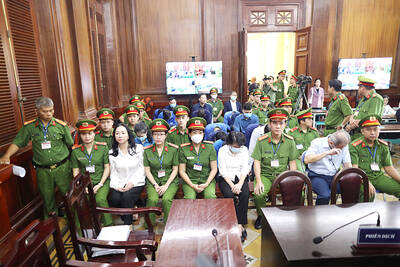
A top Vietnamese property tycoon was on Thursday sentenced to death in one of the biggest corruption cases in history, with an estimated US$27 billion in damages. A panel of three hand-picked jurors and two judges rejected all defense arguments by Truong My Lan, chair of major developer Van Thinh Phat, who was found guilty of swindling cash from Saigon Commercial Bank (SCB) over a decade. “The defendant’s actions ... eroded people’s trust in the leadership of the [Communist] Party and state,” read the verdict at the trial in Ho Chi Minh City. After the five-week trial, 85 others were also sentenced on

‘DELUSIONAL’: Targeting the families of Hamas’ leaders would not push the group to change its position or to give up its demands for Palestinians, Ismail Haniyeh said Israeli aircraft on Wednesday killed three sons of Hamas’ top political leader in the Gaza Strip, striking high-stakes targets at a time when Israel is holding delicate ceasefire negotiations with the militant group. Hamas said four of the leader’s grandchildren were also killed. Ismail Haniyeh’s sons are among the highest-profile figures to be killed in the war so far. Israel said they were Hamas operatives, and Haniyeh accused Israel of acting in “the spirit of revenge and murder.” The deaths threatened to strain the internationally mediated ceasefire talks, which appeared to gain steam in recent days even as the sides remain far


 RSS
RSS