


A black-veiled woman strapped with explosives blew herself up outside a police station in Iraq yesterday, killing 16 people, many of them looking for jobs in the police force.
The bombing occurred in the restive town of Muqdadiyah, in the flashpoint province of Diyala which is now considered the second most dangerous area of Iraq after Baghdad itself.
Police First Lieutenant Mohammed Ahmed said the bomber detonated her charge amid a group of people at a kiosk opposite a police station where would-be recruits were buying application forms to join the US-backed security force.

PHOTO: AP
Another 32 people were wounded in the attack.
Interior ministry spokesman Brigadier General Abdul Karim Khalaf, who earlier put the death toll at nine, confirmed that the woman had dressed in the all enveloping traditional black abaya worn by all women in the area.
Insurgents also killed four more US soldiers and attacked a US military helicopter in Baghdad, the military reported yesterday.
Two roadside bomb blasts killed three soldiers and wounded another on Monday while they were patrolling southeastern Baghdad where a massive Iraqi-US security crackdown has been underway for nearly two months to quell bloodshed.
The fourth soldier died on Monday while conducting combat operations in the restive Al-Anbar province, a known hotbed for Sunni insurgents and al-Qaeda militants west of Baghdad.
The latest fatalities brought to 32 the US military's losses in this month alone and to 3,280 since the March 2003 invasion to topple Saddam Hussein, according to a count based on Pentagon figures.
Insurgents also attacked a US military helicopter in Baghdad yesterday.
"We had an incident. A helicopter took small arms fire but returned safely to the base," military spokeswoman Lieutenant Colonel Josslyn Aberle said. "It did not go down. The pilot had control all the time. It happened somewhere in Baghdad. We are still gathering details."
Since Jan. 20, at least 10 US helicopters -- including two operated by private security firms -- have crashed in Iraq, most of them to hostile fire.
Facing its toughest time in Iraq, the US military is under pressure from sustained attacks by insurgents and militias, and also faces rising calls for troops to withdraw, both back home and in Iraq itself.
On Monday, the military witnessed the strongest protest yet against its four-year presence in Iraq when a massive Shiite rally in the holy city of Najaf called for US troops to leave.
The movement of radical cleric Moqtada al-Sadr, which organized the rally, cited television footage, pictures and the number of vehicles that brought the protesters to Najaf to claim nearly a million people attended the protest.
Local police spokesman Brigadier General Ali Jeriu said yesterday that tens of thousands of people attended the demonstration, while US military spokesman Lieutenant Colonel Scott Bleichwehl gave a much lower figure of 15,000.
Sadr, known for his strong anti-US stance, called rally to mark the fourth anniversary of the fall of Baghdad to US invading forces and the ouster of late president Saddam Hussein's regime, in an attempt to garner public support to demand the withdrawal of US-led troops.
Large crowds of men, women and children holding Iraqi flags and anti-US banners were heard shouting "No, No to America! Yes, Yes to Freedom!"
Many people draped in Iraqi flags set the Stars and Stripes ablaze and some stamped on US and Israeli flags painted on the ground with their shoes, a major insult in Arab culture.
But Sadr disappointed followers by not showing up, adding fuel to speculation he is not in Iraq, but perhaps in Iran as claimed by the US military.
The cleric went underground more than two months ago after the launch of the Baghdad security crackdown which targets his militiamen that are accused of spearheading the killings of Sunni Arabs.

Republican US lawmakers on Friday criticized US President Joe Biden’s administration after sanctioned Chinese telecoms equipment giant Huawei unveiled a laptop this week powered by an Intel artificial intelligence (AI) chip. The US placed Huawei on a trade restriction list in 2019 for contravening Iran sanctions, part of a broader effort to hobble Beijing’s technological advances. Placement on the list means the company’s suppliers have to seek a special, difficult-to-obtain license before shipping to it. One such license, issued by then-US president Donald Trump’s administration, has allowed Intel to ship central processors to Huawei for use in laptops since 2020. China hardliners
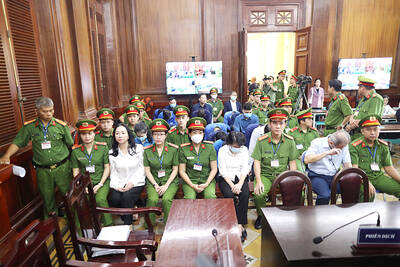
A top Vietnamese property tycoon was on Thursday sentenced to death in one of the biggest corruption cases in history, with an estimated US$27 billion in damages. A panel of three hand-picked jurors and two judges rejected all defense arguments by Truong My Lan, chair of major developer Van Thinh Phat, who was found guilty of swindling cash from Saigon Commercial Bank (SCB) over a decade. “The defendant’s actions ... eroded people’s trust in the leadership of the [Communist] Party and state,” read the verdict at the trial in Ho Chi Minh City. After the five-week trial, 85 others were also sentenced on

‘DELUSIONAL’: Targeting the families of Hamas’ leaders would not push the group to change its position or to give up its demands for Palestinians, Ismail Haniyeh said Israeli aircraft on Wednesday killed three sons of Hamas’ top political leader in the Gaza Strip, striking high-stakes targets at a time when Israel is holding delicate ceasefire negotiations with the militant group. Hamas said four of the leader’s grandchildren were also killed. Ismail Haniyeh’s sons are among the highest-profile figures to be killed in the war so far. Israel said they were Hamas operatives, and Haniyeh accused Israel of acting in “the spirit of revenge and murder.” The deaths threatened to strain the internationally mediated ceasefire talks, which appeared to gain steam in recent days even as the sides remain far
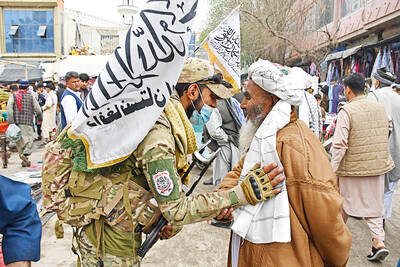
The Taliban’s reclusive supreme leader made a rare public appearance yesterday, an Afghan government spokesman said, leading thousands of worshipers in prayers marking Eid al-Fitr. Hibatullah Akhundzada has made only a handful of public appearances since inheriting the leadership of the Taliban in 2016 and leading the movement back to power with the withdrawal of US forces in 2021. Taliban government spokesman Zabihullah Mujahid said prayer in the largest mosque in Kandahar was “performed under the leadership of the supreme leader.” In a statement on X, he said the early-morning service “was attended by thousands of compatriots” in the southern province considered the


 RSS
RSS