


New Mexico Governor and US presidential hopeful Bill Richardson spent his first full day in North Korea yesterday to try to recover the remains of US war dead, saying he believes Pyongyang wants a better relationship with Washington.
The White House has said the trip by Richardson is separate from the six-party disarmament talks.
Richardson, who has undertaken five previous missions to Pyongyang, has also said he will not negotiate nuclear matters. But he expressed hope the North would honor its deal.
"I believe for the first time they do want to enter into an agreement with the six-party countries and they want a better relationship with the United States. They know that the key is dismantling their nuclear weapons," he said on his plane before arriving on Sunday night.
But he cautioned: "I have learned with the North Koreans, you don't know what they are going to do next. They are totally unpredictable."
The US, China, the two Koreas, Russia and Japan reached an agreement on Feb. 13 under which the North would disable its nuclear programs in return for economic aid and diplomatic benefits.
As a first step, it was to shut down and seal its reactor and other facilities at Yongbyon by April 14, invite in UN inspectors and receive an initial 50,000 tonnes of fuel oil.
But talks have been stymied by a row over US$25 million in North Korean funds frozen in a Macau bank at US instigation on suspicion they are linked to money-laundering and counterfeiting. The US has promised to unblock the funds to get the disarmament talks moving, but technical banking hurdles remain.
South Korea's largest circulation newspaper Chosun Ilbo indicated yesterday the dispute is not settled. A government official told the paper the North demands the money be transferred to another of its overseas bank accounts, "but there are too many difficulties in reality."
"The US and China insist that everything should be taken care of by the Macau authorities and North Korea," the official said.
US nuclear envoy Christopher Hill was to leave on Sunday for Tokyo and later head to Seoul and Beijing in an apparent bid to restart talks.
The delegation led by Richardson will visit the inter-Korean border village of Panmunjom tomorrow, where the soldiers' remains are scheduled to be transferred.
The team will then cross the border and head for a US army garrison in the Yongsan district of Seoul for a formal repatriation ceremony on Thursday.
More than 33,000 US troops died in the 1950 to 1953 war and about 8,100 are listed as missing.
Richardson has said that the return of any remains would be a great sign of progress in the relationship.
In comments in Pyongyang he expressed optimism.
"I have been informed that there will be some American remains delivered to us," he said.

Republican US lawmakers on Friday criticized US President Joe Biden’s administration after sanctioned Chinese telecoms equipment giant Huawei unveiled a laptop this week powered by an Intel artificial intelligence (AI) chip. The US placed Huawei on a trade restriction list in 2019 for contravening Iran sanctions, part of a broader effort to hobble Beijing’s technological advances. Placement on the list means the company’s suppliers have to seek a special, difficult-to-obtain license before shipping to it. One such license, issued by then-US president Donald Trump’s administration, has allowed Intel to ship central processors to Huawei for use in laptops since 2020. China hardliners

Conjoined twins Lori and George Schappell, who pursued separate careers, interests and relationships during lives that defied medical expectations, died this month in Pennsylvania, funeral home officials said. They were 62. The twins, listed by Guinness World Records as the oldest living conjoined twins, died on April 7 at the Hospital of the University of Pennsylvania, obituaries posted by Leibensperger Funeral Homes of Hamburg said. The cause of death was not detailed. “When we were born, the doctors didn’t think we’d make 30, but we proved them wrong,” Lori said in an interview when they turned 50, the Philadelphia Inquirer reported. The
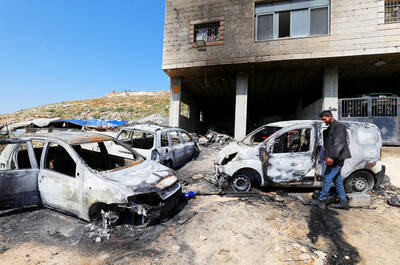
RAMPAGE: A Palestinian man was left dead after dozens of Israeli settlers searching for a missing 14-year-old boy stormed a village in the Israeli-occupied West Bank US President Joe Biden on Friday said he expected Iran to attack Israel “sooner, rather than later” and warned Tehran not to proceed. Asked by reporters about his message to Iran, Biden simply said: “Don’t,” underscoring Washington’s commitment to defend Israel. “We are devoted to the defense of Israel. We will support Israel. We will help defend Israel and Iran will not succeed,” he said. Biden said he would not divulge secure information, but said his expectation was that an attack could come “sooner, rather than later.” Israel braced on Friday for an attack by Iran or its proxies as warnings grew of

A prominent Christian leader has allegedly been stabbed at the altar during a Mass yesterday in southwest Sydney. Bishop Mar Mari Emmanuel was saying Mass at Christ The Good Shepherd Church in Wakeley just after 7pm when a man approached him at the altar and allegedly stabbed toward his head multiple times. A live stream of the Mass shows the congregation swarm forward toward Emmanuel before it was cut off. The church leader gained prominence during the COVID-19 pandemic, amassing a large online following, Officers attached to Fairfield City police area command attended a location on Welcome Street, Wakeley following reports a number


 RSS
RSS