


One of the surprise hits of US television over the past two seasons is the dark suburban comedy Weeds, which focuses on a struggling middle class widow who starts selling marijuana to her affluent neighbors in southern California.
Last year actress Mary Louise Parker won a Golden Globe best actress award for her portrayal of the lead character, whose business starts booming when she rents a house and transforms it into a state-of-the-art indoor marijuana production facility.
Parker's character is far from alone. A spate of drug busts in affluent bedroom communities in the Los Angeles region in recent weeks has netted law enforcement officials thousands of plants worth more than US$100 million.
It has also prompted officers to warn of a boom in indoor marijuana cultivation, much of it organized by gangs attracted to the relatively low risk and high profits.
Officials with the US Drug Enforcement Administration (DEA) say the number of indoor marijuana plants seized by federal, state and local authorities in California has quadrupled in just the last three years, from at least 54,000 plants to nearly 200,000 last year.
Nationally, the DEA says that more than 400,000 plants with a potential annual value of US$6.4 billion were seized from grow houses in the US last year, up from about 270,000 in 2005. In total, DEA officials estimate there are 21,000 residential marijuana operations, primarily on the west coasts of Canada and the US. Authorities have also reported cases in Florida, Georgia and along the East Coast.
The flight indoors appears to be the result of several factors, primarily the increased success of aircraft surveillance in discovering marijuana farms located in remote wilderness areas. Improved technology for indoor growing which is now easily available over the internet has also fueled the boom.
Another factor is the availability of easy credit which allows growers to buy houses with almost no cash investment, reducing their potential exposure if the property is confiscated.
Growers use advanced equipment that can cost as much as US$75,000, with high powered lights, automatic irrigation systems and sophisticated ventilation systems that scrub the pungent smell of marijuana from the air.
Many illegally jack their light systems in to the electrical grid to avoid paying bills and employ gardeners to tend the grounds and keep appearances normal.
Indoor marijuana farming can yield three or four crops a year.
The phenomenon is especially prevalent in southern California, where authorities have discovered at least six indoor suburban pot farms in just the last month. Most of the homes have been clustered throughout upscale suburbs with large Asian populations. In addition, authorities in Northern California have arrested 16 people and seized 50 suburban homes linked to an Asian organized crime syndicate, the Los Angeles Times said.
"More and more, law enforcement is out there in the wilderness, and that pushes these growers to stay one step ahead of us," Orange County Sheriff's Department spokesman Jim Amormino said.

Republican US lawmakers on Friday criticized US President Joe Biden’s administration after sanctioned Chinese telecoms equipment giant Huawei unveiled a laptop this week powered by an Intel artificial intelligence (AI) chip. The US placed Huawei on a trade restriction list in 2019 for contravening Iran sanctions, part of a broader effort to hobble Beijing’s technological advances. Placement on the list means the company’s suppliers have to seek a special, difficult-to-obtain license before shipping to it. One such license, issued by then-US president Donald Trump’s administration, has allowed Intel to ship central processors to Huawei for use in laptops since 2020. China hardliners
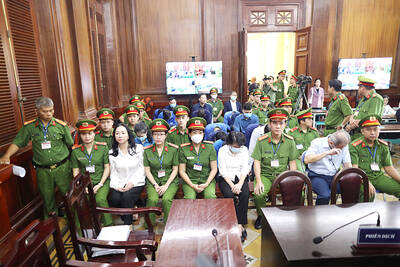
A top Vietnamese property tycoon was on Thursday sentenced to death in one of the biggest corruption cases in history, with an estimated US$27 billion in damages. A panel of three hand-picked jurors and two judges rejected all defense arguments by Truong My Lan, chair of major developer Van Thinh Phat, who was found guilty of swindling cash from Saigon Commercial Bank (SCB) over a decade. “The defendant’s actions ... eroded people’s trust in the leadership of the [Communist] Party and state,” read the verdict at the trial in Ho Chi Minh City. After the five-week trial, 85 others were also sentenced on

Conjoined twins Lori and George Schappell, who pursued separate careers, interests and relationships during lives that defied medical expectations, died this month in Pennsylvania, funeral home officials said. They were 62. The twins, listed by Guinness World Records as the oldest living conjoined twins, died on April 7 at the Hospital of the University of Pennsylvania, obituaries posted by Leibensperger Funeral Homes of Hamburg said. The cause of death was not detailed. “When we were born, the doctors didn’t think we’d make 30, but we proved them wrong,” Lori said in an interview when they turned 50, the Philadelphia Inquirer reported. The

RAMPAGE: A Palestinian man was left dead after dozens of Israeli settlers searching for a missing 14-year-old boy stormed a village in the Israeli-occupied West Bank US President Joe Biden on Friday said he expected Iran to attack Israel “sooner, rather than later” and warned Tehran not to proceed. Asked by reporters about his message to Iran, Biden simply said: “Don’t,” underscoring Washington’s commitment to defend Israel. “We are devoted to the defense of Israel. We will support Israel. We will help defend Israel and Iran will not succeed,” he said. Biden said he would not divulge secure information, but said his expectation was that an attack could come “sooner, rather than later.” Israel braced on Friday for an attack by Iran or its proxies as warnings grew of


 RSS
RSS