


International aid workers rushed to dig latrines and set up water purification systems in the Solomon Islands tsunami disaster zone yesterday in a frantic bid to stop the spread of disease.
Unhygienic conditions and a lack of clean water have contributed to a few isolated cases of diarrhea and dysentery in several of the hillside refugee camps around Gizo, the largest population center amid scores of islands slammed by Monday's magnitude 8.1 quake and tsunami.
"The disease is bit on a knife-edge," said Stefan Knollmeyer, a relief coordinator with Australia's government aid body, AusAID. "There's a few cases of diarrhea at the moment, but without clean water, that just snowballs."

PHOTO: AFP
His organization was working with New Zealand officials and the International Red Cross to dig latrines and set up water purification systems at dozens of refugee camps that have sprung up on islands and villages badly hit by the killer waves.
There were no official estimates of the number of cases of diarrhea and dysentery, but aid workers were optimistic that rudimentary sanitation measures -- such as pit toilets, water purification tablets and soap -- could contain the problem.
The UN has set the death toll from Monday's disaster at 34 people, while the Solomons' official toll is 28. However, many villagers have been burying the dead as they find them, and some deaths may never be reported to officials.
Knollmeyer said the current estimates seem accurate based on AusAID's assessments so far.
"It may go up another 10. There are still reports of missing people, but it's not going to jump [much higher]," he said from a command center in Gizo.
He said up to 7,000 people had been left homeless by the disaster -- far fewer than originally feared. Earlier this week, the premier of the western province, Alex Lokopio, said as many as 40,000 of the region's 90,000 people may have lost their homes.
Meanwhile, two large boats docked in Gizo early yesterday carrying supplies and around two dozen troops from Australia and New Zealand, including at least five medics and half a dozen sanitation experts.
After days of delays caused by transport bottlenecks and government bureaucracy, more than 2,500 tarpaulins and 1 tonne of rice have been distributed to the camps around Gizo and some of the surrounding islands, according to Guy Redding of New Zealand's national aid organization.
Three large-scale water purifiers were due to be set up yesterday, and around 50,000 water purification tablets have also been distributed to the camps, he said.
Redding said many survivors whose homes were not damaged were still too traumatized to return to their villages or to resume fishing -- their normal source of food.
"There's a psychological factor and that's completely understandable," he said.
Many villagers say they have been terrified by the more than 50 jolts that have rattled the region since Monday's quake -- including several registering magnitude 6 or stronger. Rumors of more killer waves have also spread through the villages this week, hampering efforts to coax the refugees down from the hills.
Meanwhile, villagers in the outlying islands have complained that food, shelter and other relief supplies have been slow to reach them.

Republican US lawmakers on Friday criticized US President Joe Biden’s administration after sanctioned Chinese telecoms equipment giant Huawei unveiled a laptop this week powered by an Intel artificial intelligence (AI) chip. The US placed Huawei on a trade restriction list in 2019 for contravening Iran sanctions, part of a broader effort to hobble Beijing’s technological advances. Placement on the list means the company’s suppliers have to seek a special, difficult-to-obtain license before shipping to it. One such license, issued by then-US president Donald Trump’s administration, has allowed Intel to ship central processors to Huawei for use in laptops since 2020. China hardliners
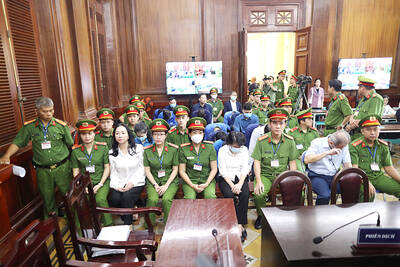
A top Vietnamese property tycoon was on Thursday sentenced to death in one of the biggest corruption cases in history, with an estimated US$27 billion in damages. A panel of three hand-picked jurors and two judges rejected all defense arguments by Truong My Lan, chair of major developer Van Thinh Phat, who was found guilty of swindling cash from Saigon Commercial Bank (SCB) over a decade. “The defendant’s actions ... eroded people’s trust in the leadership of the [Communist] Party and state,” read the verdict at the trial in Ho Chi Minh City. After the five-week trial, 85 others were also sentenced on

Conjoined twins Lori and George Schappell, who pursued separate careers, interests and relationships during lives that defied medical expectations, died this month in Pennsylvania, funeral home officials said. They were 62. The twins, listed by Guinness World Records as the oldest living conjoined twins, died on April 7 at the Hospital of the University of Pennsylvania, obituaries posted by Leibensperger Funeral Homes of Hamburg said. The cause of death was not detailed. “When we were born, the doctors didn’t think we’d make 30, but we proved them wrong,” Lori said in an interview when they turned 50, the Philadelphia Inquirer reported. The
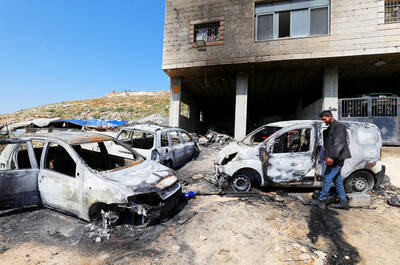
RAMPAGE: A Palestinian man was left dead after dozens of Israeli settlers searching for a missing 14-year-old boy stormed a village in the Israeli-occupied West Bank US President Joe Biden on Friday said he expected Iran to attack Israel “sooner, rather than later” and warned Tehran not to proceed. Asked by reporters about his message to Iran, Biden simply said: “Don’t,” underscoring Washington’s commitment to defend Israel. “We are devoted to the defense of Israel. We will support Israel. We will help defend Israel and Iran will not succeed,” he said. Biden said he would not divulge secure information, but said his expectation was that an attack could come “sooner, rather than later.” Israel braced on Friday for an attack by Iran or its proxies as warnings grew of


 RSS
RSS