


The newly opened Kosher Gym in Jerusalem offers prayer books instead of magazines at its juice bar, and bearded men listen to Talmudic interpretations on earphones as they exercise.
In an Internet chat room, messages about Outlook and Microsoft pop up in Yiddish. At upscale kosher restaurants, men in black hats and sidecurls, accompanied by wives in wigs and long dresses, sip fine wines.
If that's one face of the haredim -- "the God-fearing," as Israel's ultra-Orthodox Jews refer to themselves -- another is the young hotheads who torch clothing stores in their neighborhood for selling "immodest" attire and hurl bleach at women who wear it.
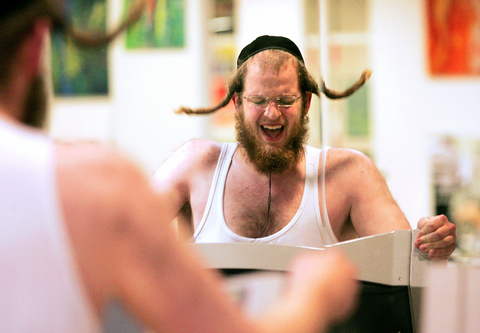
PHOTO: AP
From cellphones to Stairmasters, from women's rights to Hebrew slang, the outside world is seeping into the cloistered haredi community and plunging it into a tug-of-war between a tentative embrace of modernity and fierce resistance.
Similar communities are replicated across the world, with the Bible and Jewish law central to their lives. The difference is that in New York, London or Sydney they have little impact on society around them. In Israel, the relationship is very different, and often bumpy.
Haredi political parties have often held the political power to make or break a government. The men spend their lives in prayer and study, subsidized by taxpayers who can't see why they don't just get a job. Every secular Israeli, male and female, must do military service, the great leveler in a country of immigrants from east and west. But haredim are exempt.
They belong to a religious power structure which at various times during Israel's existence has managed to ban public transport on the Sabbath, grounded El Al, the national airline, on holy days, and has absolute control of all Jewish marriage and divorce. This power was reinforced last month when 12 of 15 new rabbinical court judges were recruited from the ultra-Orthodox -- a move that caused a furor among secular Israelis who had hoped more moderate judges would join the court.
Haredim tend not to take firm stances on the big issue confronting Israeli society -- war and peace with the Arabs. But their birthrate of seven children to a family is a force in Israel's demographic race against the Palestinians.
As Israeli society grows more pluralist, advancing the rights of women and gays, the haredim cling to the old ways, and sometimes the clash is extreme. In 2005, when Jerusalem held a gay pride parade, a protesting ultra-Orthodox Jew stabbed and wounded three marchers.
Yet reality is forcing change in many areas.
The haredim, many of whom once opposed Zionism as a blasphemous pre-empting of the Messiah, have largely made their peace with the Jewish state.
At the same time, election results have enabled coalition governments to be formed without the haredim. The sidelining of haredi parties in recent years has led to cutbacks in their subsidies, and haredim are beginning to trickle into the job market.
"There are many changes coming in the haredi world, because you can't offer only one lifestyle, you can't offer only one life opportunity for a whole range of abilities and spiritual levels. You'll lose too many that way," said Jonathan Rosenblum, a haredi columnist.
The word haredi is an umbrella term for a variety of groups, each following its own ancient sages and living rabbis.
It broadly means anyone who takes the maximalist approach to Jewish law and follows a lifestyle whose most visible characteristics are unlikely to change soon.
Haredi neighborhoods in Jerusalem or the Tel Aviv suburb of Bnei Brak feel like 18th century European ghettos: men in long black coats and large fur hats called streimels; women in shapeless dresses covering their wrists and ankles, wrapped in scarves or wigs because they shave their heads when they marry.
In Mea Shearim, Jerusalem's largest haredi neighborhood, cars are banned on the Sabbath and toddlers ride tricycles down the middle of the street. In synagogues, men press their lips to the words of an open Torah scroll.
Haredi households shun TV, and haredi rabbis have ruled that only cellphones without Internet access are permissible.
Israel's haredim number an estimated 600,000 -- nearly 9 percent of the population and growing fast. Jerusalem, the city at the center of the Arab-Israeli conflict, is now one-third haredi and has its first ultra-Orthodox mayor.

Republican US lawmakers on Friday criticized US President Joe Biden’s administration after sanctioned Chinese telecoms equipment giant Huawei unveiled a laptop this week powered by an Intel artificial intelligence (AI) chip. The US placed Huawei on a trade restriction list in 2019 for contravening Iran sanctions, part of a broader effort to hobble Beijing’s technological advances. Placement on the list means the company’s suppliers have to seek a special, difficult-to-obtain license before shipping to it. One such license, issued by then-US president Donald Trump’s administration, has allowed Intel to ship central processors to Huawei for use in laptops since 2020. China hardliners
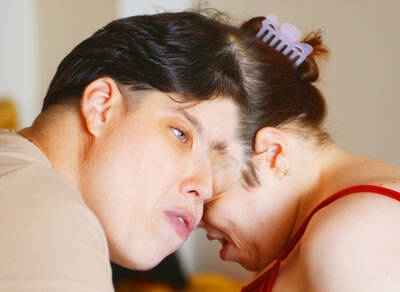
Conjoined twins Lori and George Schappell, who pursued separate careers, interests and relationships during lives that defied medical expectations, died this month in Pennsylvania, funeral home officials said. They were 62. The twins, listed by Guinness World Records as the oldest living conjoined twins, died on April 7 at the Hospital of the University of Pennsylvania, obituaries posted by Leibensperger Funeral Homes of Hamburg said. The cause of death was not detailed. “When we were born, the doctors didn’t think we’d make 30, but we proved them wrong,” Lori said in an interview when they turned 50, the Philadelphia Inquirer reported. The
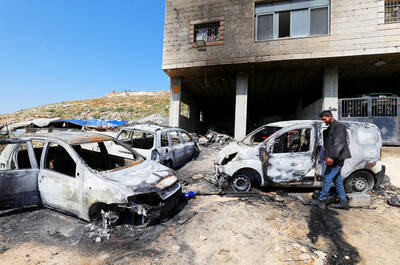
RAMPAGE: A Palestinian man was left dead after dozens of Israeli settlers searching for a missing 14-year-old boy stormed a village in the Israeli-occupied West Bank US President Joe Biden on Friday said he expected Iran to attack Israel “sooner, rather than later” and warned Tehran not to proceed. Asked by reporters about his message to Iran, Biden simply said: “Don’t,” underscoring Washington’s commitment to defend Israel. “We are devoted to the defense of Israel. We will support Israel. We will help defend Israel and Iran will not succeed,” he said. Biden said he would not divulge secure information, but said his expectation was that an attack could come “sooner, rather than later.” Israel braced on Friday for an attack by Iran or its proxies as warnings grew of
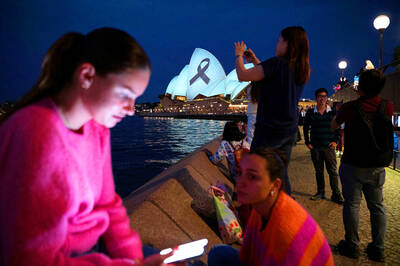
A prominent Christian leader has allegedly been stabbed at the altar during a Mass yesterday in southwest Sydney. Bishop Mar Mari Emmanuel was saying Mass at Christ The Good Shepherd Church in Wakeley just after 7pm when a man approached him at the altar and allegedly stabbed toward his head multiple times. A live stream of the Mass shows the congregation swarm forward toward Emmanuel before it was cut off. The church leader gained prominence during the COVID-19 pandemic, amassing a large online following, Officers attached to Fairfield City police area command attended a location on Welcome Street, Wakeley following reports a number


 RSS
RSS