


FBI Director Robert Mueller struggled to convince skeptical senators that despite recently revealed abuses, the FBI should retain Patriot Act authority to gather telephone, e-mail and financial records without a judge's approval.
"The statute did not cause the errors. The FBI's implementation did," the FBI chief told the Senate Judiciary Committee.
But the committee's Democratic chairman, Senator Patrick Leahy, served notice: "We're going to be re-examining the broad authorities we granted the FBI in the Patriot Act."
House Judiciary committee members delivered a similar message last week.
The Senate panel's ranking Republican, Senator Arlen Specter, went further: "The question arises as to whether any director can handle this job and whether the bureau itself can handle the job."
Grim-faced and sometimes even looking pained, Mueller testified at the panel's second hearing into a Justice Department inspector general's report this month that revealed abuses in the FBI's use of documents called national security letters to gather data.
The Patriot Act, passed in the aftermath of the Sept. 11 terror attacks, extended the use of security letters and created other expanded investigative tools for the federal enforcement agency.
Reviewing headquarters files and four of 56 FBI field offices, Inspector General Glenn Fine found 48 violations of law or presidential directives during 2003 to 2005. He estimates there may be up to 3,000 unidentified or unreported violations throughout the FBI.
Mueller said he had instituted procedures for issuing the letters.
"What I did not do and should have done is put in a compliance program to be sure those procedures were followed," he said.
He is now devising a compliance program and has ordered an audit to determine the extent of the problem and to see if any agents should be disciplined.
"We are committed to demonstrating to the committee, the Congress and the American people that we will correct the deficiencies," Mueller said.
"I still have very serious qualms," Leahy replied.
Mueller called the letters "an indispensable tool for our conduct of terrorism investigations" and began listing cases in which the letters were useful, including a plot against the Brooklyn Bridge.
Interrupting, Leahy said the panel could discuss individual plots later, including "how serious a plot it was to take down the Brooklyn Bridge."
Government court documents acknowledged that defendant Iyman Faris, now serving 20 years in the case, advised al-Qaeda the plot would be futile.
Citing the national security letters and recent inspector general criticism of FBI reporting of terrorist cases and of weapons and laptops lost, Specter said, "Every time we turn around there is another enormous failure by the bureau."
Specter said the committee should consider establishing a separate domestic intelligence agency like Britain's MI-5.
Mueller argued against some committee Democrats' suggestions to inject judicial approval into the national security letter process or to limit how far agents can roam beyond actual suspects in seeking records.
But under questioning by Democratic Senator Sheldon Whitehouse, Mueller indicated he might trade the letters for administrative subpoenas, like those used in some drug and tax cases without prior approval of a judge.
National security letters, first authorized in 1986, can be used to acquire e-mail, telephone and travel records and financial information. In 2001, the Patriot Act eliminated any requirement that the records belong to someone under suspicion. Now an innocent person's records can be obtained if FBI field agents consider the person relevant to a terrorism or spying investigation.
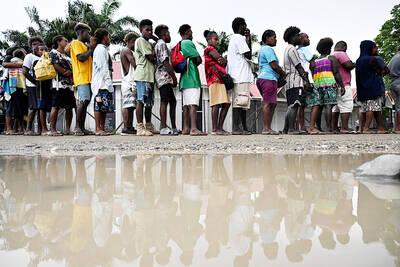
SEEKING CHANGE: A hospital worker said she did not vote in previous elections, but ‘now I can see that maybe my vote can change the system and the country’ Voting closed yesterday across the Solomon Islands in the south Pacific nation’s first general election since the government switched diplomatic allegiance from Taiwan to Beijing and struck a secret security pact that has raised fears of the Chinese navy gaining a foothold in the region. The Solomon Islands’ closer relationship with China and a troubled domestic economy weighed on voters’ minds as they cast their ballots. As many as 420,000 registered voters had their say across 50 national seats. For the first time, the national vote also coincided with elections for eight of the 10 local governments. Esther Maeluma cast her vote in the
Nearly half of China’s major cities are suffering “moderate to severe” levels of subsidence, putting millions of people at risk of flooding, especially as sea levels rise, according to a study of nationwide satellite data released yesterday. The authors of the paper, published by the journal Science, found that 45 percent of China’s urban land was sinking faster than 3mm per year, with 16 percent at more than 10mm per year, driven not only by declining water tables, but also the sheer weight of the built environment. With China’s urban population already in excess of 900 million people, “even a small portion

UNSETTLING IMAGES: The scene took place in front of TV crews covering the Trump trial, with a CNN anchor calling it an ‘emotional and unbelievably disturbing moment’ A man who doused himself in an accelerant and set himself on fire outside the courthouse where former US president Donald Trump is on trial has died, police said yesterday. The New York City Police Department (NYPD) said the man was declared dead by staff at an area hospital. The man was in Collect Pond Park at about 1:30pm on Friday when he took out pamphlets espousing conspiracy theories, tossed them around, then doused himself in an accelerant and set himself on fire, officials and witnesses said. A large number of police officers were nearby when it happened. Some officers and bystanders rushed

HYPOCRISY? The Chinese Ministry of Foreign Affairs yesterday asked whether Biden was talking about China or the US when he used the word ‘xenophobic’ US President Joe Biden on Wednesday called for a hike in steel tariffs on China, accusing Beijing of cheating as he spoke at a campaign event in Pennsylvania. Biden accused China of xenophobia, too, in a speech to union members in Pittsburgh. “They’re not competing, they’re cheating. They’re cheating and we’ve seen the damage here in America,” Biden said. Chinese steel companies “don’t need to worry about making a profit because the Chinese government is subsidizing them so heavily,” he said. Biden said he had called for the US Trade Representative to triple the tariff rates for Chinese steel and aluminum if Beijing was


 RSS
RSS