


Federalists won a close election in French-speaking Quebec on Monday, dashing separatists' hopes of holding a referendum on breaking away from Canada, election officials said.
According to projections, the federalist Liberals won 48 seats in Quebec's 125-seat National Assembly, followed by the greenhorn Action Democratique du Quebec (ADQ) with 41 seats and the separatist Parti Quebecois with 36 seats.
At the start of the campaign late last month, analysts believed federalist Liberal Premier Jean Charest would win a second term and stave off a plebiscite on Quebec independence for five years, a prescribed term.
But the separatist Parti Quebecois, which vowed to hold a referendum if it won the election, made great strides in the final stretch.
And an unexpected surge in support for the conservative ADQ, which favors more autonomy for Quebec but not independence, turned the contest into a three-way horse race.
In losing his majority, Charest is expected to face pressure to resign as party leader.
As well, a minority Liberal government now leaves the door open a crack to an early election and a possible vote on Quebec independence thereafter, with hostile separatists and Quebec nationalists in opposition.
"A few seats, a few thousand votes separated us from victory ... Millions of us still dream of an independent Quebec," Parti Quebecois leader Andre Boisclair said in defeat.
Quebec held and lost two referendums on breaking away from Canada in 1980 and 1995. Federalists led by Jean Charest narrowly won the second ballot.
"This has been a historic election," Charest said late on Monday, indicating that it would be up to all lawmakers to heal divisions in Quebec.
Throughout the campaign, voters expressed displeasure with Charest over broken promises to lower taxes and improve health care, leading to the Liberals' collapse.
The ADQ meanwhile whittled support from the two main parties by seizing on Quebecers' dream of nationhood and butterflies over letting go of Canada, offering a compromise alternative to the staunch federalists and hardline separatists.
Its third way had not been seen in Quebec politics since 1976 when the Parti Quebecois emerged to challenge the federalist status quo.
Prior to the election, the Liberals held 72 seats, the Parti Quebecois 45 seats and the ADQ five seats. One member was independent and two seats were vacant.
The ADQ was not expected to form a government, but won enough seats on Monday to ordain the first Quebec minority government since 1878 by rousing a dormant demographic -- rural nationalist conservatives.
After 1976, they had migrated to the Parti Quebecois, aligning themselves with urban social democrats in Montreal to try to build a Quebec nation.
In this election, with no referendum on the horizon and Parti Quebecois chief Boisclair deemed an anemic leader, Quebec conservatives gravitated to the ADQ.
Efforts by Canada's Conservative Prime Minister Stephen Harper to woo Quebecers also rallied the francophone hinterland.
Harper had allied himself with Charest, transferred billions of dollars to provincial coffers in a federal budget, and recognized Quebec as a "nation" within Canada in a symbolic House vote.
These initiatives were expected to give his federalist ally Charest a boost in the campaign, but unwittingly bolstered the ADQ's demands for more Quebec autonomy.
Emboldened by the unexpected rise of conservatives in Quebec and strong national polling, Harper could soon trigger a federal election.
But if he fails to satisfy the ADQ's demands for more Quebec autonomy, Harper may ultimately invigorate separatists.

Republican US lawmakers on Friday criticized US President Joe Biden’s administration after sanctioned Chinese telecoms equipment giant Huawei unveiled a laptop this week powered by an Intel artificial intelligence (AI) chip. The US placed Huawei on a trade restriction list in 2019 for contravening Iran sanctions, part of a broader effort to hobble Beijing’s technological advances. Placement on the list means the company’s suppliers have to seek a special, difficult-to-obtain license before shipping to it. One such license, issued by then-US president Donald Trump’s administration, has allowed Intel to ship central processors to Huawei for use in laptops since 2020. China hardliners
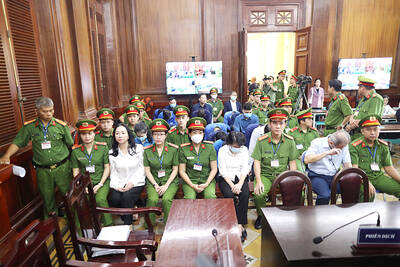
A top Vietnamese property tycoon was on Thursday sentenced to death in one of the biggest corruption cases in history, with an estimated US$27 billion in damages. A panel of three hand-picked jurors and two judges rejected all defense arguments by Truong My Lan, chair of major developer Van Thinh Phat, who was found guilty of swindling cash from Saigon Commercial Bank (SCB) over a decade. “The defendant’s actions ... eroded people’s trust in the leadership of the [Communist] Party and state,” read the verdict at the trial in Ho Chi Minh City. After the five-week trial, 85 others were also sentenced on

‘DELUSIONAL’: Targeting the families of Hamas’ leaders would not push the group to change its position or to give up its demands for Palestinians, Ismail Haniyeh said Israeli aircraft on Wednesday killed three sons of Hamas’ top political leader in the Gaza Strip, striking high-stakes targets at a time when Israel is holding delicate ceasefire negotiations with the militant group. Hamas said four of the leader’s grandchildren were also killed. Ismail Haniyeh’s sons are among the highest-profile figures to be killed in the war so far. Israel said they were Hamas operatives, and Haniyeh accused Israel of acting in “the spirit of revenge and murder.” The deaths threatened to strain the internationally mediated ceasefire talks, which appeared to gain steam in recent days even as the sides remain far
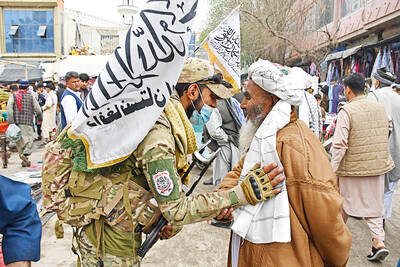
The Taliban’s reclusive supreme leader made a rare public appearance yesterday, an Afghan government spokesman said, leading thousands of worshipers in prayers marking Eid al-Fitr. Hibatullah Akhundzada has made only a handful of public appearances since inheriting the leadership of the Taliban in 2016 and leading the movement back to power with the withdrawal of US forces in 2021. Taliban government spokesman Zabihullah Mujahid said prayer in the largest mosque in Kandahar was “performed under the leadership of the supreme leader.” In a statement on X, he said the early-morning service “was attended by thousands of compatriots” in the southern province considered the


 RSS
RSS