


US Vice President Dick Cheney has assured political allies that an early withdrawal of US forces from Iraq would not be allowed, despite efforts by Congress to impose a deadline on US combat operations there.
The comments late on Saturday followed a historic vote on Friday in the House of Representatives, which called for a pullout of US combat troops from Iraq by Aug. 31, 2008 -- regardless of whether Iraqi security forces are ready to take over from them.
US President George W. Bush has vowed to veto the measure. But the threat has called into question the future of a US$124 billion emergency funding bill, to which it is attached. Lacking line-item veto power, Bush can reject bills only in their entirety.
In light of this circumstance, the president acknowledged earlier on Saturday that if the bill that finances the wars in Iraq and Afghanistan is not passed by April 15, the military "will face significant disruptions."
Cheney for his part used his appearance before the Republican Jewish Coalition in Manalaplan, Florida, to reassure allies that the current political struggle will not result in a precipitous US withdrawal from Iraq.
"A sudden withdrawal of our coalition would dissipate much of the effort that has gone into fighting the global war on terror, and result in chaos and mounting danger," the vice president declared. "And for the sake of our own security, we will not stand by and let it happen."
He did not explain what steps the administration could take if the supplemental bill dies in partisan bickering. But he expressed confidence in the final outcome, stating "We will complete the mission, and we will prevail."
Quoting extensively from al-Qaeda leader Osama bin Laden, the vice president reiterated his conviction that an US early withdrawal from Iraq would be "a complete validation of the al-Qaeda strategy."
And he painted a dire picture of the Muslim world descending into chaos and tyranny, if radical Islamists were allowed to prevail.
"Having tasted victory in Iraq, jihadists would look for new missions," he predicted. "Many would head for Afghanistan and fight alongside the Taliban. Others would set out for capitals across the Middle East, spreading more sorrow and discord as they eliminate dissenters and work to undermine moderate governments."
The speech marked a ratcheting up of a tense standoff between the White House and Democratic-controlled Congress, which is under heavy pressure from constituents to find a way to wrap up the war that most Americans now believe was a mistake.
But the Democrats made clear they have no intention of backing down. In a radio address on Saturday, Representative Paul Hodes said the era of blank checks issued by Congress to the president was over and urged Bush to respond "by listening to the American people."
The angry debate added a new wrinkle yesterday, when a leading US foreign policy expert, former national security adviser Zbigniew Brzezinski, delivered a stinging rebuke to the whole concept of the war on terror, arguing it was promoting "a culture of fear" that was being exploited for political and financial gain.
"The sense of a pervasive but otherwise imprecise danger was thus channeled in a politically expedient direction by the mobilizing appeal of being `at war,'" he wrote in the Washington Post.
The fear, Brzezinski argued, was also being exploited by so-called "terror entrepreneurs."
He reminded readers that in 2003, Congress identified 160 sites as potential terrorism targets that should be fortified at the government's expense.
With lobbyists weighing in, Brzezinski noted, by the end of that year the list had grown to 1,849, by the end of 2004 -- to 28,360, and by 2005 -- to 77,769.
Now, he said, the database lists some 300,000 possible targets, which include not only the Sears Tower in Chicago, but also the Illinois Apple and Pork Festival.

Republican US lawmakers on Friday criticized US President Joe Biden’s administration after sanctioned Chinese telecoms equipment giant Huawei unveiled a laptop this week powered by an Intel artificial intelligence (AI) chip. The US placed Huawei on a trade restriction list in 2019 for contravening Iran sanctions, part of a broader effort to hobble Beijing’s technological advances. Placement on the list means the company’s suppliers have to seek a special, difficult-to-obtain license before shipping to it. One such license, issued by then-US president Donald Trump’s administration, has allowed Intel to ship central processors to Huawei for use in laptops since 2020. China hardliners
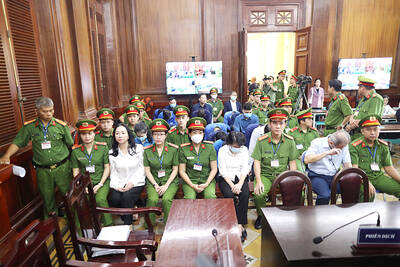
A top Vietnamese property tycoon was on Thursday sentenced to death in one of the biggest corruption cases in history, with an estimated US$27 billion in damages. A panel of three hand-picked jurors and two judges rejected all defense arguments by Truong My Lan, chair of major developer Van Thinh Phat, who was found guilty of swindling cash from Saigon Commercial Bank (SCB) over a decade. “The defendant’s actions ... eroded people’s trust in the leadership of the [Communist] Party and state,” read the verdict at the trial in Ho Chi Minh City. After the five-week trial, 85 others were also sentenced on

‘DELUSIONAL’: Targeting the families of Hamas’ leaders would not push the group to change its position or to give up its demands for Palestinians, Ismail Haniyeh said Israeli aircraft on Wednesday killed three sons of Hamas’ top political leader in the Gaza Strip, striking high-stakes targets at a time when Israel is holding delicate ceasefire negotiations with the militant group. Hamas said four of the leader’s grandchildren were also killed. Ismail Haniyeh’s sons are among the highest-profile figures to be killed in the war so far. Israel said they were Hamas operatives, and Haniyeh accused Israel of acting in “the spirit of revenge and murder.” The deaths threatened to strain the internationally mediated ceasefire talks, which appeared to gain steam in recent days even as the sides remain far
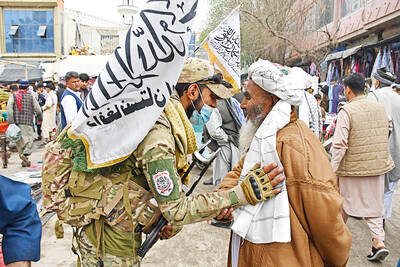
The Taliban’s reclusive supreme leader made a rare public appearance yesterday, an Afghan government spokesman said, leading thousands of worshipers in prayers marking Eid al-Fitr. Hibatullah Akhundzada has made only a handful of public appearances since inheriting the leadership of the Taliban in 2016 and leading the movement back to power with the withdrawal of US forces in 2021. Taliban government spokesman Zabihullah Mujahid said prayer in the largest mosque in Kandahar was “performed under the leadership of the supreme leader.” In a statement on X, he said the early-morning service “was attended by thousands of compatriots” in the southern province considered the


 RSS
RSS