


EU leaders faced a debate over how to drag the 27-member union out of a mid-life crisis yesterday, as they gathered for the signing of a declaration aimed at rallying a skeptical public behind efforts to renew the EU's political rule book.
German Chancellor Angela Merkel, whose country holds the EU's rotating presidency, is challenging member countries to break out of two-years of deadlock over the stalled EU constitution and find a way to improve the bloc's decision-making processes before it can accept any more new members.
The summit marks the 50th anniversary of the signing of the Treaty of Rome by six core countries of what was then called the European Economic Community.
EU Commission President Jose Manuel Barroso urged renewed unity, saying it was the only way to tackle the pressing problems of the modern age.
"Together we can achieve results we could never dream of alone, tackling the challenges of the globalized world: climate change, energy security, terrorism and organized crime, mass migration, a more competitive economic environment and global poverty," he said.
The leaders were to witness the signing by Merkel, Barroso and European Parliament head Hans-Gert Poettering of a declaration of basic principles.
However, they could not bring themselves to mention the word "constitution," instead calling for a "renewed common basis" by 2009.
By glacial EU standards, the declaration's small step forward on the constitution -- achieved after armtwisting phone calls by Merkel as late as Friday -- is considered progress.
The celebrations marking the EU's 50th birthday, including poetry readings, the serving of baked goods and all-night dancing at the Delicious Doughnut nightclub, were aimed at inspiring the leaders and the public with the EU's success in achieving peace and prosperity on a continent that spent much of the past century mired in war and ideological division.
Today, European leaders cannot agree on how or whether to revive the constitution rejected in referendums in France and the Netherlands in 2005. The charter would have created a bill of rights, a full-time EU president and foreign minister and faster decision-making to give the bloc a more assertive global role.
There is no single view on whether, or how soon, to admit other countries that want in, such as Turkey, which is in membership talks, or more distant prospects such as Ukraine.
Merkel told reporters she was confident the 27 EU governments could overcome their deep differences over the EU's future by the 2009 deadline.
Nearly half of China’s major cities are suffering “moderate to severe” levels of subsidence, putting millions of people at risk of flooding, especially as sea levels rise, according to a study of nationwide satellite data released yesterday. The authors of the paper, published by the journal Science, found that 45 percent of China’s urban land was sinking faster than 3mm per year, with 16 percent at more than 10mm per year, driven not only by declining water tables, but also the sheer weight of the built environment. With China’s urban population already in excess of 900 million people, “even a small portion

UNSETTLING IMAGES: The scene took place in front of TV crews covering the Trump trial, with a CNN anchor calling it an ‘emotional and unbelievably disturbing moment’ A man who doused himself in an accelerant and set himself on fire outside the courthouse where former US president Donald Trump is on trial has died, police said yesterday. The New York City Police Department (NYPD) said the man was declared dead by staff at an area hospital. The man was in Collect Pond Park at about 1:30pm on Friday when he took out pamphlets espousing conspiracy theories, tossed them around, then doused himself in an accelerant and set himself on fire, officials and witnesses said. A large number of police officers were nearby when it happened. Some officers and bystanders rushed

HYPOCRISY? The Chinese Ministry of Foreign Affairs yesterday asked whether Biden was talking about China or the US when he used the word ‘xenophobic’ US President Joe Biden on Wednesday called for a hike in steel tariffs on China, accusing Beijing of cheating as he spoke at a campaign event in Pennsylvania. Biden accused China of xenophobia, too, in a speech to union members in Pittsburgh. “They’re not competing, they’re cheating. They’re cheating and we’ve seen the damage here in America,” Biden said. Chinese steel companies “don’t need to worry about making a profit because the Chinese government is subsidizing them so heavily,” he said. Biden said he had called for the US Trade Representative to triple the tariff rates for Chinese steel and aluminum if Beijing was
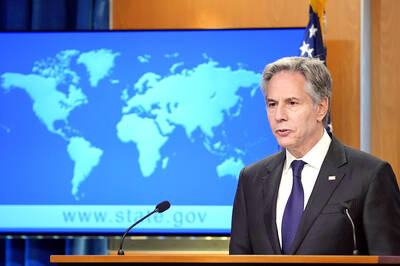
Beijing is continuing to commit genocide and crimes against humanity against Uyghurs and other Muslim minorities in its western Xinjiang province, U.S. Secretary of State Antony Blinken said in a report published on Monday, ahead of his planned visit to China this week. The State Department’s annual human rights report, which documents abuses recorded all over the world during the previous calendar year, repeated language from previous years on the treatment of Muslims in Xinjiang, but the publication raises the issue ahead of delicate talks, including on the war in Ukraine and global trade, between the top U.S. diplomat and Chinese


 RSS
RSS