


Khun Sokha looked on while camera flashes popped in the pre-dawn haze, as hundreds of tourists perched along the outer wall of Cambodia's Angkor Wat waiting to catch that moment when the sun rises over the temple's distinctive towering spires.
Over the next few hours, those hundreds would multiply to thousands, largely free to wander in and out of the temple ruins, probing dark corners, climbing over fallen stones or tracing the delicate bas reliefs with their hands.
"The ancients built the temples for religious purposes, not for such crowds of tourists to climb on," said Khun Sokha, a tour guide whose job depends on the vast crowds swarming Cambodia's Angkor National Park in rising numbers each year.
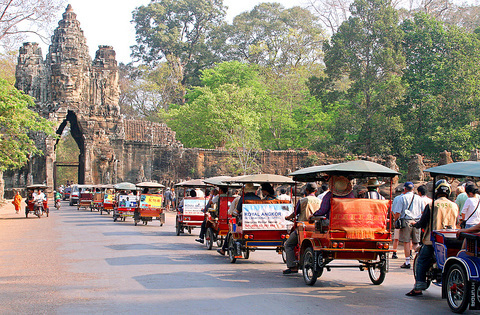
PHOTO: AFP
"The harm is obvious. We are worried, but the people's livelihood depends on these tourists," he added.
Like Khun Sokha, Cambodia's government is at odds over what to do with its most famous landmark.
Angkor is at the very heart of Cambodia's identity, and with nearly two million tourists coming to the country last year -- more than half of them visiting Angkor -- it is recognizing the need to keep these precious ruins intact.
"The harm to the temples is unavoidable when many people walk in and out of them," said Soeung Kong, deputy director-general of the Apsara Authority which oversees Angkor's upkeep.
But at the same time, it is also hard to ignore the nearly US$1.5 billion in revenue that tourism brought to the impoverished country last year, forcing officials into a delicate balancing act.
"We are trying to keep that harm at a minimal level," Soeung Kong said.
Just over 7,600 visitors ventured to Angkor in 1993, when it was added to UNESCO's World Heritage List.
Since then, tourist arrivals have risen meteorically, with the government hoping for three million visitors to Cambodia by 2010.
The intimacy offered by Angkor -- the close interaction with its historic stones -- is a large part of its appeal.
But when multiplied over millions of visitors, the effects can be alarming.
"When you have such a huge mass of tourists visiting then we are concerned about damage to the heritage site and the temples and the monuments," said Teruo Jinnai, UNESCO's top official in Cambodia.
"Many temples are very fragile," he said, adding that the agency is working with the government to minimize the impact of the tourism boom.
However, the battle to preserve Cambodia's temples won't necessarily be fought in their stone breeze-ways and intricately-carved sanctuaries.
Rather, the bigger threat comes kilometers away, along Siem Reap town's increasingly congested thoroughfares, where more than 250 guesthouses and hotels, including several sprawling resorts, have sprung up in recent years.
Some 500 years after a failing irrigation system forced Angkor's rulers to abandon the sprawling Khmer capital, a lack of water is again threatening Cambodia's most famous temple complex.
Just as the ancient city's waterways collapsed under the demands of a population of as many as a million people, an unprecedented tourism boom is again sucking the area dry and risking the collapse of many of Angkor's temples.
The sinking foundation and widening cracks between the carefully carved stones of Bayon temple, famous for the serene faces carved on its 54 towers, confirm what experts have long feared; one of Angkor's best known monuments is collapsing into the sandy ground.
This is caused by the unrestricted consumption of ground water by Siem Reap's hotels, whose enormous demand is destabilizing the earth beneath the Angkor complex.
"Most of the hotels have underground wells. We have warned them not to pump out more than 8,000m3 per day, especially during the dry season," Soeung Kong said.
"As long as the number of tourists increases, the use of water increases. This is our concern, but we are not standing still, we are trying to make a balance between use of water and tourists," he added.
"The construction of hotels is booming. We cannot ban the rich people from building accommodations," said Kuy Song, director of Siem Reap's tourism office.
But, he added: "The future of the temples is really worrisome."
Nearly half of China’s major cities are suffering “moderate to severe” levels of subsidence, putting millions of people at risk of flooding, especially as sea levels rise, according to a study of nationwide satellite data released yesterday. The authors of the paper, published by the journal Science, found that 45 percent of China’s urban land was sinking faster than 3mm per year, with 16 percent at more than 10mm per year, driven not only by declining water tables, but also the sheer weight of the built environment. With China’s urban population already in excess of 900 million people, “even a small portion

UNSETTLING IMAGES: The scene took place in front of TV crews covering the Trump trial, with a CNN anchor calling it an ‘emotional and unbelievably disturbing moment’ A man who doused himself in an accelerant and set himself on fire outside the courthouse where former US president Donald Trump is on trial has died, police said yesterday. The New York City Police Department (NYPD) said the man was declared dead by staff at an area hospital. The man was in Collect Pond Park at about 1:30pm on Friday when he took out pamphlets espousing conspiracy theories, tossed them around, then doused himself in an accelerant and set himself on fire, officials and witnesses said. A large number of police officers were nearby when it happened. Some officers and bystanders rushed

HYPOCRISY? The Chinese Ministry of Foreign Affairs yesterday asked whether Biden was talking about China or the US when he used the word ‘xenophobic’ US President Joe Biden on Wednesday called for a hike in steel tariffs on China, accusing Beijing of cheating as he spoke at a campaign event in Pennsylvania. Biden accused China of xenophobia, too, in a speech to union members in Pittsburgh. “They’re not competing, they’re cheating. They’re cheating and we’ve seen the damage here in America,” Biden said. Chinese steel companies “don’t need to worry about making a profit because the Chinese government is subsidizing them so heavily,” he said. Biden said he had called for the US Trade Representative to triple the tariff rates for Chinese steel and aluminum if Beijing was
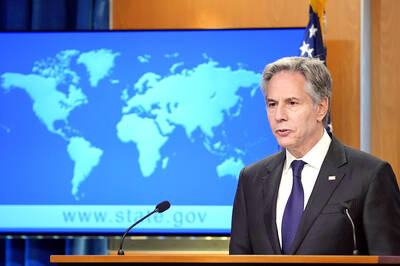
Beijing is continuing to commit genocide and crimes against humanity against Uyghurs and other Muslim minorities in its western Xinjiang province, U.S. Secretary of State Antony Blinken said in a report published on Monday, ahead of his planned visit to China this week. The State Department’s annual human rights report, which documents abuses recorded all over the world during the previous calendar year, repeated language from previous years on the treatment of Muslims in Xinjiang, but the publication raises the issue ahead of delicate talks, including on the war in Ukraine and global trade, between the top U.S. diplomat and Chinese


 RSS
RSS