


It is hard to find a family in Mexico that doesn't have relatives in the US.
Even Mexican President Felipe Calderon says he has distant cousins, uncles and in-laws scattered in Chicago, Los Angeles and other US cities, many of them living "a salto de mata," a Mexican phrase that translates roughly as "on the run."
In other words, Calderon acknowledged that his own relatives may be violating US immigration laws.

PHOTO: AP
But Calderon also maintained he doesn't know their legal status -- and that's plausible because the Calderon clan has lost touch with its migrant relatives, family mem-bers interviewed by the Associated Press said.
And that illustrates another trend: As the immigration boom enters its third decade, many Mexicans have committed themselves to one side of the border or the other, weakening family ties, often forever.
Like the crumbling rows of low stone walls that mark abandoned family farm plots in this village where generations of Calderons once lived, the passage of time has disrupted once close-knit families.
When a reporter confronted Calderon about his relatives during a news conference in Mexico with US President George W. Bush, he refused to share what little information he had about his family, saying he wanted to avoid drawing unwanted attention to them.
"It was an insult to the American people," said Stephen Eichler, executive director of the Minuteman Project, a citizens' group that monitors immigration.
He said Calderon's response showed the US can't enforce its laws.
Calderon's aides told the AP they don't know the names of the president's relatives in the US. And Calderon family members in Mexico who agreed to be interviewed for this story -- one in his mother's hometown of Puruandiro, the other in his father's town of Morelia -- said they didn't know of any relatives in the US at all.
A third cousin on Calderon's father's side, Jose Calderon Zendejas, who lives in Monterey Park, California, provided details that match the Calderon family tree -- the grandfather's birthplace and the school the president attended. But the president's close relatives in Mexico don't recall Calderon Zendejas, who crossed illegally in 1985 and is now in the process of becoming a US citizen.
About 1.2 million Mexicans -- including many who live in the US illegally -- return to Mexico for the holidays, despite increased border security. But the visitors say ties to their extended families are weakening.
"Life is up there. The job is up there. The opportunities are up there," said Adrian Alvarado, 29, a bakery employee who has lived in Omaha, Nebraska, for 11 years.
He brought his sons to Puruandiro, in western Michoacan state, but said he has no plans to return permanently.
"We won't come back until they start paying the same here as they do there," he said.
Even as Alvarado enjoyed a stroll around Puruandiro's main square, his grade-school sons spent their time speaking English, appearing bored and uncomfortable.
While Mexicans have long emigrated to the US, there was a notable boom in the mid-1970s, as the US agricultural industry increasingly recruited Mexicans.
A 1986 amnesty encouraged many more other immigrants to bring in relatives, and the US immigrant population boomed from 10 million in 1970 to more than 28 million today, the Washington-based Center for Immigration Studies, which advocates tighter immigration controls, said.
Mexican emigration to the US increased tenfold during this time, from less than 800,000 to nearly 8 million.
Hundreds of miles east of Puruandiro, in the Huasteca mountain town of Jalpan de Serra, migrants have returned for years to show off their prized US pickup trucks in an annual competition known as "La Camioneta Mas Perrona," literally, "The Bitchin'est Truck."
Although this year's contestants increased in wealth -- the trucks included a US$70,000 Hummer -- they declined in numbers: Only 17 joined the Dec. 28 contest, less than half the participants of previous years.
In some Michoacan villages, "whole families are leaving, and businesses are closing down," said Agustin Constantino Aldame, a 50-year-old migrant farmworker who has harvested crops all around the US.
Nearly half of China’s major cities are suffering “moderate to severe” levels of subsidence, putting millions of people at risk of flooding, especially as sea levels rise, according to a study of nationwide satellite data released yesterday. The authors of the paper, published by the journal Science, found that 45 percent of China’s urban land was sinking faster than 3mm per year, with 16 percent at more than 10mm per year, driven not only by declining water tables, but also the sheer weight of the built environment. With China’s urban population already in excess of 900 million people, “even a small portion

UNSETTLING IMAGES: The scene took place in front of TV crews covering the Trump trial, with a CNN anchor calling it an ‘emotional and unbelievably disturbing moment’ A man who doused himself in an accelerant and set himself on fire outside the courthouse where former US president Donald Trump is on trial has died, police said yesterday. The New York City Police Department (NYPD) said the man was declared dead by staff at an area hospital. The man was in Collect Pond Park at about 1:30pm on Friday when he took out pamphlets espousing conspiracy theories, tossed them around, then doused himself in an accelerant and set himself on fire, officials and witnesses said. A large number of police officers were nearby when it happened. Some officers and bystanders rushed

HYPOCRISY? The Chinese Ministry of Foreign Affairs yesterday asked whether Biden was talking about China or the US when he used the word ‘xenophobic’ US President Joe Biden on Wednesday called for a hike in steel tariffs on China, accusing Beijing of cheating as he spoke at a campaign event in Pennsylvania. Biden accused China of xenophobia, too, in a speech to union members in Pittsburgh. “They’re not competing, they’re cheating. They’re cheating and we’ve seen the damage here in America,” Biden said. Chinese steel companies “don’t need to worry about making a profit because the Chinese government is subsidizing them so heavily,” he said. Biden said he had called for the US Trade Representative to triple the tariff rates for Chinese steel and aluminum if Beijing was
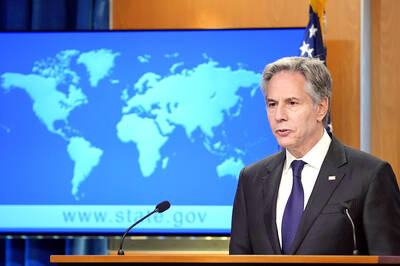
Beijing is continuing to commit genocide and crimes against humanity against Uyghurs and other Muslim minorities in its western Xinjiang province, U.S. Secretary of State Antony Blinken said in a report published on Monday, ahead of his planned visit to China this week. The State Department’s annual human rights report, which documents abuses recorded all over the world during the previous calendar year, repeated language from previous years on the treatment of Muslims in Xinjiang, but the publication raises the issue ahead of delicate talks, including on the war in Ukraine and global trade, between the top U.S. diplomat and Chinese


 RSS
RSS