


Aiguerim Chynbergen was born four years after the last nuclear tests in then-Soviet Kazakhstan, but the radioactive fallout blamed for crippling her still poisons her village.
"It is hard for me to walk for too long. I can't even do housework," said the 14-year-old, who suffers from a congenital double hip deformity that condemns her to a life indoors.
"I can't go to school anymore," she said.

PHOTO: AFP
Aiguerim's family lives 20km from the Semipalatinsk nuclear test site, where the Soviet military tested about 500 atomic bombs between 1949 and 1991.
Together with other Soviet former republics, Kazakhstan turned its nuclear arsenal over to Russia when the Soviet Union fell in 1991, but the decades of testing left a grim legacy -- chronic disease in villages like Aiguerim's, where the 2,000 inhabitants can rarely afford treatment even when it is available.
"The dispensary only provides drugs for emergencies and the hospital was closed in 1991," said pediatrician Laura Medetkyzy, who works in Aiguerim's village, Sarzhal.
The most serious diseases are blamed on the 160 bombs exploded above ground before 1962.
"People have deformities, cancers, anaemias, cataracts, renal diseases, pulmonary or cardiac" problems, Medetkyzy said. "It is rare that anyone here lives beyond 60."
Radioactive fallout is only part of the legacy of Soviet planning mistakes in Central Asia. Another is the rapidly vanishing Aral Sea, which lies between Kazakhstan and Uzbekistan and was devastated by decades of pollution and poorly conceived irrigation projects.
And the fallout of nuclear testing is not limited to a few small villages. Dangerous radiation levels here affect some 1.2 million people, nearly 10 percent of Kazakhstan's population, according to the official figure.
"For this population, cases of cancers are 300 to 400 percent above" average, said Boris Galich, the top state expert and the deputy manager at the Institute of Radiation of Semipalatinsk, a government-run treatment and research facility.
"It's terrible. The average age for [developing] cancer has fallen from 60 to 40," he said.
The victims are entitled to disability pensions, but they require a long bureaucratic procedure with regular appearances before various committees -- - and mistakes are common.
Irina, 58, who suffers from throat cancer, in January lost her official status as a victim of the tests she witnessed as a child, astonished by the spectacle of mushroom clouds rising in the sky.
Last December her doctor told her she needed a third operation, which filled her with fear.
When she refused, "they told me I was not sick anymore and withdrew my disability," she gasped, her voice broken by an earlier operation that damaged her vocal chords.
Irina appealed to the NGO Ekho Polygon, which supports test victims, for help.
"There are fewer problems now than after Kazakhstan's independence [in 1991], when the state had no money," said Nadezhda Isanova, the organization's director. "But there are always shortages."
The local population's nightmare is not over, as each day children fall sick or are born with deformities.
For this new generation of victims, activists said, compensation is being kept to a bare minimum.
This is partly blamed on meager government funds and -- critics say -- insufficient official attention to the victims' suffering.
But according to Galich, correctly identifying those made sick from radiation and those from other unrelated causes is not simple.
"There are many contradictions on what the consequences are for future generations," he said. "It is not clear what is being passed on to the next generation."

Republican US lawmakers on Friday criticized US President Joe Biden’s administration after sanctioned Chinese telecoms equipment giant Huawei unveiled a laptop this week powered by an Intel artificial intelligence (AI) chip. The US placed Huawei on a trade restriction list in 2019 for contravening Iran sanctions, part of a broader effort to hobble Beijing’s technological advances. Placement on the list means the company’s suppliers have to seek a special, difficult-to-obtain license before shipping to it. One such license, issued by then-US president Donald Trump’s administration, has allowed Intel to ship central processors to Huawei for use in laptops since 2020. China hardliners
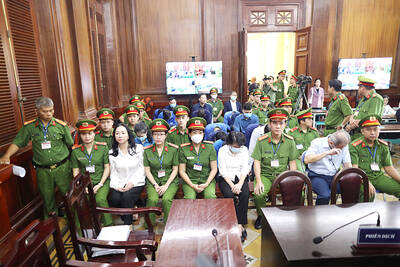
A top Vietnamese property tycoon was on Thursday sentenced to death in one of the biggest corruption cases in history, with an estimated US$27 billion in damages. A panel of three hand-picked jurors and two judges rejected all defense arguments by Truong My Lan, chair of major developer Van Thinh Phat, who was found guilty of swindling cash from Saigon Commercial Bank (SCB) over a decade. “The defendant’s actions ... eroded people’s trust in the leadership of the [Communist] Party and state,” read the verdict at the trial in Ho Chi Minh City. After the five-week trial, 85 others were also sentenced on

Conjoined twins Lori and George Schappell, who pursued separate careers, interests and relationships during lives that defied medical expectations, died this month in Pennsylvania, funeral home officials said. They were 62. The twins, listed by Guinness World Records as the oldest living conjoined twins, died on April 7 at the Hospital of the University of Pennsylvania, obituaries posted by Leibensperger Funeral Homes of Hamburg said. The cause of death was not detailed. “When we were born, the doctors didn’t think we’d make 30, but we proved them wrong,” Lori said in an interview when they turned 50, the Philadelphia Inquirer reported. The
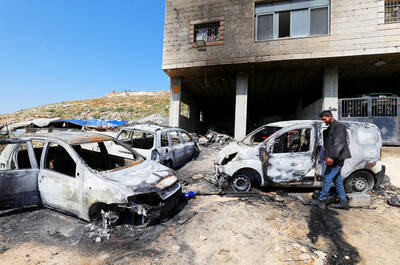
RAMPAGE: A Palestinian man was left dead after dozens of Israeli settlers searching for a missing 14-year-old boy stormed a village in the Israeli-occupied West Bank US President Joe Biden on Friday said he expected Iran to attack Israel “sooner, rather than later” and warned Tehran not to proceed. Asked by reporters about his message to Iran, Biden simply said: “Don’t,” underscoring Washington’s commitment to defend Israel. “We are devoted to the defense of Israel. We will support Israel. We will help defend Israel and Iran will not succeed,” he said. Biden said he would not divulge secure information, but said his expectation was that an attack could come “sooner, rather than later.” Israel braced on Friday for an attack by Iran or its proxies as warnings grew of


 RSS
RSS