


British Prime Minister Tony Blair won a crucial parliamentary vote to renew Britain's nuclear deterrent on Wednesday, but only after a revolt from within his ruling Labour ranks.
The bill itself passed by a healthy margin with 409 in favor of replacing the US-built Trident missile system, and 161 against, after a rowdy debate in parliament and the resignation of four junior government ministers through the course of the week.
While Blair, who is to stand down within months, told the House of Commons that nuclear weapons were essential for Britain's future security, opponents argued that the costs were prohibitive and that Britain would be seen to be hypocritical in its dealings with Iran and North Korea.
Dissent was strong within his own Labour party, with 87 Labour members of parliament (MPs) voting against replacing the submarine-based Trident. Some 95 backed a defeated amendment to delay the decision.
The government won both votes only with the support of the main opposition Conservatives in what was seen by some as a sign of Blair's weakening control over his party after nearly a decade in power. He is expected to hand over to Chancellor of the Exchequer Gordon Brown later this year.
The parliamentary rebuff was believed to be the biggest rebellion within Labour ranks since March 2003, when 138 Labour MPs, including former foreign secretary Robin Cook, voted against invading Iraq.
Anti-nuclear campaigners hailed the vote as a success with Kate Hudson of the Campaign for Nuclear Disarmament describing it as a "major victory for the peace movement."
The leader of the smaller opposition Liberal Democrats, Menzies Campbell, who opposed the decision, said it was a "humiliation" for the government.
Left-wing Labour MP John McDonnell, who has declared his intention to stand for the party's leadership when Blair steps down, meanwhile said the campaign against replacing Trident would continue.
"The scale of this rebellion clearly demonstrates that the prime minister has completely misjudged the overwhelming mood in the party ... This is only the beginning of the campaign against Trident's replacement," McDonnell said.
Before lawmakers debated the issue, Blair told them a future parliament could still decide from 2012 to 2014 whether or not to put out new contracts for new nuclear submarines that carry the weapons.
But it was vital to begin the concept and design process on the vessels immediately as they took 17 years to develop.
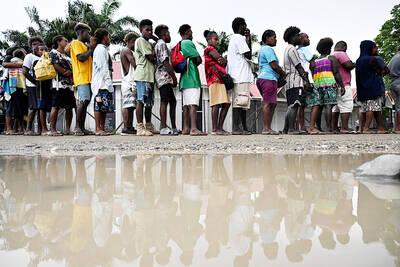
SEEKING CHANGE: A hospital worker said she did not vote in previous elections, but ‘now I can see that maybe my vote can change the system and the country’ Voting closed yesterday across the Solomon Islands in the south Pacific nation’s first general election since the government switched diplomatic allegiance from Taiwan to Beijing and struck a secret security pact that has raised fears of the Chinese navy gaining a foothold in the region. The Solomon Islands’ closer relationship with China and a troubled domestic economy weighed on voters’ minds as they cast their ballots. As many as 420,000 registered voters had their say across 50 national seats. For the first time, the national vote also coincided with elections for eight of the 10 local governments. Esther Maeluma cast her vote in the
Nearly half of China’s major cities are suffering “moderate to severe” levels of subsidence, putting millions of people at risk of flooding, especially as sea levels rise, according to a study of nationwide satellite data released yesterday. The authors of the paper, published by the journal Science, found that 45 percent of China’s urban land was sinking faster than 3mm per year, with 16 percent at more than 10mm per year, driven not only by declining water tables, but also the sheer weight of the built environment. With China’s urban population already in excess of 900 million people, “even a small portion

UNSETTLING IMAGES: The scene took place in front of TV crews covering the Trump trial, with a CNN anchor calling it an ‘emotional and unbelievably disturbing moment’ A man who doused himself in an accelerant and set himself on fire outside the courthouse where former US president Donald Trump is on trial has died, police said yesterday. The New York City Police Department (NYPD) said the man was declared dead by staff at an area hospital. The man was in Collect Pond Park at about 1:30pm on Friday when he took out pamphlets espousing conspiracy theories, tossed them around, then doused himself in an accelerant and set himself on fire, officials and witnesses said. A large number of police officers were nearby when it happened. Some officers and bystanders rushed

HYPOCRISY? The Chinese Ministry of Foreign Affairs yesterday asked whether Biden was talking about China or the US when he used the word ‘xenophobic’ US President Joe Biden on Wednesday called for a hike in steel tariffs on China, accusing Beijing of cheating as he spoke at a campaign event in Pennsylvania. Biden accused China of xenophobia, too, in a speech to union members in Pittsburgh. “They’re not competing, they’re cheating. They’re cheating and we’ve seen the damage here in America,” Biden said. Chinese steel companies “don’t need to worry about making a profit because the Chinese government is subsidizing them so heavily,” he said. Biden said he had called for the US Trade Representative to triple the tariff rates for Chinese steel and aluminum if Beijing was


 RSS
RSS