


South African trade unions and church leaders have called their government's response to unrest in Zimbabwe shameful, while a US envoy urged all Zimbabwe's neighbors to do more to rein in Zimbabwean President Robert Mugabe.
While leaders across the world including US Secretary of State Condoleezza Rice, the UN and the EU had strong denunciations of the Zimbabwean government, accused of brutally cracking down on dissenters this week, regional power center South Africa maintained that Zimbabwe's problems could only be resolved by Zimbabweans.
In a statement, South African Deputy Foreign Affairs Minister Aziz Pahad urged the Zimbabwean government to ensure respect for the rule of law and the opposition to "work towards a climate that is conducive to finding a lasting solution to the current challenges faced by the people of Zimbabwe."
The Congress of South African Trade Unions said it deplored the government's "shamefully weak response."
"Such a response is disgraceful, in the face of such massive attacks on democracy and human rights, especially coming from those who owed so much to international solidarity when South Africans were fighting for democracy and human rights against the apartheid regime," the country's largest federation of trade unions said in a statement.
South Africa has pursued what it calls a policy of "quiet diplomacy," arguing working behind the scenes would do more to encourage reform in Zimbabwe than isolating its president, Mugabe. Now concerns are being raised that South Africa's silence has added to Zimbabwe's woes and is tarnishing South Africa's image as a beacon of human rights.
"The silence of the South African government is aggravating the situation. Our leaders must show that they are committed to helping the people of Zimbabwe to find rapid solutions to the many problems confronting them," the South African Council of Churches said.
Eddie Makue, the organization's general-secretary, said in a statement that the situation in Zimbabwe threatened to destabilize the region.
"One would hope that in the glaring light of the growing brutality of the Zimbabwean government those [neighboring] states would finally feel moved to act," US Ambassador to Zimbabwe Christopher Dell told the BBC on Tuesday.
South African Foreign Affairs spokesman Ronnie Mamoepa said calls for the government to condemn Zimbabwe were misplaced while contact between the two governments continued.
But Steven Friedman, a researcher at Idasa, a pro-democracy think tank, said there was a sense South Africa was concerned about not being seen to be siding with white farmers against a black government and giving the opposition any undue credibility, than it was in "defending people's rights to protest, which is a basic right enshrined in our Constitution."
Friedman said South Africa was damaging its reputation as a country with a strong record on human rights issues.
"What the government fails to understand is that we are not a very large country so the extent to which we have any leverage in the world arena comes from our past," he said.
"A consistent human rights approach is our greatest asset and we are busy squandering it and this is particularly true with regard to Zimbabwe," Friedman said.
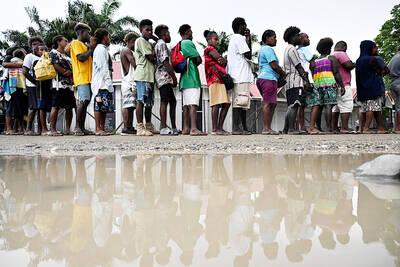
SEEKING CHANGE: A hospital worker said she did not vote in previous elections, but ‘now I can see that maybe my vote can change the system and the country’ Voting closed yesterday across the Solomon Islands in the south Pacific nation’s first general election since the government switched diplomatic allegiance from Taiwan to Beijing and struck a secret security pact that has raised fears of the Chinese navy gaining a foothold in the region. The Solomon Islands’ closer relationship with China and a troubled domestic economy weighed on voters’ minds as they cast their ballots. As many as 420,000 registered voters had their say across 50 national seats. For the first time, the national vote also coincided with elections for eight of the 10 local governments. Esther Maeluma cast her vote in the
Nearly half of China’s major cities are suffering “moderate to severe” levels of subsidence, putting millions of people at risk of flooding, especially as sea levels rise, according to a study of nationwide satellite data released yesterday. The authors of the paper, published by the journal Science, found that 45 percent of China’s urban land was sinking faster than 3mm per year, with 16 percent at more than 10mm per year, driven not only by declining water tables, but also the sheer weight of the built environment. With China’s urban population already in excess of 900 million people, “even a small portion

UNSETTLING IMAGES: The scene took place in front of TV crews covering the Trump trial, with a CNN anchor calling it an ‘emotional and unbelievably disturbing moment’ A man who doused himself in an accelerant and set himself on fire outside the courthouse where former US president Donald Trump is on trial has died, police said yesterday. The New York City Police Department (NYPD) said the man was declared dead by staff at an area hospital. The man was in Collect Pond Park at about 1:30pm on Friday when he took out pamphlets espousing conspiracy theories, tossed them around, then doused himself in an accelerant and set himself on fire, officials and witnesses said. A large number of police officers were nearby when it happened. Some officers and bystanders rushed

HYPOCRISY? The Chinese Ministry of Foreign Affairs yesterday asked whether Biden was talking about China or the US when he used the word ‘xenophobic’ US President Joe Biden on Wednesday called for a hike in steel tariffs on China, accusing Beijing of cheating as he spoke at a campaign event in Pennsylvania. Biden accused China of xenophobia, too, in a speech to union members in Pittsburgh. “They’re not competing, they’re cheating. They’re cheating and we’ve seen the damage here in America,” Biden said. Chinese steel companies “don’t need to worry about making a profit because the Chinese government is subsidizing them so heavily,” he said. Biden said he had called for the US Trade Representative to triple the tariff rates for Chinese steel and aluminum if Beijing was


 RSS
RSS