


Iranian President Mahmoud Ahmadinejad and Saudi King Abdullah agreed to counter attempts to fuel Sunni-Shiite strife during a visit by the Iranian leader to Saudi Arabia, official media said yesterday.
Ahmadinejad said he concurred with Abdullah during talks on Saturday that Iran and the kingdom would work together to thwart "enemy" plots seeking to divide the Islamic world.
Saudi SPA news agency said that Ahmadinejad also endorsed Riyadh's efforts to resolve the political crisis in Lebanon.
It said the two leaders stressed the need to preserve Iraq's national unity and ensure equality between its citizens.
The agreement to prevent sectarian strife was reported after Ahmadinejad ended a brief visit to Riyadh overshadowed by the ongoing Sunni-Shiite violence in Iraq and a political deadlock in Lebanon which has raised fears of similar infighting.
Relations between Iran and Saudi Arabia have been strained over non-Arab Iran's growing influence in Iraq and its perceived backing of Shiite militias battling the once-ruling Sunni minority.
"The two leaders affirmed that the greatest danger presently threatening the Islamic nation is the attempt to fuel the fire of strife between Sunni and Shiite Muslims, and that efforts must concentrate on countering these attempts and closing ranks," SPA said.
Ahmadinejad told reporters after returning to Tehran that he discussed with Abdullah "the plots carried out by the enemies in order to divide the world of Islam."
He did not specify who the enemies were. Iran's chief Western foe, the US, is one of Riyadh's closest allies.
Lebanon has also severely tested ties between predominantly Shiite Iran and Sunni-dominated Saudi Arabia, which provides substantial financial aid to Beirut and has close links with the Western-backed government of Sunni Prime Minister Fuad Siniora.
The anti-Syrian Lebanese administration has been crippled by an opposition ministerial walkout and an open-ended protest spearheaded by the Iranian-backed Shiite movement Hezbollah.
But Riyadh and Tehran recently began working together to reduce tensions in Lebanon, and according to the Saudi account of the talks, Ahmadinejad stated that Iran "assists the kingdom's efforts to calm the situation in Lebanon and end its political crisis."
He and Abdullah expressed the hope that "all Lebanese sides will respond [positively] to these efforts," SPA said.
The two leaders affirmed that they were keen on preserving "Iraq's independence, national unity and equality between its citizens," it said.
"We discussed the Palestinian and Iraq issues comprehensively. We have common views in this regard," Ahmadinejad told reporters at Tehran's main airport.
Ahmadinejad "voiced support for the [Saudi-authored] Arab peace initiative endorsed by the Arab summit in Beirut in 2002," SPA said without elaborating.
Under the plan, the Arab world would normalize ties with Israel in exchange for a full withdrawal from Arab land occupied since 1967 and the establishment of a Palestinian state.
Ahmadinejad, on the other hand, has said that Israel should be "wiped from the map" and is doomed to disappear.
Ahmadinejad's visit came at a time when his country is under intense Western pressure over its nuclear program. Saudi Arabia champions a nuclear-free Middle East, but is also keen to avert a US-Iran military showdown that could destabilize the entire Gulf region.
The Iranian leader had previously met King Abdullah at an Islamic summit in Mecca in December 2005, making this his first visit to the kingdom specifically for bilateral talks.
The two oil powerhouses have sought to contain differences over Iraq, which at one point saw Saudi Arabia accusing the US of effectively handing the country to Iran and triggered reports -- swiftly denied by Riyadh -- of possible Saudi intervention on behalf of Sunnis.

Republican US lawmakers on Friday criticized US President Joe Biden’s administration after sanctioned Chinese telecoms equipment giant Huawei unveiled a laptop this week powered by an Intel artificial intelligence (AI) chip. The US placed Huawei on a trade restriction list in 2019 for contravening Iran sanctions, part of a broader effort to hobble Beijing’s technological advances. Placement on the list means the company’s suppliers have to seek a special, difficult-to-obtain license before shipping to it. One such license, issued by then-US president Donald Trump’s administration, has allowed Intel to ship central processors to Huawei for use in laptops since 2020. China hardliners

DISADVANTAGE: Erin O’Toole, who led the Conservatives during the election campaign in 2021, estimated that the interference cost his party as many as nine legislative seats Canada’s domestic spy agency on Monday concluded that China interfered in the past two elections, an official probe heard, the firmest evidence so far of suspected Chinese meddling in Canadian politics. Canadian Prime Minister Justin Trudeau’s Liberal Party won both the elections, held in 2019 and 2021. Under pressure from opposition lawmakers unhappy about media reports on China’s possible role, Trudeau set up a commission into foreign interference. The commission was shown a slide on Monday containing an extract of a briefing in February last year from the Canadian Security Intelligence Service (CSIS). “We know that the PRC [People’s Republic of China] clandestinely
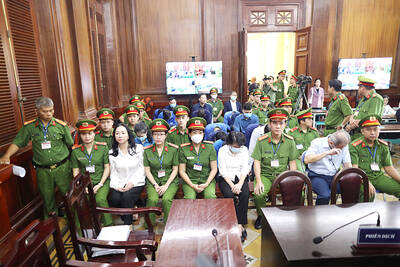
A top Vietnamese property tycoon was on Thursday sentenced to death in one of the biggest corruption cases in history, with an estimated US$27 billion in damages. A panel of three hand-picked jurors and two judges rejected all defense arguments by Truong My Lan, chair of major developer Van Thinh Phat, who was found guilty of swindling cash from Saigon Commercial Bank (SCB) over a decade. “The defendant’s actions ... eroded people’s trust in the leadership of the [Communist] Party and state,” read the verdict at the trial in Ho Chi Minh City. After the five-week trial, 85 others were also sentenced on

‘DELUSIONAL’: Targeting the families of Hamas’ leaders would not push the group to change its position or to give up its demands for Palestinians, Ismail Haniyeh said Israeli aircraft on Wednesday killed three sons of Hamas’ top political leader in the Gaza Strip, striking high-stakes targets at a time when Israel is holding delicate ceasefire negotiations with the militant group. Hamas said four of the leader’s grandchildren were also killed. Ismail Haniyeh’s sons are among the highest-profile figures to be killed in the war so far. Israel said they were Hamas operatives, and Haniyeh accused Israel of acting in “the spirit of revenge and murder.” The deaths threatened to strain the internationally mediated ceasefire talks, which appeared to gain steam in recent days even as the sides remain far


 RSS
RSS