


One of Britain's most senior police officers accused the nation's security service, MI5, on Wednesday night of "smearing" him after it emerged that the security service told Scotland Yard it suspected him of being an Iranian spy.
The Guardian newspaper learned that the warning about Chief Superintendent Ali Dizaei was one of the principal reasons the force pursued him for four years, mounting a corruption inquiry costing at least ?3 million. He was suspended amid allegations of drug use, corruption and threatening national security, but was cleared by a jury of minor criminal charges.
The Metropolitan Police (Met)'s anti-corruption squad bugged his phones, investigated his bank accounts, tracked their own officer to the US and set him several integrity tests which he passed. A key reason why it was so determined to see him convicted was a claim by MI5 that he was suspected of being an agent of influence for the Iranian government. Informed sources say MI5 based its warning on the officer's association with people from the Iranian embassy and nationals, his visits to the embassy, and an intercept by the UK's eavesdropping station at GCHQ.
Chief Superintendent Dizaei, who now runs policing in a west London borough, was born in Iran and holds dual UK and Iranian citizenship.
He said: "MI5 should be ashamed of themselves, as should the police service. This allegation is wholly baseless and false and it is outrageous that it could still be used to blight my career. It is nothing more than a smear."
Dizaei consented to the Guardian publishing details of the allegation because he said he had nothing to hide.
The Met's investigation began in July 1999. By October he was the subject of wiretaps and covert surveillance into his alleged drug use, that proved baseless. In mid 2000, the Scotland Yard squad received the intelligence from MI5.
After his acquittal in 2003 the force paid him ?80,000 in compensation.
In a deal reached after pressure from the home secretary at the time, David Blunkett, he also returned to work with the Met.

Republican US lawmakers on Friday criticized US President Joe Biden’s administration after sanctioned Chinese telecoms equipment giant Huawei unveiled a laptop this week powered by an Intel artificial intelligence (AI) chip. The US placed Huawei on a trade restriction list in 2019 for contravening Iran sanctions, part of a broader effort to hobble Beijing’s technological advances. Placement on the list means the company’s suppliers have to seek a special, difficult-to-obtain license before shipping to it. One such license, issued by then-US president Donald Trump’s administration, has allowed Intel to ship central processors to Huawei for use in laptops since 2020. China hardliners
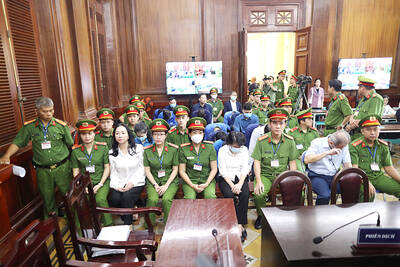
A top Vietnamese property tycoon was on Thursday sentenced to death in one of the biggest corruption cases in history, with an estimated US$27 billion in damages. A panel of three hand-picked jurors and two judges rejected all defense arguments by Truong My Lan, chair of major developer Van Thinh Phat, who was found guilty of swindling cash from Saigon Commercial Bank (SCB) over a decade. “The defendant’s actions ... eroded people’s trust in the leadership of the [Communist] Party and state,” read the verdict at the trial in Ho Chi Minh City. After the five-week trial, 85 others were also sentenced on

‘DELUSIONAL’: Targeting the families of Hamas’ leaders would not push the group to change its position or to give up its demands for Palestinians, Ismail Haniyeh said Israeli aircraft on Wednesday killed three sons of Hamas’ top political leader in the Gaza Strip, striking high-stakes targets at a time when Israel is holding delicate ceasefire negotiations with the militant group. Hamas said four of the leader’s grandchildren were also killed. Ismail Haniyeh’s sons are among the highest-profile figures to be killed in the war so far. Israel said they were Hamas operatives, and Haniyeh accused Israel of acting in “the spirit of revenge and murder.” The deaths threatened to strain the internationally mediated ceasefire talks, which appeared to gain steam in recent days even as the sides remain far

RAMPAGE: A Palestinian man was left dead after dozens of Israeli settlers searching for a missing 14-year-old boy stormed a village in the Israeli-occupied West Bank US President Joe Biden on Friday said he expected Iran to attack Israel “sooner, rather than later” and warned Tehran not to proceed. Asked by reporters about his message to Iran, Biden simply said: “Don’t,” underscoring Washington’s commitment to defend Israel. “We are devoted to the defense of Israel. We will support Israel. We will help defend Israel and Iran will not succeed,” he said. Biden said he would not divulge secure information, but said his expectation was that an attack could come “sooner, rather than later.” Israel braced on Friday for an attack by Iran or its proxies as warnings grew of


 RSS
RSS