


Canada's parliament voted on Tuesday not to extend two measures that were passed as part of a sweeping package of anti-terrorism laws weeks after the Sept. 11, 2001, attacks on the US.
The measures will expire today. One allows the police to arrest people suspected of preparing to commit an act of terrorism and hold them for 72 hours without charges, and the other enables courts to compel witnesses to testify at special hearings similar to grand jury proceedings in the US.
Neither has ever been used.
The vote took place just days after the Supreme Court struck down a law allowing the government to detain foreign-born terrorism suspects indefinitely using secret evidence and without charges while their deportations were being considered.
But the debate reflected the fractious politics of Canada's minority Parliament as much as a national reassessment of anti-terrorism measures.
The Liberal Party was in power when the legislation was passed. But on Tuesday, with the Conservative Party in power and pushing to extend the two measures, all but two of the Liberal members present voted against the extension, as instructed by their new leader, Stephane Dion. That, combined with the no votes of two smaller opposition parties, ensured the overwhelming defeat of the Conservatives' hopes.
After the vote, the Conservatives portrayed their opponents as unwilling to protect national security.
"Any party that doesn't take the national security of Canadians seriously will never be chosen by Canadians to form the government of Canada," Prime Minister Stephen Harper said.
The harsh words began long before the vote. In the House of Commons last week, Harper suggested that the Liberal opposition to the measures stemmed from the possibility that they could be used to compel a relative of a Liberal Party member to testify at a special hearing to look into the bombing of an Air India flight in 1985.
A prolonged criminal trial in the deaths of 329 people as a result of that bombing ended in two acquittals in 2005. Harper was jeered down before he could finish his remarks.
Canadians who lost relatives in the 9/11 attacks held a news conference in Ottawa on Tuesday morning, before the vote, to urge that the provisions be extended. The laws, said one widow, Cindy Barkway, "allow law enforcement officials to prevent terrorism from turning people like you into victims like us."
There was some disappointment that the issue of public safety had become politicized by Liberals and Conservatives alike.
Professor Errol Mendes, who teaches human rights law at the University of Ottawa, said that without the preventive arrest provision there could be circumstances when the police would be unable to stop an attack in progress.
He said judicial oversight of the arrests and the investigative court hearings would prevent human rights abuses.
Canada has a long history of allowing preventive detention. In 1970, under the now-defunct War Measures Act of 1914, 453 people were jailed without charges after the kidnapping and killing of a Quebec Cabinet minister and the abduction of British diplomat. That episode remains controversial throughout the country, especially in Quebec.
Amnesty International and other human rights groups urged Parliament let the measures expire. Amnesty argued that conventional criminal laws allowed the police and courts to stop imminent terrorist acts without jeopardizing civil liberties, a position largely shared by Dion.
After the vote, Alex Neve, Amnesty International's Canadian secretary-general, said: "This by no means should be interpreted or misunderstood that Canada is somehow going soft on terrorism. What I think this is an affirmation of is that Canada is increasingly concerned that its approach to terrorism is fully grounded in respect to fundamental human rights."
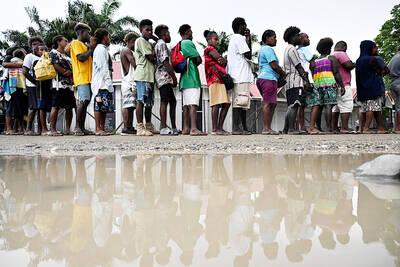
SEEKING CHANGE: A hospital worker said she did not vote in previous elections, but ‘now I can see that maybe my vote can change the system and the country’ Voting closed yesterday across the Solomon Islands in the south Pacific nation’s first general election since the government switched diplomatic allegiance from Taiwan to Beijing and struck a secret security pact that has raised fears of the Chinese navy gaining a foothold in the region. The Solomon Islands’ closer relationship with China and a troubled domestic economy weighed on voters’ minds as they cast their ballots. As many as 420,000 registered voters had their say across 50 national seats. For the first time, the national vote also coincided with elections for eight of the 10 local governments. Esther Maeluma cast her vote in the
Nearly half of China’s major cities are suffering “moderate to severe” levels of subsidence, putting millions of people at risk of flooding, especially as sea levels rise, according to a study of nationwide satellite data released yesterday. The authors of the paper, published by the journal Science, found that 45 percent of China’s urban land was sinking faster than 3mm per year, with 16 percent at more than 10mm per year, driven not only by declining water tables, but also the sheer weight of the built environment. With China’s urban population already in excess of 900 million people, “even a small portion

UNSETTLING IMAGES: The scene took place in front of TV crews covering the Trump trial, with a CNN anchor calling it an ‘emotional and unbelievably disturbing moment’ A man who doused himself in an accelerant and set himself on fire outside the courthouse where former US president Donald Trump is on trial has died, police said yesterday. The New York City Police Department (NYPD) said the man was declared dead by staff at an area hospital. The man was in Collect Pond Park at about 1:30pm on Friday when he took out pamphlets espousing conspiracy theories, tossed them around, then doused himself in an accelerant and set himself on fire, officials and witnesses said. A large number of police officers were nearby when it happened. Some officers and bystanders rushed

HYPOCRISY? The Chinese Ministry of Foreign Affairs yesterday asked whether Biden was talking about China or the US when he used the word ‘xenophobic’ US President Joe Biden on Wednesday called for a hike in steel tariffs on China, accusing Beijing of cheating as he spoke at a campaign event in Pennsylvania. Biden accused China of xenophobia, too, in a speech to union members in Pittsburgh. “They’re not competing, they’re cheating. They’re cheating and we’ve seen the damage here in America,” Biden said. Chinese steel companies “don’t need to worry about making a profit because the Chinese government is subsidizing them so heavily,” he said. Biden said he had called for the US Trade Representative to triple the tariff rates for Chinese steel and aluminum if Beijing was


 RSS
RSS