


Union chiefs have announced they will end a crippling two-week nationwide strike in Guinea, saying embattled President Lansana Conte had given in to a key demand and agreed to appoint a new consensus prime minister.
Ibrahima Fofana, one of the country's two main union chiefs, said that although the strike would technically end at midnight on Sunday, yesterday was to be a day of prayer devoted to the more than 100 people who have died in violent strike-related crackdowns and protests this year. Most were shot by security forces.
Another union chief, Rabiatou Serah Diallo, said union officials and civil society leaders had proposed five names for the prime minister's post and Conte was expected to choose one of them, though it was unclear when.
Ousman Bah, a protocol official at parliament where some of the talks took place, said Conte would select one of the five by Friday.
Former Nigerian military ruler Ibrahim Babangida has been shuttling between union leaders and Conte this weekend in a bid to resolve the impasse, which fueled strikes and deadly violence in the tense West African nation for weeks.
In talks late on Saturday, Conte told Babangida he was ready to appoint a new premier and asked his opponents to propose five names for the post, Bah said.
Babangida is helping mediate the crisis on the part of the 15-member Economic Community of West African States (ECOWAS). He met with Conte on Saturday and was due to meet with him again Sunday on the latest union proposal.
Diallo had vowed on Saturday that the latest round of strikes, which began Feb. 12, would continue until a new premier is named.
After an earlier strike last month turned bloody with security forces firing on demonstrators and killing dozens, Conte agreed to appoint a new prime minister with increased powers who many hoped would wrest the country from its plight.
Conte was supposed to name a consensus premier, but instead named Eugene Camara, a close ally who union leaders rejected immediately. The post of prime minister had been vacant since Conte fired prime minister Cellou Dalein Diallo last April.
Accusing Conte of skirting the agreement by naming a confidant, angry youths took to the streets again as strikes resumed on Feb. 12. Conte responded by imposing martial law. The move included a curfew, roadblocks and military searches across the country.

Republican US lawmakers on Friday criticized US President Joe Biden’s administration after sanctioned Chinese telecoms equipment giant Huawei unveiled a laptop this week powered by an Intel artificial intelligence (AI) chip. The US placed Huawei on a trade restriction list in 2019 for contravening Iran sanctions, part of a broader effort to hobble Beijing’s technological advances. Placement on the list means the company’s suppliers have to seek a special, difficult-to-obtain license before shipping to it. One such license, issued by then-US president Donald Trump’s administration, has allowed Intel to ship central processors to Huawei for use in laptops since 2020. China hardliners

Conjoined twins Lori and George Schappell, who pursued separate careers, interests and relationships during lives that defied medical expectations, died this month in Pennsylvania, funeral home officials said. They were 62. The twins, listed by Guinness World Records as the oldest living conjoined twins, died on April 7 at the Hospital of the University of Pennsylvania, obituaries posted by Leibensperger Funeral Homes of Hamburg said. The cause of death was not detailed. “When we were born, the doctors didn’t think we’d make 30, but we proved them wrong,” Lori said in an interview when they turned 50, the Philadelphia Inquirer reported. The
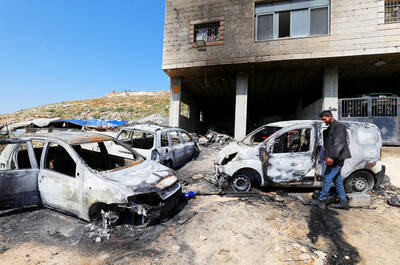
RAMPAGE: A Palestinian man was left dead after dozens of Israeli settlers searching for a missing 14-year-old boy stormed a village in the Israeli-occupied West Bank US President Joe Biden on Friday said he expected Iran to attack Israel “sooner, rather than later” and warned Tehran not to proceed. Asked by reporters about his message to Iran, Biden simply said: “Don’t,” underscoring Washington’s commitment to defend Israel. “We are devoted to the defense of Israel. We will support Israel. We will help defend Israel and Iran will not succeed,” he said. Biden said he would not divulge secure information, but said his expectation was that an attack could come “sooner, rather than later.” Israel braced on Friday for an attack by Iran or its proxies as warnings grew of

A prominent Christian leader has allegedly been stabbed at the altar during a Mass yesterday in southwest Sydney. Bishop Mar Mari Emmanuel was saying Mass at Christ The Good Shepherd Church in Wakeley just after 7pm when a man approached him at the altar and allegedly stabbed toward his head multiple times. A live stream of the Mass shows the congregation swarm forward toward Emmanuel before it was cut off. The church leader gained prominence during the COVID-19 pandemic, amassing a large online following, Officers attached to Fairfield City police area command attended a location on Welcome Street, Wakeley following reports a number


 RSS
RSS