


US President George W. Bush has decided to send an unusually tough message to one of his most important allies, President Pervez Musharraf of Pakistan, warning him that the newly Democratic Congress could cut aid to his country unless his forces became far more aggressive in hunting down operatives with al-Qaeda, senior administration officials say.
The decision came after the White House concluded that Musharraf has so far failed to live up to commitments he made to Bush during a visit to the US last September. Musharraf insisted then, both in private and public, that a peace deal he struck with tribal leaders in one of the country's most lawless border areas would not diminish the hunt for the leaders of al-Qaeda and the Taliban or their training camps.
Now, US intelligence officials have concluded that the terrorist infrastructure is being rebuilt, and that while Pakistan has attacked some camps, its overall effort has flagged.
"He's made a number of assurances over the past few months, but the bottom line is that what they are doing now is not working," one senior administration official who deals often with South Asian issues said late last week. "The message we're sending to him now is that the only thing that matters is results."
Democrats, who took control of Congress last month, have urged the White House to put greater pressure on Pakistan because of statements from US commanders that units based in Pakistan that are linked to the Taliban, Afghanistan's ousted rulers, are increasing their attacks into Afghanistan.
For the time being, officials say, the White House has ruled out unilateral strikes against the training camps that US spy satellites are monitoring in North Waziristan, in Pakistan's tribal areas on the border. The fear is that such strikes would result in what one administration official referred to as a "shock to the stability" of Musharraf's government.
Musharraf, a savvy survivor in the brutal world of Pakistani politics, knows that the administration is hesitant to push him too far. If his government collapses, it is not clear who would succeed him or who would gain control over Pakistan's arsenal of nuclear weapons.
But the spread of al-Qaeda in the tribal areas threatens to undermine a central element of Bush's argument that he is succeeding in the administration's effort to curb terrorism. The bomb plot that was disrupted in Britain last summer, involving plans to hijack airplanes, has been linked by British and US intelligence agencies to camps in the Pakistan-Afghan border areas.
Meanwhile, US Vice President Dick Cheney made a surprise visit to Pakistan yesterday for talks with Musharraf on efforts to stabilize neighboring Afghanistan, an official said.
Cheney arrived yesterday morning and went straight to Musharraf's office in Rawalpindi, just south of the capital Islamabad, for talks on bilateral and international issues, a senior official in the president's office said. State-run Pakistan Television also reported that the meeting was underway but reported the leaders were meeting at Musharraf's official residence in the capital, Islamabad.

Republican US lawmakers on Friday criticized US President Joe Biden’s administration after sanctioned Chinese telecoms equipment giant Huawei unveiled a laptop this week powered by an Intel artificial intelligence (AI) chip. The US placed Huawei on a trade restriction list in 2019 for contravening Iran sanctions, part of a broader effort to hobble Beijing’s technological advances. Placement on the list means the company’s suppliers have to seek a special, difficult-to-obtain license before shipping to it. One such license, issued by then-US president Donald Trump’s administration, has allowed Intel to ship central processors to Huawei for use in laptops since 2020. China hardliners
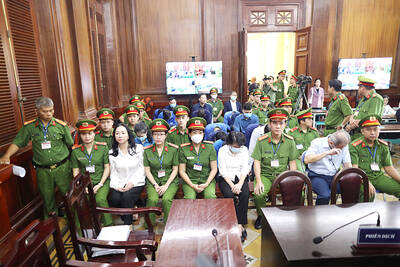
A top Vietnamese property tycoon was on Thursday sentenced to death in one of the biggest corruption cases in history, with an estimated US$27 billion in damages. A panel of three hand-picked jurors and two judges rejected all defense arguments by Truong My Lan, chair of major developer Van Thinh Phat, who was found guilty of swindling cash from Saigon Commercial Bank (SCB) over a decade. “The defendant’s actions ... eroded people’s trust in the leadership of the [Communist] Party and state,” read the verdict at the trial in Ho Chi Minh City. After the five-week trial, 85 others were also sentenced on

Conjoined twins Lori and George Schappell, who pursued separate careers, interests and relationships during lives that defied medical expectations, died this month in Pennsylvania, funeral home officials said. They were 62. The twins, listed by Guinness World Records as the oldest living conjoined twins, died on April 7 at the Hospital of the University of Pennsylvania, obituaries posted by Leibensperger Funeral Homes of Hamburg said. The cause of death was not detailed. “When we were born, the doctors didn’t think we’d make 30, but we proved them wrong,” Lori said in an interview when they turned 50, the Philadelphia Inquirer reported. The

RAMPAGE: A Palestinian man was left dead after dozens of Israeli settlers searching for a missing 14-year-old boy stormed a village in the Israeli-occupied West Bank US President Joe Biden on Friday said he expected Iran to attack Israel “sooner, rather than later” and warned Tehran not to proceed. Asked by reporters about his message to Iran, Biden simply said: “Don’t,” underscoring Washington’s commitment to defend Israel. “We are devoted to the defense of Israel. We will support Israel. We will help defend Israel and Iran will not succeed,” he said. Biden said he would not divulge secure information, but said his expectation was that an attack could come “sooner, rather than later.” Israel braced on Friday for an attack by Iran or its proxies as warnings grew of


 RSS
RSS