


A high-speed train traveling from London to Scotland derailed in northwestern England, sending carriages slipping down an embankment, leaving passengers trapped for hours and killing at least one person, officials said.
The Glasgow-bound Virgin train derailed on Friday night near Lambrigg in Cumbria, 435km northwest of London, after reportedly hitting an obstruction in the rain, at 8:10pm.
A Royal Lancaster Infirmary spokeswoman confirmed early yesterday that one of the hospital's patients had died of injuries sustained in the crash. Cumbria Police Detective Superintendent Jon Rush identified her only as an elderly woman, adding that five others were in serious condition.
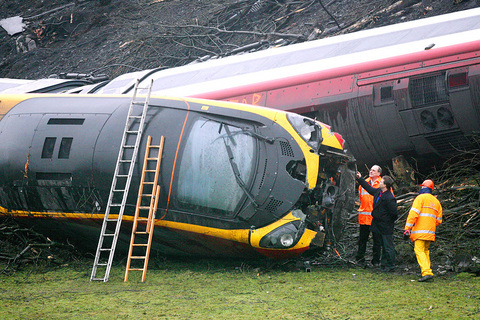
PHOTO: AP
Cumbria Ambulance Service spokeswoman Claudine Shacklock said rescue workers believed no one was left in the nine-car train. She said at least 77 people were injured.
Officials have accounted for all 120 passengers and staff who were on the train at the time of the accident, Rush told reporters.
Virgin Trains spokesman Lee West told Sky News that the cause of the accident was unknown.
The company said the train was traveling at 153kph at the time of the derailment. Authorities were investigating.
Firefighters in yellow suits searched overturned train carriages tangled in downed power lines. The red roof of one carriage had been torn off in the accident, another was left hanging over the embankment's edge.
Shacklock said all of the train's nine carriages had derailed, but the fallen power lines had prevented rescue officials from being able to immediately help people out of the cars.
Twelve ambulances and five fire trucks responded to the scene, and the Royal Air Force dispatched three Sea King helicopters and two mountain rescue teams. The military helicopters, along with one police helicopter, were sent to transport the injured to hospitals.
BBC executive Caroline Thompson, who was on the train, told the BBC that the train appeared to hit something and lurched from side to side "in a very dramatic way."
Passenger Ruth Colton told the BBC she was reading a book when the journey became bumpy, like the train was being battered by heavy winds, "as if we were on a plane," before derailing.
She said the train flipped over, and items such as bottles and bags were "flying everywhere."
Vanessa Robinson, 25, from Perth, Australia, said she was thrown from the train through a smashed window when her carriage rolled upside down.
"I heard a sudden thump, I thought the train was going to catch fire and I thought I was going to die. I felt a bump which threw me against the wall of the carriage," said Robinson, who was traveling to Glasgow on holiday.
The train involved was a Pendolino train, which has a special tilting mechanism that enables it to reach speeds of 200kph.
The area where the train derailed on Friday has seen two accidents on its railway lines in the past four years.
Rail safety has been a major problem in Britain in recent years. One of the most serious accidents occurred in October 1999, when a train heading out of London's Paddington station went through a red light and crashed into an incoming high-speed train, killing 31 people. Around 400 people were injured in the accident, which was Britain's worst rail crash in 25 years.

‘IN A DIFFERENT PLACE’: The envoy first visited Shanghai, where he attended a Chinese basketball playoff match, and is to meet top officials in Beijing tomorrow US Secretary of State Antony Blinken yesterday arrived in China on his second visit in a year as the US ramps up pressure on its rival over its support for Russia while also seeking to manage tensions with Beijing. The US diplomat tomorrow is to meet China’s top brass in Beijing, where he is also expected to plead for restraint as Taiwan inaugurates president-elect William Lai (賴清德), and to raise US concerns on Chinese trade practices. However, Blinken is also seeking to stabilize ties, with tensions between the world’s two largest economies easing since his previous visit in June last year. At the
Nearly half of China’s major cities are suffering “moderate to severe” levels of subsidence, putting millions of people at risk of flooding, especially as sea levels rise, according to a study of nationwide satellite data released yesterday. The authors of the paper, published by the journal Science, found that 45 percent of China’s urban land was sinking faster than 3mm per year, with 16 percent at more than 10mm per year, driven not only by declining water tables, but also the sheer weight of the built environment. With China’s urban population already in excess of 900 million people, “even a small portion

UNSETTLING IMAGES: The scene took place in front of TV crews covering the Trump trial, with a CNN anchor calling it an ‘emotional and unbelievably disturbing moment’ A man who doused himself in an accelerant and set himself on fire outside the courthouse where former US president Donald Trump is on trial has died, police said yesterday. The New York City Police Department (NYPD) said the man was declared dead by staff at an area hospital. The man was in Collect Pond Park at about 1:30pm on Friday when he took out pamphlets espousing conspiracy theories, tossed them around, then doused himself in an accelerant and set himself on fire, officials and witnesses said. A large number of police officers were nearby when it happened. Some officers and bystanders rushed

Beijing is continuing to commit genocide and crimes against humanity against Uyghurs and other Muslim minorities in its western Xinjiang province, U.S. Secretary of State Antony Blinken said in a report published on Monday, ahead of his planned visit to China this week. The State Department’s annual human rights report, which documents abuses recorded all over the world during the previous calendar year, repeated language from previous years on the treatment of Muslims in Xinjiang, but the publication raises the issue ahead of delicate talks, including on the war in Ukraine and global trade, between the top U.S. diplomat and Chinese


 RSS
RSS