


Palestinian Prime Minister Ismail Haniyeh of Hamas took the job of forming a new government with the moderate Fatah movement, facing unresolved internal disputes and a reported warning of a US boycott.
In quick succession on Thursday, Haniyeh and his government resigned and President Mahmoud Abbas of Fatah appointed him to form the new team, based on last week's agreement in the Muslim holy city of Mecca to split power between the two rivals.
Haniyeh has five weeks to put together a new Cabinet. During that period, Hamas and Fatah need to resolve deep disputes over control of the security forces and whether to dismantle a separate Hamas militia.
However, even if the coalition is formed, it appears increasingly unlikely it will win international backing. The new government's political program falls short of a key condition by the international community, explicit recognition of Israel. Instead, it contains a vague promise to "respect" international agreements, at best implying recognition.
Hamas is considered a terror group by the US, the EU and Israel, and the Hamas-led government was targeted by a crippling international aid boycott.
Abbas aides said on Thursday that US officials made it clear that Washington would boycott the emerging Palestinian government, including independent and Fatah Cabinet ministers.
Abbas, elected separately, would not be included in such a boycott, the aides said.
US Secretary of State Condoleezza Rice is cheduled to attend a three-way summit with Abbas and Israeli Prime Minister Ehud Olmert on Monday.
Initially billed as a step toward resuming peace talks, frozen for more than six years, the summit will now likely be overshadowed by the disagreements over the Palestinian government.
In an interview on Palestinian TV late on Thursday, Abbas told his people that the boycott would not be lifted right away, but "we will fight and struggle, and we hope this can be accomplished soon, though there are still obstacles."
Abbas also said the letter appointing Haniyeh to form the government backs implicitly peace talks with Israel, run by Abbas' PLO.
The international demands have put Abbas in a bind. Had he pulled out of the deal with Hamas, he could have been branded a traitor by his people, become increasingly ineffective and triggered more factional fighting.
Since May, more than 130 Palestinians have been killed in Fatah-Hamas clashes.
In moving forward with the new partnership, Abbas will likely deepen the Palestinians' isolation.
Abbas will meet David Welch, a senior US State Department official, today and Rice tomorrow, in part to try to persuade them to change their position, the Abbas aides said.
The Palestinians also hope Saudi Arabia, a US ally, will help. Saudi Arabia brokered the Mecca power-sharing deal that formed the basis for the Hamas-Fatah coalition talks.
Fatah spokesman Abdel Hakim Awad said Saudi Arabia would be the guarantor of the agreement "because of the influence it has in the international, Arab and Islamic arenas."

Republican US lawmakers on Friday criticized US President Joe Biden’s administration after sanctioned Chinese telecoms equipment giant Huawei unveiled a laptop this week powered by an Intel artificial intelligence (AI) chip. The US placed Huawei on a trade restriction list in 2019 for contravening Iran sanctions, part of a broader effort to hobble Beijing’s technological advances. Placement on the list means the company’s suppliers have to seek a special, difficult-to-obtain license before shipping to it. One such license, issued by then-US president Donald Trump’s administration, has allowed Intel to ship central processors to Huawei for use in laptops since 2020. China hardliners

Conjoined twins Lori and George Schappell, who pursued separate careers, interests and relationships during lives that defied medical expectations, died this month in Pennsylvania, funeral home officials said. They were 62. The twins, listed by Guinness World Records as the oldest living conjoined twins, died on April 7 at the Hospital of the University of Pennsylvania, obituaries posted by Leibensperger Funeral Homes of Hamburg said. The cause of death was not detailed. “When we were born, the doctors didn’t think we’d make 30, but we proved them wrong,” Lori said in an interview when they turned 50, the Philadelphia Inquirer reported. The
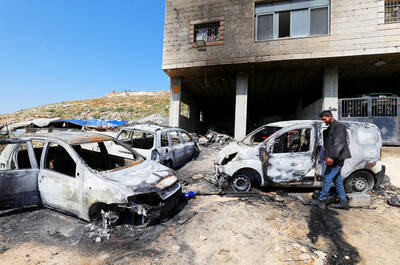
RAMPAGE: A Palestinian man was left dead after dozens of Israeli settlers searching for a missing 14-year-old boy stormed a village in the Israeli-occupied West Bank US President Joe Biden on Friday said he expected Iran to attack Israel “sooner, rather than later” and warned Tehran not to proceed. Asked by reporters about his message to Iran, Biden simply said: “Don’t,” underscoring Washington’s commitment to defend Israel. “We are devoted to the defense of Israel. We will support Israel. We will help defend Israel and Iran will not succeed,” he said. Biden said he would not divulge secure information, but said his expectation was that an attack could come “sooner, rather than later.” Israel braced on Friday for an attack by Iran or its proxies as warnings grew of

A prominent Christian leader has allegedly been stabbed at the altar during a Mass yesterday in southwest Sydney. Bishop Mar Mari Emmanuel was saying Mass at Christ The Good Shepherd Church in Wakeley just after 7pm when a man approached him at the altar and allegedly stabbed toward his head multiple times. A live stream of the Mass shows the congregation swarm forward toward Emmanuel before it was cut off. The church leader gained prominence during the COVID-19 pandemic, amassing a large online following, Officers attached to Fairfield City police area command attended a location on Welcome Street, Wakeley following reports a number


 RSS
RSS