


British Prime Minister Tony Blair's plan to pave the way for a new generation of nuclear power stations for the UK by the time he leaves office fell into disarray on Thursday after the high court in London ruled the British government had carried out a "misleading" and "seriously flawed" consultation on its energy review.
High Court Justice Jeremy Sullivan's judgment forces the government to canvass public opinion once again and is likely to force a delay of several months in the publication of the energy policy paper, which had been expected next month.
The judge delivered a symbolic victory to Greenpeace. The organization had applied for judicial review of the 12-week consultation last year, which it condemned as a sham.
Blair insisted last night that new nuclear power stations had to be part of future energy provision.
"This won't affect the policy at all," he said.
UK Trade and Industry Secretary Alistair Darling said he was unlikely to appeal against the ruling and promised "to put it right and consult properly, to make sure we can get the process back on track."
Ministers will decide next week whether to go ahead with the white paper next month. They believe they may technically be able to proceed even if the new consultation has not been completed, but realize that could be another PR disaster.
Darling said climate change meant the UK was "in a race against time" to reduce dependency on oil and gas and deliver a 60 percent cut in carbon dioxide emissions by 2050.
"On a matter so important as climate change it just isn't possible to stand back and say: `We don't have any views,'" Darling told the BBC.
Last July the government gave the green light to new nuclear power stations, promising to speed up the planning and regulatory regime but insisting they had to be funded by private investors.
UK civil service sources said on Thursday that new nuclear power stations would not appear before the late 2010s at the earliest, and that timetable was unaffected by Thursday's judgment.
Chris Huhne, the Liberal Democrat environment spokesman, said: "The judgment really shows you can't perform a 180-degree U-turn on a matter as important as nuclear power without a proper public debate."
Nuclear energy accounts for 19 percent of UK energy, but the phasing out of existing plants means that by 2020 it will only provide 7 percent.
Blair, however, wants new stations to be built in order to deliver up to 40 percent of the nation's supply in the future.
Sarah North, who heads the Greenpeace nuclear campaign, said ministers had "now been forced back to the drawing board to conduct a proper and lengthy review."
Sullivan said something had gone "clearly and radically wrong" with the consultation paper, issued in January last year.
"The 2006 consultation document contained no information of any substance on any of the issues identified as being of crucial importance," he said.
"It was not merely inadequate, but it was also misleading," he said.
Greenpeace argues that nuclear energy is not as environmentally friendly as the government claims.
"Nuclear power is a dangerous distraction from the real solutions to climate change as it only represents 3.6 percent of our total energy," North said.

Republican US lawmakers on Friday criticized US President Joe Biden’s administration after sanctioned Chinese telecoms equipment giant Huawei unveiled a laptop this week powered by an Intel artificial intelligence (AI) chip. The US placed Huawei on a trade restriction list in 2019 for contravening Iran sanctions, part of a broader effort to hobble Beijing’s technological advances. Placement on the list means the company’s suppliers have to seek a special, difficult-to-obtain license before shipping to it. One such license, issued by then-US president Donald Trump’s administration, has allowed Intel to ship central processors to Huawei for use in laptops since 2020. China hardliners

Conjoined twins Lori and George Schappell, who pursued separate careers, interests and relationships during lives that defied medical expectations, died this month in Pennsylvania, funeral home officials said. They were 62. The twins, listed by Guinness World Records as the oldest living conjoined twins, died on April 7 at the Hospital of the University of Pennsylvania, obituaries posted by Leibensperger Funeral Homes of Hamburg said. The cause of death was not detailed. “When we were born, the doctors didn’t think we’d make 30, but we proved them wrong,” Lori said in an interview when they turned 50, the Philadelphia Inquirer reported. The
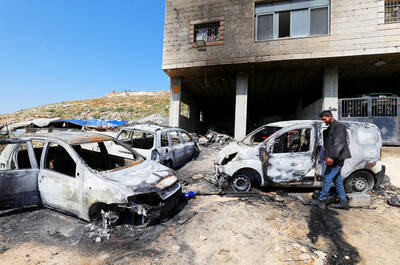
RAMPAGE: A Palestinian man was left dead after dozens of Israeli settlers searching for a missing 14-year-old boy stormed a village in the Israeli-occupied West Bank US President Joe Biden on Friday said he expected Iran to attack Israel “sooner, rather than later” and warned Tehran not to proceed. Asked by reporters about his message to Iran, Biden simply said: “Don’t,” underscoring Washington’s commitment to defend Israel. “We are devoted to the defense of Israel. We will support Israel. We will help defend Israel and Iran will not succeed,” he said. Biden said he would not divulge secure information, but said his expectation was that an attack could come “sooner, rather than later.” Israel braced on Friday for an attack by Iran or its proxies as warnings grew of

IN PURSUIT: Israel’s defense minister said the revenge attacks by Israeli settlers would make it difficult for security forces to find those responsible for the 14-year-old’s death Israeli Prime Minister Benjamin Netanyahu on Saturday condemned the “heinous murder” of an Israeli teenager in the occupied West Bank as attacks on Palestinian villages intensified following news of his death. After Benjamin Achimeir, 14, was reported missing near Ramallah on Friday, hundreds of Jewish settlers backed by Israeli forces raided nearby Palestinian villages, torching vehicles and homes, leaving at least one villager dead and dozens wounded. The attacks escalated in several villages on Saturday after Achimeir’s body was found near the Malachi Hashalom outpost. Agence France-Presse correspondents saw smoke rising from burned houses and fields. Mayor Amin Abu Alyah, of the


 RSS
RSS