


Serbia's new parliament has overwhelmingly rejected a UN plan that would give virtual independence to the breakaway province of Kosovo.
Wednesday's result dooms hopes of a compromise between Serbian and ethnic Albanian officials at a final round of negotiations on the plan scheduled to start next week in Vienna, Austria. It is also means that a resolution to the dispute over Kosovo's final status will probably have to be imposed by the UN Security Council.
The 250-member parliament voted 225-15 to reject the plan, which was drafted by UN envoy Martti Ahtisaari. Four lawmakers abstained and another six were absent from the vote in the inaugural parliamentary session after last month's elections.
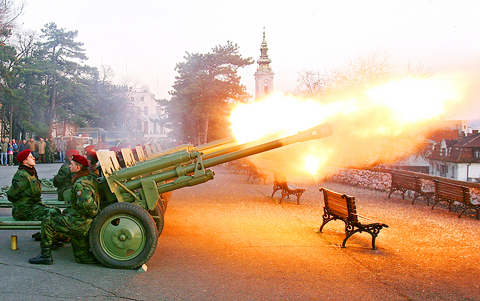
PHOTO: AP
Resolution
The parliament adopted a resolution saying Ahtisaari's draft "breaches fundamental principles of international law" and "illegally lays the foundation for the creation of a new independent state on the territory of Serbia."
The plan was welcomed by Kosovo's ethnic Albanian leadership. Although it does not specify that Kosovo will be independent, the UN draft sees internationally supervised self-rule for the southern province, including a flag, anthem, army, constitution and the right to join international organizations.
Serbian pro-Western President Boris Tadic told parliament that Ahtisaari's plan "essentially opens the way for an independent Kosovo, which is a violation of the essential principles of the U.N. charter, which guarantees inviolability of internationally recognized states."
Tomislav Nikolic, a leader of the ultranationalist Serbian Radical Party -- the biggest group in Serbia's new parliament -- hailed the parliament resolution, saying ``no one can create a new country on Serbia's territory without Serbia's consent.''
Future
But Kosovo Prime Minister Agim Ceku said Serbia's views would have no impact on the future status of the province.
``What matters is what the European Union and the international community are saying, and not what Belgrade is saying. That's their problem,'' Ceku said.
A few Serb politicians are not opposed to Ahtisaari's plan. Cedomir Jovanovic, of the Liberal Democrats, urged the parliament to ``accept the reality that Kosovo has not been under our control since 1999.''
Serbia lost control over the province in 1999 when NATO bombing halted former President Slobodan Milosevic's crackdown on ethnic Albanian separatists and turned Kosovo into a UN protectorate.
Belgrade has offered broad autonomy for Kosovo, which it considers the medieval cradle of its statehood. But Kosovo Albanians demand complete secession.
After the final round of negotiations in Vienna, Ahtisaari plans to put his proposal before the UN Security Council by the end of next month.
Resigned
The commander of the UN police in Kosovo resigned on Wednesday, days after violent clashes between the police and demonstrators left two protesters dead and another critically injured. The commander, Stephen Curtis, a former British police officer, resigned under pressure from the mission's most senior official, Joachim Ruecker.
On Tuesday, autopsy reports showed the two had been killed by rubber-coated bullets.
Television pictures of the demonstration in the center of Pristina, the regional capital, showed members of a Romanian riot squad attached to the UN firing rubber bullets into the crowd.
A third man is being treated in a military hospital and remains in critical condition, UN officials said.
Ruecker said the commissioner's resignation "would follow the principle of political accountability."
He also appointed an international prosecutor to head the investigation into the men's deaths.
The UN is planning to withdraw from the region by the end of summer and grant the province substantial self-rule.
Nearly half of China’s major cities are suffering “moderate to severe” levels of subsidence, putting millions of people at risk of flooding, especially as sea levels rise, according to a study of nationwide satellite data released yesterday. The authors of the paper, published by the journal Science, found that 45 percent of China’s urban land was sinking faster than 3mm per year, with 16 percent at more than 10mm per year, driven not only by declining water tables, but also the sheer weight of the built environment. With China’s urban population already in excess of 900 million people, “even a small portion

UNSETTLING IMAGES: The scene took place in front of TV crews covering the Trump trial, with a CNN anchor calling it an ‘emotional and unbelievably disturbing moment’ A man who doused himself in an accelerant and set himself on fire outside the courthouse where former US president Donald Trump is on trial has died, police said yesterday. The New York City Police Department (NYPD) said the man was declared dead by staff at an area hospital. The man was in Collect Pond Park at about 1:30pm on Friday when he took out pamphlets espousing conspiracy theories, tossed them around, then doused himself in an accelerant and set himself on fire, officials and witnesses said. A large number of police officers were nearby when it happened. Some officers and bystanders rushed
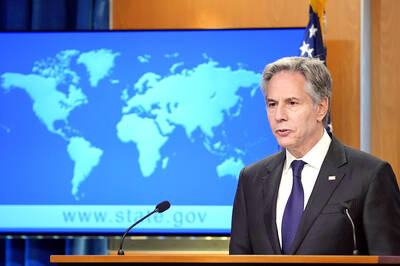
Beijing is continuing to commit genocide and crimes against humanity against Uyghurs and other Muslim minorities in its western Xinjiang province, U.S. Secretary of State Antony Blinken said in a report published on Monday, ahead of his planned visit to China this week. The State Department’s annual human rights report, which documents abuses recorded all over the world during the previous calendar year, repeated language from previous years on the treatment of Muslims in Xinjiang, but the publication raises the issue ahead of delicate talks, including on the war in Ukraine and global trade, between the top U.S. diplomat and Chinese

HYPOCRISY? The Chinese Ministry of Foreign Affairs yesterday asked whether Biden was talking about China or the US when he used the word ‘xenophobic’ US President Joe Biden on Wednesday called for a hike in steel tariffs on China, accusing Beijing of cheating as he spoke at a campaign event in Pennsylvania. Biden accused China of xenophobia, too, in a speech to union members in Pittsburgh. “They’re not competing, they’re cheating. They’re cheating and we’ve seen the damage here in America,” Biden said. Chinese steel companies “don’t need to worry about making a profit because the Chinese government is subsidizing them so heavily,” he said. Biden said he had called for the US Trade Representative to triple the tariff rates for Chinese steel and aluminum if Beijing was


 RSS
RSS