


Tens of thousands of people swarmed into Beirut yesterday to commemorate the murder two years ago of Lebanese prime minister Rafiq Hariri, with tensions running high after deadly bus bombings.
Troops backed by tanks were out in force across the greater Beirut area for the highly-charged event as government supporters flocked from around the country to Hariri's grave on Martyrs' Square.
Security was tight because of fears of possible confrontation as the demonstrators massed in the square where pro-Syrian opposition activists have been holding an around-the-clock sit-in since late last year.
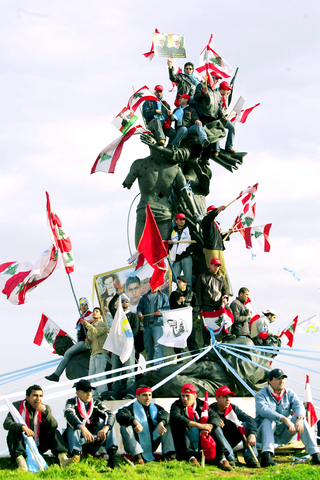
PHOTO: AP
Tens of thousands thronged the square, carrying candles, flags and balloons in the blue color of the political party now headed by Hariri's son, parliamentary leader Saad Hariri.
Roads leading to Beirut were clogged by convoys of vehicles loaded with people, who then walked the last 5km to reach Martyrs' Square on foot.
Prime Minister Fuad Siniora, once a close aide to Hariri, led prayers at the slain billionaire's grave where officials, religious leaders and supporters were taking turns to pay their homage.
The anniversary comes at a time of acute political crisis in the deeply divided country with the Hezbollah-led opposition demanding the resignation of the anti-Syrian cabinet to make way for a government of national unity and fresh elections.
Government forces have erected a barbed-wire fence in Beirut to separate the two camps which engaged in street fights last month that left seven dead.
Tensions were also running high after three people were killed and 18 wounded when bomb blasts tore through two buses in a mountainous Christian area northeast of Beirut on Tuesday.
"We came in defiance of those planting bombs," said Hariri supporter Omar Qabbani.
"We want to live. All Lebanese people should rise up to stop this cycle of terrorism," said Nadia Saikali, a housewife from the Christian neighborhood of Ashrafiyeh in Beirut.
Tuesday's bombings were the latest in a series of attacks blamed on Lebanon's former powerbroker Syria, which also stands accused of orchestrating the massive bomb blast that killed Hariri and 22 others on the Beirut seafront on Feb. 14, 2005.
"We consider that the Syrian regime bears full responsibility for this odious crime," said a statement by the ruling coalition known as March 14.
"[Damascus] is trying to destroy Lebanon's peace and security in order to abort the creation of the international tribunal," it said, referring to plans for a UN court to try suspects into Hariri's murder.
A UN probe has fingered senior Syrian officials over Hariri's assassination but the opposition is blocking plans for the tribunal and six pro-Syrian ministers quit in November over the issue.
Anger at the murder triggered national and international protests which culminated in a rally at Martyrs' Square on March 14, 2005, when an estimated 1 million people turned out.
The protests helped force the withdrawal of Syrian troops from Lebanon the following month, ending Damascus's three-decade long military domination of its smaller neighbor and bringing an anti-Syrian movement to power.
Leaders from both sides said the bus attacks were all the more reason to work to end divisions.
Nearly half of China’s major cities are suffering “moderate to severe” levels of subsidence, putting millions of people at risk of flooding, especially as sea levels rise, according to a study of nationwide satellite data released yesterday. The authors of the paper, published by the journal Science, found that 45 percent of China’s urban land was sinking faster than 3mm per year, with 16 percent at more than 10mm per year, driven not only by declining water tables, but also the sheer weight of the built environment. With China’s urban population already in excess of 900 million people, “even a small portion

UNSETTLING IMAGES: The scene took place in front of TV crews covering the Trump trial, with a CNN anchor calling it an ‘emotional and unbelievably disturbing moment’ A man who doused himself in an accelerant and set himself on fire outside the courthouse where former US president Donald Trump is on trial has died, police said yesterday. The New York City Police Department (NYPD) said the man was declared dead by staff at an area hospital. The man was in Collect Pond Park at about 1:30pm on Friday when he took out pamphlets espousing conspiracy theories, tossed them around, then doused himself in an accelerant and set himself on fire, officials and witnesses said. A large number of police officers were nearby when it happened. Some officers and bystanders rushed

HYPOCRISY? The Chinese Ministry of Foreign Affairs yesterday asked whether Biden was talking about China or the US when he used the word ‘xenophobic’ US President Joe Biden on Wednesday called for a hike in steel tariffs on China, accusing Beijing of cheating as he spoke at a campaign event in Pennsylvania. Biden accused China of xenophobia, too, in a speech to union members in Pittsburgh. “They’re not competing, they’re cheating. They’re cheating and we’ve seen the damage here in America,” Biden said. Chinese steel companies “don’t need to worry about making a profit because the Chinese government is subsidizing them so heavily,” he said. Biden said he had called for the US Trade Representative to triple the tariff rates for Chinese steel and aluminum if Beijing was

Beijing is continuing to commit genocide and crimes against humanity against Uyghurs and other Muslim minorities in its western Xinjiang province, U.S. Secretary of State Antony Blinken said in a report published on Monday, ahead of his planned visit to China this week. The State Department’s annual human rights report, which documents abuses recorded all over the world during the previous calendar year, repeated language from previous years on the treatment of Muslims in Xinjiang, but the publication raises the issue ahead of delicate talks, including on the war in Ukraine and global trade, between the top U.S. diplomat and Chinese


 RSS
RSS