


To be perched under pollution-free, open skies on the Antarctic Plateau 3.2km above sea level is a professional stargazer's dream, even if it is cold enough to freeze the blood.
Armed with a small telescope and a photometer to measure light intensity, Herve Trinquet of the University Astrophysics Laboratory in the southern French city of Nice gazes out on an unblemished celestial vault.
With other colleagues from France and Italy, Trinquet is assessing the optical qualities of the Antarctic sky.
It is part of the groundwork for the AstroConcordia Observatory, the toughest yet possibly the most rewarding place on the planet from which to view the cosmos.
At the Franco-Italian base of Concordia, also called Dome C, atmospheric turbulence that muddies the view from most other spots on the planet is reduced to a minimum.
"It's at a height of about 30m in winter, which is unique in the world," says Trinquet.
What's more, he adds, 90 percent of that turbulence is near ground level, rather than distributed in several different layers ascending toward the heavens.
Besides the purity of the atmosphere, Dome C is also well suited for an infrared telescope, which collects long-wave radiation emitted by faint celestial objects.
Djamel Mekarnia, who works for the French Center for Scientific Research's observatory on the Cote d'Azur is observing a star with a pair of 30cm optical telescopes, one on the ground, the other on a platform 8m high.
As the Antarctic summer subsides, Mekarnia has a telescope trained on the never-setting sun. In the looming winter, when night will descend for three months, he will target the Moon. Next year, he will power up by several magnitudes with a new telescope that he hopes will be able to detect planets outside the solar system.
Nearby, Italian teams are installing six telescopes.
Antarctica's forbiddingly hostile temperatures are both an advantage and an impediment.
Average temperatures ranging from minus 30oC in summer to minus 60oC in winter make for clear viewing due to lowered thermal emissions.
But they can also frost up the mirror in the telescopes and make for arduous working conditions. Contact lenses are banned, and just placing an ungloved hand on metal will cause frostbite.
The big goal is to build something called the Keops Project, a network of 36 telescopes with 1.5m mirrors that will be spaced evenly in a circle 1km across.
It could be in place next year, Trinquet says.
Nearly half of China’s major cities are suffering “moderate to severe” levels of subsidence, putting millions of people at risk of flooding, especially as sea levels rise, according to a study of nationwide satellite data released yesterday. The authors of the paper, published by the journal Science, found that 45 percent of China’s urban land was sinking faster than 3mm per year, with 16 percent at more than 10mm per year, driven not only by declining water tables, but also the sheer weight of the built environment. With China’s urban population already in excess of 900 million people, “even a small portion

UNSETTLING IMAGES: The scene took place in front of TV crews covering the Trump trial, with a CNN anchor calling it an ‘emotional and unbelievably disturbing moment’ A man who doused himself in an accelerant and set himself on fire outside the courthouse where former US president Donald Trump is on trial has died, police said yesterday. The New York City Police Department (NYPD) said the man was declared dead by staff at an area hospital. The man was in Collect Pond Park at about 1:30pm on Friday when he took out pamphlets espousing conspiracy theories, tossed them around, then doused himself in an accelerant and set himself on fire, officials and witnesses said. A large number of police officers were nearby when it happened. Some officers and bystanders rushed

HYPOCRISY? The Chinese Ministry of Foreign Affairs yesterday asked whether Biden was talking about China or the US when he used the word ‘xenophobic’ US President Joe Biden on Wednesday called for a hike in steel tariffs on China, accusing Beijing of cheating as he spoke at a campaign event in Pennsylvania. Biden accused China of xenophobia, too, in a speech to union members in Pittsburgh. “They’re not competing, they’re cheating. They’re cheating and we’ve seen the damage here in America,” Biden said. Chinese steel companies “don’t need to worry about making a profit because the Chinese government is subsidizing them so heavily,” he said. Biden said he had called for the US Trade Representative to triple the tariff rates for Chinese steel and aluminum if Beijing was
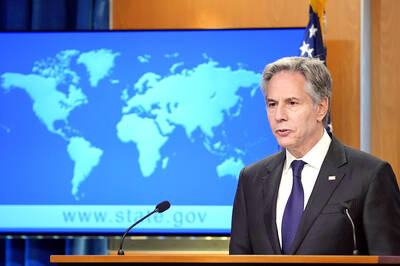
Beijing is continuing to commit genocide and crimes against humanity against Uyghurs and other Muslim minorities in its western Xinjiang province, U.S. Secretary of State Antony Blinken said in a report published on Monday, ahead of his planned visit to China this week. The State Department’s annual human rights report, which documents abuses recorded all over the world during the previous calendar year, repeated language from previous years on the treatment of Muslims in Xinjiang, but the publication raises the issue ahead of delicate talks, including on the war in Ukraine and global trade, between the top U.S. diplomat and Chinese


 RSS
RSS