


Envoys from six nations entered a third day of talks yesterday, hoping to resolve just "one or two" issues standing in the way of a long-awaited deal to begin dismantling North Korea's nuclear program.
Talks centered on a draft accord circulated by host China outlining steps the six would take to begin getting North Korea to disarm, but "sticking points" remained.
"It's basically one or two items, but it can be best described as one item," US envoy Christopher Hill told reporters yesterday.
"I don't think it's the most important issue, but you never know what is important for the North Koreans. We'll have to see," he said.
Under the draft agreement, North Korea would close its main nuclear-related facilities, including a 5 megawatt reactor at Yongbyon, within two months in return for alternative energy sources, press reports said.
US officials described the agreement as very different from the nuclear freeze the Clinton administration negotiated in 1994, the New York Times said.
"This is the Libya model," the Times quoted one senior official as saying, referring to Libya's decision in late 2003 to turn over all the equipment it had purchased from the secret nuclear network run by a Pakistani scientist.
In that agreement, both the Libyans and the US took a series of steps that eventually rid the country of nuclear technology and ended its isolation.
Yesterday was spent in a flurry of bilateral and trilateral meetings at the Diaoyutai Guest House in western Beijing, scene of all six-party negotiations since their start four years ago.
Russian representative Alexander Losyukov said the talks would end with a two-page joint statement, China's state-run Xinhua news agency reported.
China was expected to work out a proposal based on the draft, with revisions on issues such as how to provide aid to North Korea, Xinhua quoted Losyukov as saying.
"[North Korea] is very concerned about the wording of the joint statement," said Losyukov, who was quoted earlier by Xinhua as saying the talks might end before tomorrow.
A South Korean official told reporters that the delegates had kept "revising words or reflecting opinions."
Negotiations had "entered a period of labor pain," Japanese envoy Kenichiro Sasae said.
"It's a matter of balance between steps to be taken by North Korea and steps to be taken by our side in implementing what is written in the joint statement," he told reporters, referring to the September 2005 deal.
That deal fell through within just two months over North Korean objections to US financial sanctions imposed against it for alleged money laundering and counterfeiting.
Observers speculated that a deal would not be definitively announced until today at the earliest, since any agreement reached yesterday would need the approval of all six governments.
"Today and tomorrow will likely be the critical point," South Korean chief delegate Chun Yung-woo told reporters early yesterday.
Envoys refused to give specifics about the draft accord, but said it sought to begin implementing a six-party deal from September 2005.
In that deal, Pyongyang agreed to scrap its nuclear program in return for security guarantees, energy benefits and aid.
The potential breakthrough this week comes after North Korea conducted its first atomic test in October last year, an event it said confirmed its status as a global nuclear power, but which also drew UN sanctions.
The six-party forum began in 2003 with the aim of convincing North Korea to disarm.
But negotiations have seen many false dawns and failed to stop the regime from conducting its atomic test.
Piao Jianyi, an international relations scholar at the Chinese Academy of Social Sciences, the nation's top government think tank, said this session was likely to produce "a positive outcome," the state-run China Daily reported.
But he added: "It will be difficult for the negotiators to reach a consensus on how much economic compensation each party would pay for Pyongyang's commitment to give up its nuclear program."
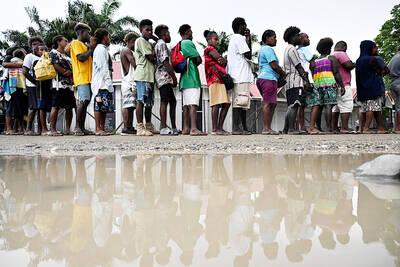
SEEKING CHANGE: A hospital worker said she did not vote in previous elections, but ‘now I can see that maybe my vote can change the system and the country’ Voting closed yesterday across the Solomon Islands in the south Pacific nation’s first general election since the government switched diplomatic allegiance from Taiwan to Beijing and struck a secret security pact that has raised fears of the Chinese navy gaining a foothold in the region. The Solomon Islands’ closer relationship with China and a troubled domestic economy weighed on voters’ minds as they cast their ballots. As many as 420,000 registered voters had their say across 50 national seats. For the first time, the national vote also coincided with elections for eight of the 10 local governments. Esther Maeluma cast her vote in the
Nearly half of China’s major cities are suffering “moderate to severe” levels of subsidence, putting millions of people at risk of flooding, especially as sea levels rise, according to a study of nationwide satellite data released yesterday. The authors of the paper, published by the journal Science, found that 45 percent of China’s urban land was sinking faster than 3mm per year, with 16 percent at more than 10mm per year, driven not only by declining water tables, but also the sheer weight of the built environment. With China’s urban population already in excess of 900 million people, “even a small portion

UNSETTLING IMAGES: The scene took place in front of TV crews covering the Trump trial, with a CNN anchor calling it an ‘emotional and unbelievably disturbing moment’ A man who doused himself in an accelerant and set himself on fire outside the courthouse where former US president Donald Trump is on trial has died, police said yesterday. The New York City Police Department (NYPD) said the man was declared dead by staff at an area hospital. The man was in Collect Pond Park at about 1:30pm on Friday when he took out pamphlets espousing conspiracy theories, tossed them around, then doused himself in an accelerant and set himself on fire, officials and witnesses said. A large number of police officers were nearby when it happened. Some officers and bystanders rushed

HYPOCRISY? The Chinese Ministry of Foreign Affairs yesterday asked whether Biden was talking about China or the US when he used the word ‘xenophobic’ US President Joe Biden on Wednesday called for a hike in steel tariffs on China, accusing Beijing of cheating as he spoke at a campaign event in Pennsylvania. Biden accused China of xenophobia, too, in a speech to union members in Pittsburgh. “They’re not competing, they’re cheating. They’re cheating and we’ve seen the damage here in America,” Biden said. Chinese steel companies “don’t need to worry about making a profit because the Chinese government is subsidizing them so heavily,” he said. Biden said he had called for the US Trade Representative to triple the tariff rates for Chinese steel and aluminum if Beijing was


 RSS
RSS