


US President George W. Bush yesterday distanced himself from predictions US troops could begin leaving Iraq by late summer, stating bluntly he would accept no timetable for such a pullout.
"We don't set timetables in this administration because an enemy will adjust their tactics based upon perceived action by the United States," Bush told the USA Today newspaper.
The comment signaled a stiffening of his position amid a brewing confrontation with the Democrat-controlled Congress, which is juggling proposals to begin "redeploying" 132,000 US troops from Iraq in four to six months.
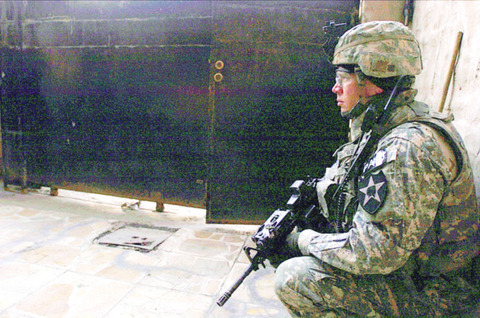
PHOTO: AFP
It also followed a prediction made last week by the US commander of coalition forces in Iraq, General George Casey, who indicated that reinforcements currently being sent to Iraq could begin to leave the country by August or September.
Flanked by visiting Defense Secretary Robert Gates, the general told reporters, "I believe the projections are late summer," provided security in Baghdad showed signs of steady improvement.
But Bush, writing after 25 US servicemen lost their lives on Saturday in one of the deadliest days since the March 2003 invasion, stopped short of repeating the same assurance.
In fact, he refused to rule out US forces remaining in Iraq even after January 20, 2009, when a new president will take over from him.
"This will be a long struggle," he remarked when asked if Iraq was going to be a problem for his successor.
In his address to the nation on Jan. 10, Bush announced a decision to boost the US force level in Iraq by 21,500 troops, arguing the surge was needed to help the embattled Iraqi government bring the situation under control.
The first elements of the promised reinforcements have already begun arriving in Baghdad.
The US leader will defend his highly unpopular Iraq strategy in a State of the Union address he will deliver at a joint session of Congress today.
But Democrats are insisting he will not be given "a black check" as they consider a raft of proposals, ranging from a non-binding resolution rejecting the troop "surge," to bills capping US forces at the existing level or even cutting war funds altogether.
In a bid to blunt the criticism, the president reaffirmed his confidence that in two years, Iraq will be a place where Iraqis will be increasingly taking the lead in operations against insurgents and sectarian militias.
But he avoided predictions that the war would be over.
The president acknowledged he had been studying the history of the Vietnam War, which ended with the chaotic evacuation of Americans and their Vietnamese allies from the roof of the US embassy in Saigon in 1975.
Asked if he drew any lessons from this debacle, he answered: "Yes, win. Win, when you're in a battle for the security."
Bush reiterated his earlier warnings to Iran, which is accused by the US of secretly funneling sophisticated weapons and ammunition to insurgents and pro-Iranian Shiite militias in Iraq that try to infiltrate the government security apparatus.
Earlier this month, US forces arrested five Iranian nationals in northern Iraq, saying they were connected to an Iranian Revolutionary Guard that provides weapons to Iraqi insurgents.
Several Iranians were also detained in Baghdad last month, when US troops raided a compound belonging to Abdul Aziz Hakim, leader of a powerful pro-Iranian party.
This new, more aggressive strategy was laid out in a secret executive order signed by Bush several months ago as part of efforts to reduce Iran's clout in the neighboring country, according to administration officials.
And Bush reaffirmed his determination to stand by it.
"The Iranians have heard my message that they should not be inside of Iraq providing weapons that will harm our troops or anybody else's," the president said.
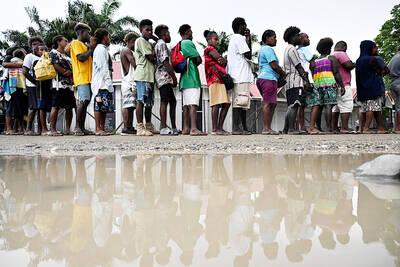
SEEKING CHANGE: A hospital worker said she did not vote in previous elections, but ‘now I can see that maybe my vote can change the system and the country’ Voting closed yesterday across the Solomon Islands in the south Pacific nation’s first general election since the government switched diplomatic allegiance from Taiwan to Beijing and struck a secret security pact that has raised fears of the Chinese navy gaining a foothold in the region. The Solomon Islands’ closer relationship with China and a troubled domestic economy weighed on voters’ minds as they cast their ballots. As many as 420,000 registered voters had their say across 50 national seats. For the first time, the national vote also coincided with elections for eight of the 10 local governments. Esther Maeluma cast her vote in the
Nearly half of China’s major cities are suffering “moderate to severe” levels of subsidence, putting millions of people at risk of flooding, especially as sea levels rise, according to a study of nationwide satellite data released yesterday. The authors of the paper, published by the journal Science, found that 45 percent of China’s urban land was sinking faster than 3mm per year, with 16 percent at more than 10mm per year, driven not only by declining water tables, but also the sheer weight of the built environment. With China’s urban population already in excess of 900 million people, “even a small portion

UNSETTLING IMAGES: The scene took place in front of TV crews covering the Trump trial, with a CNN anchor calling it an ‘emotional and unbelievably disturbing moment’ A man who doused himself in an accelerant and set himself on fire outside the courthouse where former US president Donald Trump is on trial has died, police said yesterday. The New York City Police Department (NYPD) said the man was declared dead by staff at an area hospital. The man was in Collect Pond Park at about 1:30pm on Friday when he took out pamphlets espousing conspiracy theories, tossed them around, then doused himself in an accelerant and set himself on fire, officials and witnesses said. A large number of police officers were nearby when it happened. Some officers and bystanders rushed

HYPOCRISY? The Chinese Ministry of Foreign Affairs yesterday asked whether Biden was talking about China or the US when he used the word ‘xenophobic’ US President Joe Biden on Wednesday called for a hike in steel tariffs on China, accusing Beijing of cheating as he spoke at a campaign event in Pennsylvania. Biden accused China of xenophobia, too, in a speech to union members in Pittsburgh. “They’re not competing, they’re cheating. They’re cheating and we’ve seen the damage here in America,” Biden said. Chinese steel companies “don’t need to worry about making a profit because the Chinese government is subsidizing them so heavily,” he said. Biden said he had called for the US Trade Representative to triple the tariff rates for Chinese steel and aluminum if Beijing was


 RSS
RSS