


Defense Minister Amir Peretz defied calls to resign and Prime Minister Ehud Olmert ignored them after the Israeli army chief of staff stepped down over the military's failure to stop Hezbollah rocket attacks from Lebanon last summer.
Public and political pressure on the two embattled leaders was noticeably building on Wednesday, reinforcing the feeling that Lieutenant General Dan Halutz was just the first to go.
A poll broadcast on Wednesday evening on Channel 10 TV showed that 69 percent wanted Olmert to resign and 85 percent hoped Peretz would quit. The Smith Research poll by telephone questioned 425 Israelis and quoted a margin of error of 4.8 percent.
"Halutz's resignation is a positive and unavoidable move," said Ophir Pines-Paz, a member of Peretz's Labor Party. "But the political leadership also has to take responsibility."
In Lebanon, Hezbollah legislator Hussein Haj Hassan called Halutz's resignation "the result of the defeat of the Israeli enemy in Lebanon." Demonstrators in Beirut, at their nightly anti-government protest, celebrated with fireworks when the announcement of Halutz's resignation was made.
In his first public comment since Halutz resigned, Peretz warned Israel's enemies, "Do not misinterpret the army chief's decision to resign as a sign of weakness."
Speaking on Wednesday evening in Haifa at a graduation ceremony for naval commanders, Peretz said Halutz's decision was "premature. I am sorry he won't be with us to complete the task" of restoring the army after the failures of the summer's war in Lebanon.
Peretz insisted that he would continue to guide the reforms -- instead of resigning. Olmert and Peretz hoped to pick a new army chief within days.
Halutz stepped down after internal army inquiries found widespread problems in the military's performance. Halutz, a decorated former combat pilot, had rejected calls to resign, defending the army's performance in Lebanon.
Israel launched the Lebanon war hours after Hezbollah guerrillas killed three Israeli soldiers and captured two others in a July 12 cross-border raid.
Critics say Olmert moved too hastily with a campaign that ended without achieving its declared aims -- recovering the captured soldiers and crushing Hezbollah. Soldiers returning from the battlefield said they were poorly trained, lacked basic ammunition and food supplies, and received conflicting orders from superiors.
Nearly 160 Israelis and more than 1,000 Lebanese died in the fighting, and many Israelis criticized the army's inability to stop Hezbollah from firing nearly 4,000 rockets into northern Israel. Analysts say that failure has dealt a major blow to the army's prestige in the Arab world and its ability to deter future attacks.
Olmert did not comment publicly about the resignation calls.
"It's business as usual in the prime minister's office," said Olmert's spokeswoman, Miri Eisin.
But pressure on Olmert and Peretz could increase ahead of the release of a wide-ranging government probe into the war. The investigative panel, focusing on the performance of military and political leaders, is expected to announce its conclusions in the coming weeks.
Even before the army commander's resignation, Olmert's public standing was scraping bottom. An opinion poll published last week showed his approval rating at just 14 percent, and said his Kadima Party would lose if new elections were held.
Peretz's public standing is equally dismal. The former union leader won the defense portfolio under a coalition deal with Olmert's Kadima Party, despite his scant military experience.
The war's many flaws only cemented sweeping doubts about his fitness to serve as defense minister, and he now faces multiple challenges to his leadership within his own Labor Party, which is set to hold primaries in May.
Nearly half of China’s major cities are suffering “moderate to severe” levels of subsidence, putting millions of people at risk of flooding, especially as sea levels rise, according to a study of nationwide satellite data released yesterday. The authors of the paper, published by the journal Science, found that 45 percent of China’s urban land was sinking faster than 3mm per year, with 16 percent at more than 10mm per year, driven not only by declining water tables, but also the sheer weight of the built environment. With China’s urban population already in excess of 900 million people, “even a small portion

UNSETTLING IMAGES: The scene took place in front of TV crews covering the Trump trial, with a CNN anchor calling it an ‘emotional and unbelievably disturbing moment’ A man who doused himself in an accelerant and set himself on fire outside the courthouse where former US president Donald Trump is on trial has died, police said yesterday. The New York City Police Department (NYPD) said the man was declared dead by staff at an area hospital. The man was in Collect Pond Park at about 1:30pm on Friday when he took out pamphlets espousing conspiracy theories, tossed them around, then doused himself in an accelerant and set himself on fire, officials and witnesses said. A large number of police officers were nearby when it happened. Some officers and bystanders rushed

HYPOCRISY? The Chinese Ministry of Foreign Affairs yesterday asked whether Biden was talking about China or the US when he used the word ‘xenophobic’ US President Joe Biden on Wednesday called for a hike in steel tariffs on China, accusing Beijing of cheating as he spoke at a campaign event in Pennsylvania. Biden accused China of xenophobia, too, in a speech to union members in Pittsburgh. “They’re not competing, they’re cheating. They’re cheating and we’ve seen the damage here in America,” Biden said. Chinese steel companies “don’t need to worry about making a profit because the Chinese government is subsidizing them so heavily,” he said. Biden said he had called for the US Trade Representative to triple the tariff rates for Chinese steel and aluminum if Beijing was
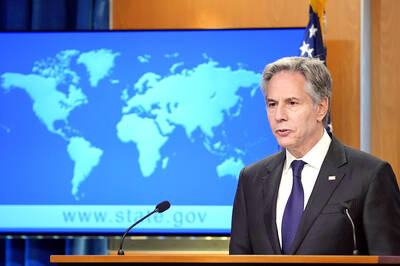
Beijing is continuing to commit genocide and crimes against humanity against Uyghurs and other Muslim minorities in its western Xinjiang province, U.S. Secretary of State Antony Blinken said in a report published on Monday, ahead of his planned visit to China this week. The State Department’s annual human rights report, which documents abuses recorded all over the world during the previous calendar year, repeated language from previous years on the treatment of Muslims in Xinjiang, but the publication raises the issue ahead of delicate talks, including on the war in Ukraine and global trade, between the top U.S. diplomat and Chinese


 RSS
RSS