


California Governor Arnold Schwar-zenegger proposed extending health coverage to California's 6.5 million uninsured residents, promising to spread the cost among businesses, individuals, hospitals, insurers and the government.
Schwarzenegger said his plan will save US$10 billion a year by cutting costs and redirecting money already in the health care system.
"My solution is that everyone in California must have health insurance," the governor said. "If you can't afford it, the state will help you buy it. But you must be insured. That is number one."
The US is among few developed countries without some form of federal universal health coverage. Early in the administration of President George W. Bush's predecessor, Bill Clinton, the administration recommended an elaborate plan for universal health coverage. Pilloried by huge amounts of advertising, much of it sponsored by the insurance industry, the plan went nowhere.
Under Schwarzenegger's state plan, all Californians would be required to have insurance, although plans for the poorest people would be subsidized. Businesses with 10 or more employees would have to offer insurance to workers or pay 4 percent of their payroll into a state fund. Smaller businesses, which the governor's office said make up 80 percent of California businesses, would be exempt.
Insurers will no longer be allowed to deny coverage to people because of their medical problems. And all children, regardless of immigration status, will be covered through an expansion of the state and federal Healthy Families program.
Last year, Massachusetts became the first state to require universal health insurance. Massachusetts companies must offer insurance to employees or pay into a state pool.
"This plan one-ups Massachusetts," said Peter Harbage, a health care consultant with the New America Foundation, a nonpartisan think tank.
"The governor has gone further and added doctors, hospitals and health plans" to those who must help pay, he said.
California would subsidize insurance for the estimated 1.2 million poor people who do not currently qualify for state health coverage. They would be able to buy insurance through a state-run pool and would have to make a small contribution toward their premiums. Californians who go uninsured will be subject to tax penalties.
The governor said savings created by his plan would offset new fees he is asking doctors and hospitals to pay -- 4 percent of revenue for hospitals and 2 percent for doctors.
The state also would increase what it pays doctors and hospitals through Medi-Cal, the state insurance plan for the poor.
Insurers, seeing the possibility of 4 million to 5 million new customers, praised the proposal, despite the new restrictions it places on them, such as limiting administrative costs.
But employers and doctors said they were being taxed to fund the plan, while unions protested that low-income workers would bear the brunt of the costs because they will be forced to buy insurance.
Fellow Republicans also reacted negatively.
"Imposing a new jobs tax on employers of any size and expanding costly government mandates is the wrong approach," Assembly Republican leader Mike Villines said in a statement.
Allan Zaremberg, executive officer of the California Chamber of Commerce, questioned whether businesses would be asked to pay more in the future as premiums rise.

Republican US lawmakers on Friday criticized US President Joe Biden’s administration after sanctioned Chinese telecoms equipment giant Huawei unveiled a laptop this week powered by an Intel artificial intelligence (AI) chip. The US placed Huawei on a trade restriction list in 2019 for contravening Iran sanctions, part of a broader effort to hobble Beijing’s technological advances. Placement on the list means the company’s suppliers have to seek a special, difficult-to-obtain license before shipping to it. One such license, issued by then-US president Donald Trump’s administration, has allowed Intel to ship central processors to Huawei for use in laptops since 2020. China hardliners
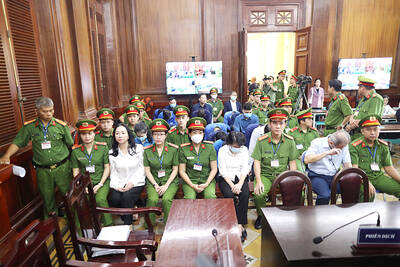
A top Vietnamese property tycoon was on Thursday sentenced to death in one of the biggest corruption cases in history, with an estimated US$27 billion in damages. A panel of three hand-picked jurors and two judges rejected all defense arguments by Truong My Lan, chair of major developer Van Thinh Phat, who was found guilty of swindling cash from Saigon Commercial Bank (SCB) over a decade. “The defendant’s actions ... eroded people’s trust in the leadership of the [Communist] Party and state,” read the verdict at the trial in Ho Chi Minh City. After the five-week trial, 85 others were also sentenced on

Conjoined twins Lori and George Schappell, who pursued separate careers, interests and relationships during lives that defied medical expectations, died this month in Pennsylvania, funeral home officials said. They were 62. The twins, listed by Guinness World Records as the oldest living conjoined twins, died on April 7 at the Hospital of the University of Pennsylvania, obituaries posted by Leibensperger Funeral Homes of Hamburg said. The cause of death was not detailed. “When we were born, the doctors didn’t think we’d make 30, but we proved them wrong,” Lori said in an interview when they turned 50, the Philadelphia Inquirer reported. The

RAMPAGE: A Palestinian man was left dead after dozens of Israeli settlers searching for a missing 14-year-old boy stormed a village in the Israeli-occupied West Bank US President Joe Biden on Friday said he expected Iran to attack Israel “sooner, rather than later” and warned Tehran not to proceed. Asked by reporters about his message to Iran, Biden simply said: “Don’t,” underscoring Washington’s commitment to defend Israel. “We are devoted to the defense of Israel. We will support Israel. We will help defend Israel and Iran will not succeed,” he said. Biden said he would not divulge secure information, but said his expectation was that an attack could come “sooner, rather than later.” Israel braced on Friday for an attack by Iran or its proxies as warnings grew of


 RSS
RSS