


The bound and gagged bodies of nine people have been found in a shallow grave in the violence-plagued state where Mexican President Felipe Calderon kicked off his crackdown on drug trafficking, officials said.
An anonymous call sent police to an abandoned warehouse in Uruapan, about 290km west of Mexico City in Michoacan state. There, officials removed a loose section of flooring and discovered the bodies, state prosecutor's office spokeswoman Magdalena Guzman said on Friday.
Officials on Thursday found the bodies of three men and one woman, their feet and hands tied together and their mouths covered with tape. The bodies of five other men were uncovered on Friday. All were in advanced stages of decomposition, indicating the victims had been killed some time ago.
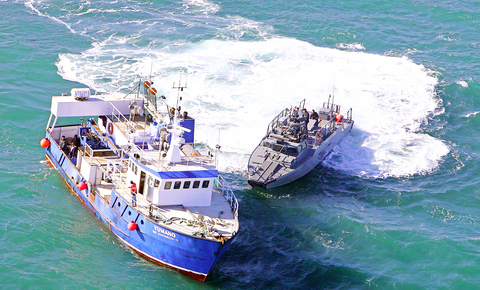
PHOTO: AFP
Guzman said the female victim was identified by family members as 29-year-old Perla Soledad Almanza Rodriguez.
Police arrested the owner of the warehouse, his wife and four other men and women who were in the building, the federal Public Safety Department announced in a news release late on Friday.
Last month, Calderon sent 7,000 troops to his native state of Michoacan. Uruapan itself has been the site of some of the most brutal slayings in Mexico, including a Sept. 6 attack in which gunmen dumped five severed human heads onto a bar dance floor.
Drug gangs are blamed for more than 2,000 murders nationwide last year and have left a particularly bloody trail in Michoacan and in the northern border city of Tijuana, where more than 300 people were slain last year.
Tijuana police stayed off of patrols on Friday morning after soldiers sent by Calderon to crack down on drug gangs and corruption there seized most of their guns for inspection.
Tijuana Public Safety Secretary Luis Javier Algorri said that without arms it was too dangerous for the force of 2,000 police to patrol the streets of the city, where 13 officers were shot dead last year.
"This is an unfortunate situation because it leaves agents defenseless and does not allow them to serve the community," Algorri said in a news conference.
By the evening, however, many officers returned to duty without guns but with support from armed state police, said municipal police spokesman Fernando Bojorquez.
Calderon sent 3,300 soldiers and federal police into Tijuana on Tuesday to hunt down drug gangs. The soldiers swept police stations and took officers' guns for inspection on Thursday amid federal investigators' allegations that a corrupt network of officers supports smugglers who traffic drugs into the US.
On Friday, soldiers monitored those leaving and entering Tijuana, while federal and state police manned checkpoints within the city limits.
The federal Attorney General's office also said that officials had arrested seven alleged kidnappers in the border city of Mexicali and freed three of their victims.
Officials in the Pacific states of Sinaloa and Guerrero, home to the resort of Acapulco, said on Friday that the offensive may reach their cities soon. Both states have been plagued by waves of killings blamed on drug gangs.
"It's possible that in the next few weeks, there will be similar operations in Guerrero. It depends on the results in Tijuana and Michoacan," Guerrero Secretary-General Armando Chavarria said.
Opposition politicians have expressed doubts that Calderon's highly publicized campaign will have much of an impact. Calderon took office on Dec. 1 promising to crack down on drug gangs and other organized crime.
His predecessor, Vicente Fox, also designated thousands of agents to fight drug trafficking, arresting several alleged kingpins during his six-year term. But those actions appeared to spark more violence as other traffickers battled to take over the smuggling routes of those killed or detained.
Nearly half of China’s major cities are suffering “moderate to severe” levels of subsidence, putting millions of people at risk of flooding, especially as sea levels rise, according to a study of nationwide satellite data released yesterday. The authors of the paper, published by the journal Science, found that 45 percent of China’s urban land was sinking faster than 3mm per year, with 16 percent at more than 10mm per year, driven not only by declining water tables, but also the sheer weight of the built environment. With China’s urban population already in excess of 900 million people, “even a small portion

‘IN A DIFFERENT PLACE’: The envoy first visited Shanghai, where he attended a Chinese basketball playoff match, and is to meet top officials in Beijing tomorrow US Secretary of State Antony Blinken yesterday arrived in China on his second visit in a year as the US ramps up pressure on its rival over its support for Russia while also seeking to manage tensions with Beijing. The US diplomat tomorrow is to meet China’s top brass in Beijing, where he is also expected to plead for restraint as Taiwan inaugurates president-elect William Lai (賴清德), and to raise US concerns on Chinese trade practices. However, Blinken is also seeking to stabilize ties, with tensions between the world’s two largest economies easing since his previous visit in June last year. At the

UNSETTLING IMAGES: The scene took place in front of TV crews covering the Trump trial, with a CNN anchor calling it an ‘emotional and unbelievably disturbing moment’ A man who doused himself in an accelerant and set himself on fire outside the courthouse where former US president Donald Trump is on trial has died, police said yesterday. The New York City Police Department (NYPD) said the man was declared dead by staff at an area hospital. The man was in Collect Pond Park at about 1:30pm on Friday when he took out pamphlets espousing conspiracy theories, tossed them around, then doused himself in an accelerant and set himself on fire, officials and witnesses said. A large number of police officers were nearby when it happened. Some officers and bystanders rushed

Beijing is continuing to commit genocide and crimes against humanity against Uyghurs and other Muslim minorities in its western Xinjiang province, U.S. Secretary of State Antony Blinken said in a report published on Monday, ahead of his planned visit to China this week. The State Department’s annual human rights report, which documents abuses recorded all over the world during the previous calendar year, repeated language from previous years on the treatment of Muslims in Xinjiang, but the publication raises the issue ahead of delicate talks, including on the war in Ukraine and global trade, between the top U.S. diplomat and Chinese


 RSS
RSS