


Four Japanese opposition parties yesterday submitted a motion of no-confidence against the government of Prime Minister Shinzo Abe over a series of staged public hearings, a move seen as a tactic to delay an education bill intended to boost patriotism in classrooms.
The move forced the ruling party to agree with opposition to extend the parliamentary session, initially scheduled to end yesterday, for another four days, to further discuss the bill.
The Democratic Party of Japan and three other parties also introduced a no-confidence motion at the lower house against Foreign Minister Taro Aso over recent remarks that Japan should debate acquiring nuclear weapons, according to the DPJ Web site.
Abe has come under fire after a commission found the government staged a series of public meetings on educational reform, with officials posing as ordinary citizens lobbing softball questions.
After the scandal broke on Wednesday, Abe and several top minister were forced to forfeit months of pay in penance, a painful blow to a new government that was already sliding in the popularity polls.
The no-confidence motion, which is expected to fail because Abe's ruling Liberal Democratic Party and its smaller coalition partner New Komeito dominate both houses of parliament, is seen as a tactic being used to delay a vote on the education bill.
Aso, meanwhile, has enraged the opposition and even those within the LDP by suggesting Japan should discuss developing a nuclear arsenal as a deterrent against a nuclear North Korea.
Meanwhile yesterday a full-fledged defense ministry was created in Japan for the first time since World War II, when the US stripped the defeated country of its right to a military.
The upper house voted to create the defense agency. The lower house had earlier passed the bill, meaning it becomes law, a parliamentary official said.
The reform would give Defense Agency Director General Fumio Kyuma the title of defense minister, although Japanese troops would still be called the "Self-Defense Forces."
Previous attempts to create a defense ministry stalled over political sensitivities in light of Japan's past aggression and fears of upsetting neighboring countries.

Republican US lawmakers on Friday criticized US President Joe Biden’s administration after sanctioned Chinese telecoms equipment giant Huawei unveiled a laptop this week powered by an Intel artificial intelligence (AI) chip. The US placed Huawei on a trade restriction list in 2019 for contravening Iran sanctions, part of a broader effort to hobble Beijing’s technological advances. Placement on the list means the company’s suppliers have to seek a special, difficult-to-obtain license before shipping to it. One such license, issued by then-US president Donald Trump’s administration, has allowed Intel to ship central processors to Huawei for use in laptops since 2020. China hardliners
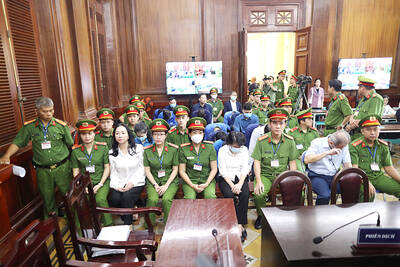
A top Vietnamese property tycoon was on Thursday sentenced to death in one of the biggest corruption cases in history, with an estimated US$27 billion in damages. A panel of three hand-picked jurors and two judges rejected all defense arguments by Truong My Lan, chair of major developer Van Thinh Phat, who was found guilty of swindling cash from Saigon Commercial Bank (SCB) over a decade. “The defendant’s actions ... eroded people’s trust in the leadership of the [Communist] Party and state,” read the verdict at the trial in Ho Chi Minh City. After the five-week trial, 85 others were also sentenced on

‘DELUSIONAL’: Targeting the families of Hamas’ leaders would not push the group to change its position or to give up its demands for Palestinians, Ismail Haniyeh said Israeli aircraft on Wednesday killed three sons of Hamas’ top political leader in the Gaza Strip, striking high-stakes targets at a time when Israel is holding delicate ceasefire negotiations with the militant group. Hamas said four of the leader’s grandchildren were also killed. Ismail Haniyeh’s sons are among the highest-profile figures to be killed in the war so far. Israel said they were Hamas operatives, and Haniyeh accused Israel of acting in “the spirit of revenge and murder.” The deaths threatened to strain the internationally mediated ceasefire talks, which appeared to gain steam in recent days even as the sides remain far

Conjoined twins Lori and George Schappell, who pursued separate careers, interests and relationships during lives that defied medical expectations, died this month in Pennsylvania, funeral home officials said. They were 62. The twins, listed by Guinness World Records as the oldest living conjoined twins, died on April 7 at the Hospital of the University of Pennsylvania, obituaries posted by Leibensperger Funeral Homes of Hamburg said. The cause of death was not detailed. “When we were born, the doctors didn’t think we’d make 30, but we proved them wrong,” Lori said in an interview when they turned 50, the Philadelphia Inquirer reported. The


 RSS
RSS