


A suicide car bomb exploded near a revered shrine in one of Iraq's holiest Shiite cities yesterday, killing eight people and wounding 36, police said, in an apparent attempt by Sunni Arab insurgents to cause another spike in Iraq's sectarian violence.
Tensions between Sunnis and the US-led coalition also rose yesterday when the Association of Muslim Scholars and the country's largest Sunni political party condemned a deadly US military attack in a Sunni-dominated area northwest of Baghdad. The US command has said Friday's raid and airstrike killed 20 insurgents, but the association and the Iraqi Islamic Party joined a village mayor who alleged that the attack killed civilians, including women and children.
Yesterday morning, about 1,000 residents of al-Ishaqi village in the volatile province of Salahuddin held a funeral for the 19 civilians they say were killed in the US attack, shouting slogans such as "Down with the occupiers," "Long live the resistance," and "There is no God but Allah."

PHOTO: AFP
The suicide car bomb exploded at 10:30am outside the al-Abbas shrine in Karbala, 80km south of Baghdad, said Rahman Meshawi, the city's police spokesman, who provided the casualty totals.
Karbala is considered Iraq's second holiest Shiite city after Najaf, which is 70km to the southeast. Shiites make pilgrimages to both locations and bury their dead in large cemeteries there.
During the Iraq war, a main goal of Sunni Arab insurgent groups such as al-Qaeda in Iraq has been to spark sectarian violence by attacking sites considered holy by the country's Shiite majority.
On Feb. 23, at least 136 Iraqis were killed in sectarian violence a day after an explosion destroyed the dome of a revered Shiite shrine in Samarra, 95km north of Baghdad.
On March 2, 2004, coordinated suicide bombings, mortar attacks and planted explosives struck Shiite shrines in Karbala and Baghdad, killing at least 181 Iraqis and wounding 573.
Attacks by Sunni insurgents and Shiite militias, and revenge killings in mixed Sunni-Shiite areas of cities such as Baghdad, often kill scores of Iraqis a day now.
On Friday night, a mortar attack by suspected Sunni insurgents on a poor Shiite neighborhood on the outskirts of Baghdad killed 25 people, police said.
The US military also announced that roadside bombs killed three US soldiers and wounded two in and around Baghdad, raising the war's US death toll to more than 2,920.
Friday's coalition attack was targeting al-Qaeda-linked militants in a predominantly Sunni area near Lake Tharthar in Salahuddin Province northwest of Baghdad, the US command said.
Ground forces returned fire when they were attacked while searching buildings, killing two insurgents, the US military said. Under continuing fire, the troops called in air support, killing 18 insurgents, the command said, adding that two women were among those killed.
"Al-Qaeda in Iraq has both men and women supporting and facilitating their operations unfortunately," it said.
Searching the area, the coalition forces found and destroyed several weapons caches, including AK-47s, machine guns, rocket-propelled grenades, anti-personnel mines, explosives, blasting caps and suicide vests, the command said.
Amir Fayadh, the mayor of the al-Ishaqi Village, and local police disputed the claim that the strike only killed insurgents, alleging that 19 civilians were among the dead. Fayadh said seven of those were women and eight were children.
Fayadh acknowledged yesterday that initial casualty reports from the scene had been too high, but he and Captain Mahmoud al-Daraji confirmed the final death toll of eight children, seven women and four men.
The residents holding yesterday's emotional funeral carried 19 coffins to a local cemetery on the rooftops of vehicles taking part in a procession.
On Friday, AP Television News video showed more than a dozen charred and bloody bodies, some of which appeared almost mummified with their faces unrecognizable. Angry villagers gathered around several of the bodies, which were covered in colorful wool blankets and laid out on the ground near the concrete rubble left by the devastated houses in the remote desert area.

Republican US lawmakers on Friday criticized US President Joe Biden’s administration after sanctioned Chinese telecoms equipment giant Huawei unveiled a laptop this week powered by an Intel artificial intelligence (AI) chip. The US placed Huawei on a trade restriction list in 2019 for contravening Iran sanctions, part of a broader effort to hobble Beijing’s technological advances. Placement on the list means the company’s suppliers have to seek a special, difficult-to-obtain license before shipping to it. One such license, issued by then-US president Donald Trump’s administration, has allowed Intel to ship central processors to Huawei for use in laptops since 2020. China hardliners
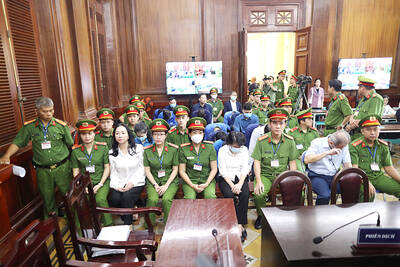
A top Vietnamese property tycoon was on Thursday sentenced to death in one of the biggest corruption cases in history, with an estimated US$27 billion in damages. A panel of three hand-picked jurors and two judges rejected all defense arguments by Truong My Lan, chair of major developer Van Thinh Phat, who was found guilty of swindling cash from Saigon Commercial Bank (SCB) over a decade. “The defendant’s actions ... eroded people’s trust in the leadership of the [Communist] Party and state,” read the verdict at the trial in Ho Chi Minh City. After the five-week trial, 85 others were also sentenced on

DISADVANTAGE: Erin O’Toole, who led the Conservatives during the election campaign in 2021, estimated that the interference cost his party as many as nine legislative seats Canada’s domestic spy agency on Monday concluded that China interfered in the past two elections, an official probe heard, the firmest evidence so far of suspected Chinese meddling in Canadian politics. Canadian Prime Minister Justin Trudeau’s Liberal Party won both the elections, held in 2019 and 2021. Under pressure from opposition lawmakers unhappy about media reports on China’s possible role, Trudeau set up a commission into foreign interference. The commission was shown a slide on Monday containing an extract of a briefing in February last year from the Canadian Security Intelligence Service (CSIS). “We know that the PRC [People’s Republic of China] clandestinely

‘DELUSIONAL’: Targeting the families of Hamas’ leaders would not push the group to change its position or to give up its demands for Palestinians, Ismail Haniyeh said Israeli aircraft on Wednesday killed three sons of Hamas’ top political leader in the Gaza Strip, striking high-stakes targets at a time when Israel is holding delicate ceasefire negotiations with the militant group. Hamas said four of the leader’s grandchildren were also killed. Ismail Haniyeh’s sons are among the highest-profile figures to be killed in the war so far. Israel said they were Hamas operatives, and Haniyeh accused Israel of acting in “the spirit of revenge and murder.” The deaths threatened to strain the internationally mediated ceasefire talks, which appeared to gain steam in recent days even as the sides remain far


 RSS
RSS