


No one will ever know how many Chinese men -- and women -- were sexually satisfied after taking the American Number One, Male Exclusive, Great Big Brother pills sold by Xi Yongli.
When the product was raised in court recently, it was not its potency that was on trial. Rather, it was the legality of using a drug better known as Viagra.
In the latest case to highlight the rampant piracy in China's pharmaceutical industry, Xi and his accomplices were found guilty of making 60 tonnes of pills without a license or the permission of Pfizer -- the US company that has the patent on Viagra's active ingredient, sildenafil citrate.
According to reports by the Xinhua state news agency, Xi and his gang rented an old pharmaceutical factory in Bangbu City, Anhui Province, in May 2001. Although he registered the business as a food company, Xi bought bulk supplies of sildenafil and mixed them with sugar and other ingredients to make pills and capsules. By the time he was caught in October last year, the company had sold more than 21 million yuan (US$2.7 million) worth of drugs, almost half of which was profit for Xi.
The Bangbu intermediate court sentenced Xi to eight years in prison at the end of a widely publicized case that was hailed by the authorities as a sign that China is getting tough on counterfeiters. But trade negotiators and medical experts warn that the problem of pirated drugs continues to be a largely hidden epidemic with dire consequences not just for business but for health.
Last month EU Trade Commissioner Peter Mandelson revealed that fake birth control pills and HIV retroviral drugs from China had been seized by European customs officers. This year the US Federal Drug Administration intercepted 51 shipments of Chinese-made counterfeit Tamiflu -- the most popular drug for the treatment and prophylaxis of bird flu.
The consequences can be deadly. In May, 11 people were killed by antibiotics made in Heilongjiang. The manufacturers had mistakenly added diethylene glycol, an industrial toxin, to the ingredients. Last year, the media in Guangdong reported the deaths of two boys from rabies, against which their parents thought they had been inoculated until police found fake vaccine. A year before, at least 50 babies in Anhui Province died after being fed fake milk formula, which had only six percent of the vitamins and minerals needed for a growing infant.
The worst affected are the poor, who look for the cheapest products and have the least safety information. According to the WHO, less than 1 percent of drugs in wealthy nations are fake. In developing countries, the proportion can reach 30 percent. A Lancet study found a third of anti-malarial drugs in Cambodia, Laos, Burma, Thailand and Vietnam had no active ingredient.
Many of those fake products have been traced back to China, which along with India and Russia are thought to be the biggest suppliers in the world. It is a huge market. The US Center for Medicines in the Public Interest predicts that global sales of counterfeit drugs will reach US$75 billion in 2010 -- an increase of more than 90 percent from last year.
According to official figures, China investigated 310,000 reports of counterfeit drugs last year, worth about 51 million yuan, and destroyed 530 factories. A 50,000-yuan reward is on offer for information about drug piracy.
But huge loopholes remain. As well as 4,850 registered pharmaceutical companies in China, there are still countless illegal plants operating in much the same way as Xi's "food factory." The worst consequences will be a lot more serious than erectile dysfunction.

Republican US lawmakers on Friday criticized US President Joe Biden’s administration after sanctioned Chinese telecoms equipment giant Huawei unveiled a laptop this week powered by an Intel artificial intelligence (AI) chip. The US placed Huawei on a trade restriction list in 2019 for contravening Iran sanctions, part of a broader effort to hobble Beijing’s technological advances. Placement on the list means the company’s suppliers have to seek a special, difficult-to-obtain license before shipping to it. One such license, issued by then-US president Donald Trump’s administration, has allowed Intel to ship central processors to Huawei for use in laptops since 2020. China hardliners
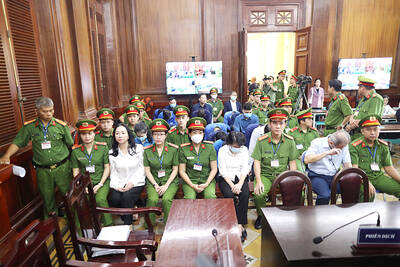
A top Vietnamese property tycoon was on Thursday sentenced to death in one of the biggest corruption cases in history, with an estimated US$27 billion in damages. A panel of three hand-picked jurors and two judges rejected all defense arguments by Truong My Lan, chair of major developer Van Thinh Phat, who was found guilty of swindling cash from Saigon Commercial Bank (SCB) over a decade. “The defendant’s actions ... eroded people’s trust in the leadership of the [Communist] Party and state,” read the verdict at the trial in Ho Chi Minh City. After the five-week trial, 85 others were also sentenced on

Conjoined twins Lori and George Schappell, who pursued separate careers, interests and relationships during lives that defied medical expectations, died this month in Pennsylvania, funeral home officials said. They were 62. The twins, listed by Guinness World Records as the oldest living conjoined twins, died on April 7 at the Hospital of the University of Pennsylvania, obituaries posted by Leibensperger Funeral Homes of Hamburg said. The cause of death was not detailed. “When we were born, the doctors didn’t think we’d make 30, but we proved them wrong,” Lori said in an interview when they turned 50, the Philadelphia Inquirer reported. The
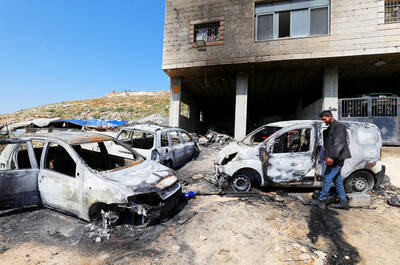
RAMPAGE: A Palestinian man was left dead after dozens of Israeli settlers searching for a missing 14-year-old boy stormed a village in the Israeli-occupied West Bank US President Joe Biden on Friday said he expected Iran to attack Israel “sooner, rather than later” and warned Tehran not to proceed. Asked by reporters about his message to Iran, Biden simply said: “Don’t,” underscoring Washington’s commitment to defend Israel. “We are devoted to the defense of Israel. We will support Israel. We will help defend Israel and Iran will not succeed,” he said. Biden said he would not divulge secure information, but said his expectation was that an attack could come “sooner, rather than later.” Israel braced on Friday for an attack by Iran or its proxies as warnings grew of


 RSS
RSS