


Mario Scaramella, who met with former Russian spy Alexander Litvinenko on the day he fell ill, said he had five times the amount of the radioactive substance polonium considered deadly in his body, as British police officers prepared yesterday to travel to Russia to continue their inquiry.
Scaramella, an Italian self-styled security expert who met with the former spy at a central London sushi bar on Nov. 1, three weeks before Litvinenko died, was said to be "well" in University College Hospital (UCH).
"I have an amount of polonium in my body which is five times higher than the dose considered deadly," he said in a telephone interview which was aired by Italy's RAI 1 television.
The Italian "remains well, the results of his pathology tests to date remain normal," said a spokesman for UCH, where Litvinenko died on Nov. 23, with large quantities of polonium-210 in his urine.
Scaramella's lawyer Sergio Rastrelli said his client had either "ingested or inhaled" the polonium and had not been contaminated by Litvinenko.
Meanwhile, police confirmed that counter-terrorism officers were expected to leave for Moscow "very soon," and the BBC said nine officers could travel to Russia as early as yesterday.
A spokesman for London's Metropolitan Police, however, declined to comment.
According to a report in the Guardian on Monday, the officers were to interview the three Russian men who met Litvinenko on the same day as the ex-spy's meeting with Scaramella, about three weeks before he eventually died.
The three men -- Andrei Lugovoi, Dmitri Kovtun and Vyacheslav Sokolenko -- have all protested their innocence, and Lugovoi has said that he believes they are being framed by the real culprit.
Former KGB man Lugovoi denied involvement in any plot against Litvinenko, telling the Sunday Times: "We suspect that someone has been trying to frame us.
The Guardian also reported that police wanted to interview two other men in Moscow -- whose names have not yet appeared in public -- who may have met with Litvinenko on a trip to London.
Home Secretary John Reid said he was confident London was getting the necessary assistance from Moscow on the former Russian agent issue.
But as the police probe into Litvinenko's mysterious radiation poisoning entered its third week, reports said Britain feared a long-term diplomatic fall-out with Russia from the affair.
Reid, who was to meet European counterparts in Brussels yesterday and today, vowed that all information would be followed up wherever it led.
"Over the next few days, I think all of these things will widen out a little from the circle just being here in Britain," he told Sky News television.
The Sunday Times reported that British Foreign Secretary Margaret Beckett had told senior ministers that Russian President Vladimir Putin had expressed his discontent at Britain's failure to gag Litvinenko after he was poisoned.
The former Russian agent wrote a letter on his death-bed which pointed the finger directly at Putin, whom he described as "barbaric and ruthless".
Foreign Office officials later confirmed that Russia had raised the letter with Beckett.

Republican US lawmakers on Friday criticized US President Joe Biden’s administration after sanctioned Chinese telecoms equipment giant Huawei unveiled a laptop this week powered by an Intel artificial intelligence (AI) chip. The US placed Huawei on a trade restriction list in 2019 for contravening Iran sanctions, part of a broader effort to hobble Beijing’s technological advances. Placement on the list means the company’s suppliers have to seek a special, difficult-to-obtain license before shipping to it. One such license, issued by then-US president Donald Trump’s administration, has allowed Intel to ship central processors to Huawei for use in laptops since 2020. China hardliners
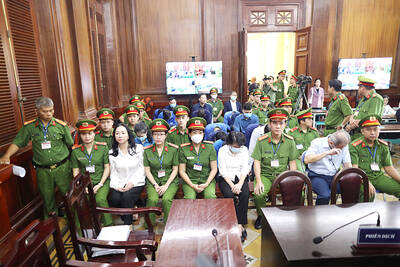
A top Vietnamese property tycoon was on Thursday sentenced to death in one of the biggest corruption cases in history, with an estimated US$27 billion in damages. A panel of three hand-picked jurors and two judges rejected all defense arguments by Truong My Lan, chair of major developer Van Thinh Phat, who was found guilty of swindling cash from Saigon Commercial Bank (SCB) over a decade. “The defendant’s actions ... eroded people’s trust in the leadership of the [Communist] Party and state,” read the verdict at the trial in Ho Chi Minh City. After the five-week trial, 85 others were also sentenced on

‘DELUSIONAL’: Targeting the families of Hamas’ leaders would not push the group to change its position or to give up its demands for Palestinians, Ismail Haniyeh said Israeli aircraft on Wednesday killed three sons of Hamas’ top political leader in the Gaza Strip, striking high-stakes targets at a time when Israel is holding delicate ceasefire negotiations with the militant group. Hamas said four of the leader’s grandchildren were also killed. Ismail Haniyeh’s sons are among the highest-profile figures to be killed in the war so far. Israel said they were Hamas operatives, and Haniyeh accused Israel of acting in “the spirit of revenge and murder.” The deaths threatened to strain the internationally mediated ceasefire talks, which appeared to gain steam in recent days even as the sides remain far
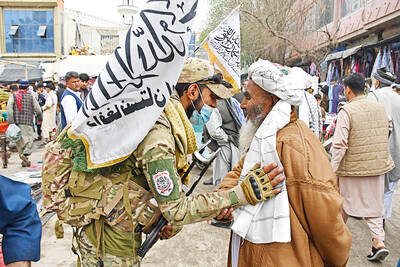
The Taliban’s reclusive supreme leader made a rare public appearance yesterday, an Afghan government spokesman said, leading thousands of worshipers in prayers marking Eid al-Fitr. Hibatullah Akhundzada has made only a handful of public appearances since inheriting the leadership of the Taliban in 2016 and leading the movement back to power with the withdrawal of US forces in 2021. Taliban government spokesman Zabihullah Mujahid said prayer in the largest mosque in Kandahar was “performed under the leadership of the supreme leader.” In a statement on X, he said the early-morning service “was attended by thousands of compatriots” in the southern province considered the


 RSS
RSS