


British Prime Minister Tony Blair was set to promise yesterday to cut the number of operational nuclear warheads on Britain's Trident submarines by a fifth, from 200 to about 160.
The reduction is part of Blair's campaign to persuade MPs that the government must start work almost immediately on plans detailed in a white paper to build a replacement fleet.
One less trident
Blair was scheduled to announce the Cabinet's decision in the House of Commons yesterday afternoon and was also expected to say that the number of new Trident submarines could be reduced from four to three without reducing the UK deterrent's effectiveness.
The white paper also also said that the new Trident system will cost less than £25 billion (US$49.3 billion) -- 5 percent of the annual defense budget and about 0.1 percent of GDP, government sources said yesterday.
Some ministers have rejected claims that Britain no longer needs nuclear weapons to deter potential enemies and have embraced the "insurance policy" argument that it is impossible to predict the shape of threats in 20 years.
The promised reduction in Trident, whose warheads will have been halved from 300 since 1997 when Labour came to power, is unlikely to appease critics of nuclear weapons or MPs in all parties who challenge Downing Street's view that Trident must not only be renewed, but that a decision is urgent.
With a public debate followed by a Commons vote in February set to follow the white paper, ministers hope they will win the vote comfortably. But they accept they will need Conservative party support to push the measure through.
Up to 40 Labour MPs oppose nuclear weapons but the key group Blair seeks to persuade, however, are those -- including the Liberal Democrats -- who think there is no need to take an early decision. The Tories remain pro-deterrent but their defense spokesman, Liam Fox, said yesterday they will only "replace it when necessary."
One Labour minister seemed confident that the government's view would prevail.
"There will be some trouble in the parliamentary party. My activists will not want it either, but they will not object to it," the minister said.
The white paper also rejects arguments urging a delay on a decision to commission new submarines by at least five years, as the Liberal Democrat leader, Menzies Campbell, and many independent analysts have proposed.
Given the long lead times between decisions and operational availability -- 14 years between the Trident decision and the day it replaced Polaris -- it would be too risky. Delay would also not be cost effective, mainly because nuclear reactors which propel the current boats need replacing soon.
The white paper said that a sea-based system is the only "credible" nuclear deterrent available, rejecting arguments for a land-based cruise missile system.
The government has also rejected the argument that a Trident submarine need not be continuously at sea.
Instead it suggests that advances in technology may allow Britain to manage on three rather than four submarines, a decision which would also save up to £2 billion.
Protests
Anti-nuclear campaigners intended to step up their protest to coincide with the presentation of the white paper.
The Campaign for Nuclear Disarmament, accompanied by a number of MPs, were scheduled to hand an alternative white paper to the prime minister's office at No 10 Downing Street and express concern about the amount of time being given to discuss the issue.

Republican US lawmakers on Friday criticized US President Joe Biden’s administration after sanctioned Chinese telecoms equipment giant Huawei unveiled a laptop this week powered by an Intel artificial intelligence (AI) chip. The US placed Huawei on a trade restriction list in 2019 for contravening Iran sanctions, part of a broader effort to hobble Beijing’s technological advances. Placement on the list means the company’s suppliers have to seek a special, difficult-to-obtain license before shipping to it. One such license, issued by then-US president Donald Trump’s administration, has allowed Intel to ship central processors to Huawei for use in laptops since 2020. China hardliners
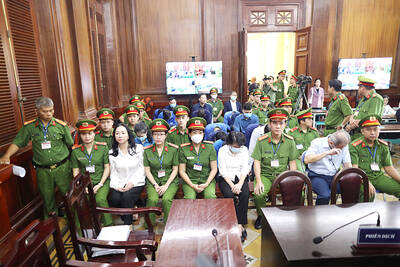
A top Vietnamese property tycoon was on Thursday sentenced to death in one of the biggest corruption cases in history, with an estimated US$27 billion in damages. A panel of three hand-picked jurors and two judges rejected all defense arguments by Truong My Lan, chair of major developer Van Thinh Phat, who was found guilty of swindling cash from Saigon Commercial Bank (SCB) over a decade. “The defendant’s actions ... eroded people’s trust in the leadership of the [Communist] Party and state,” read the verdict at the trial in Ho Chi Minh City. After the five-week trial, 85 others were also sentenced on

Conjoined twins Lori and George Schappell, who pursued separate careers, interests and relationships during lives that defied medical expectations, died this month in Pennsylvania, funeral home officials said. They were 62. The twins, listed by Guinness World Records as the oldest living conjoined twins, died on April 7 at the Hospital of the University of Pennsylvania, obituaries posted by Leibensperger Funeral Homes of Hamburg said. The cause of death was not detailed. “When we were born, the doctors didn’t think we’d make 30, but we proved them wrong,” Lori said in an interview when they turned 50, the Philadelphia Inquirer reported. The

RAMPAGE: A Palestinian man was left dead after dozens of Israeli settlers searching for a missing 14-year-old boy stormed a village in the Israeli-occupied West Bank US President Joe Biden on Friday said he expected Iran to attack Israel “sooner, rather than later” and warned Tehran not to proceed. Asked by reporters about his message to Iran, Biden simply said: “Don’t,” underscoring Washington’s commitment to defend Israel. “We are devoted to the defense of Israel. We will support Israel. We will help defend Israel and Iran will not succeed,” he said. Biden said he would not divulge secure information, but said his expectation was that an attack could come “sooner, rather than later.” Israel braced on Friday for an attack by Iran or its proxies as warnings grew of


 RSS
RSS