


The Red Cross sent out an urgent plea for water, food and medicine yesterday as Philippine officials said more than 1,000 people were dead or missing after mudslides swallowed whole villages.
The government's National Disaster Coordinating Center (NDCC) confirmed 425 dead from the mudslides around Mayon volcano triggered by typhoon rains. It listed a further 599 people as missing in the rest of the Bicol region.
Executive officer Glenn Rabonza said more than one million people had been affected by the disaster with damage to property alone estimated at about 274 million pesos (US$5.48 million).
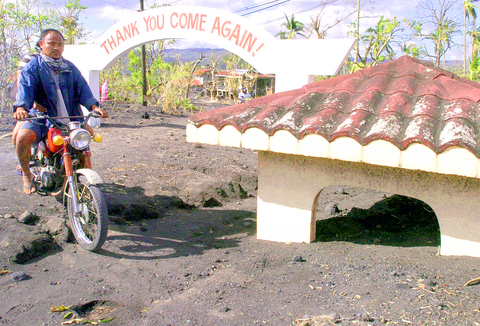
PHOTO: AFP
Philippine President Gloria Arroyo has declared a "state of national calamity" and authorized the immediate release of a billion pesos (US$20 million) to rehabilitate affected areas.
"We are receiving donations from international organizations at this point as we continue to estimate the cost of this disaster," Benjamin Delfin, a local Red Cross official, said.
"What we need now are medicines, food and items such as blankets, water and plastic sheeting for those who lost their homes," he said.
Philippine military aircraft have been ferrying supplies from Manila to the provincial capital Legazpi.
The NDCC said humanitarian aid is expected from Japan, Indonesia and Malaysia while cash is being sent from the UN and the governments of Canada and Australia.
In the village of Maipon, men returned to dig out valuables from their homes.
Like so many towns and villages around Mayon, it was reduced to rubble by the torrent of mud -- estimated to be 3.7 meters thick -- that crashed into the town carrying with it boulders as big as cars.
As of yesterday morning there were no rescue teams or heavy earth moving equipment. A stream marked where the main road used to be.
All that was left was the village's welcome arch over its main street.
"There is nothing left here, there are no neighbors left," said Josefina Olander, 66, who saved some 50 people after she told them to clamber up the roof of her two-storey concrete home.
"Those lucky to be alive are either injured or grieving," she said.
All 10 members of her family are alive, but the bottom half of the house is now underground.
"Mayon gave us fertile land to till. It took it back in an instant," she added.
Canine search team leader Marvy Umali, who conducted a sweep of one section of Maipon two days ago, said 16 bodies were recovered.
"The dogs had a hard time because the site is contaminated. There are dead animals as well as humans," he said.
Richard Gordon, the National Red Cross president, said on Sunday that he expected the death toll could pass 1,000 as hopes faded of finding further survivors.
"It is important we recover as much as we can ... but at some point we have to declare closure and declare a mass grave over the area," he said in radio interviews.
Many villages have not yet reported how many residents have died. In some cases, whole families have been buried.
In various parts of the Bicol region, southeast of Manila, communities have resorted to mass burials to deal with the scores of unclaimed bodies that were starting to decompose.
Power, communications and water remained out of service across most of the region, further hampering the efforts of relief teams, as more tales of tragedy and loss came in.

Republican US lawmakers on Friday criticized US President Joe Biden’s administration after sanctioned Chinese telecoms equipment giant Huawei unveiled a laptop this week powered by an Intel artificial intelligence (AI) chip. The US placed Huawei on a trade restriction list in 2019 for contravening Iran sanctions, part of a broader effort to hobble Beijing’s technological advances. Placement on the list means the company’s suppliers have to seek a special, difficult-to-obtain license before shipping to it. One such license, issued by then-US president Donald Trump’s administration, has allowed Intel to ship central processors to Huawei for use in laptops since 2020. China hardliners

Conjoined twins Lori and George Schappell, who pursued separate careers, interests and relationships during lives that defied medical expectations, died this month in Pennsylvania, funeral home officials said. They were 62. The twins, listed by Guinness World Records as the oldest living conjoined twins, died on April 7 at the Hospital of the University of Pennsylvania, obituaries posted by Leibensperger Funeral Homes of Hamburg said. The cause of death was not detailed. “When we were born, the doctors didn’t think we’d make 30, but we proved them wrong,” Lori said in an interview when they turned 50, the Philadelphia Inquirer reported. The
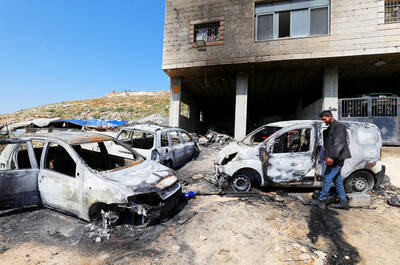
RAMPAGE: A Palestinian man was left dead after dozens of Israeli settlers searching for a missing 14-year-old boy stormed a village in the Israeli-occupied West Bank US President Joe Biden on Friday said he expected Iran to attack Israel “sooner, rather than later” and warned Tehran not to proceed. Asked by reporters about his message to Iran, Biden simply said: “Don’t,” underscoring Washington’s commitment to defend Israel. “We are devoted to the defense of Israel. We will support Israel. We will help defend Israel and Iran will not succeed,” he said. Biden said he would not divulge secure information, but said his expectation was that an attack could come “sooner, rather than later.” Israel braced on Friday for an attack by Iran or its proxies as warnings grew of

A prominent Christian leader has allegedly been stabbed at the altar during a Mass yesterday in southwest Sydney. Bishop Mar Mari Emmanuel was saying Mass at Christ The Good Shepherd Church in Wakeley just after 7pm when a man approached him at the altar and allegedly stabbed toward his head multiple times. A live stream of the Mass shows the congregation swarm forward toward Emmanuel before it was cut off. The church leader gained prominence during the COVID-19 pandemic, amassing a large online following, Officers attached to Fairfield City police area command attended a location on Welcome Street, Wakeley following reports a number


 RSS
RSS