


Voting for the student government at Gaza City's Al-Azhar University was proceeding smoothly on a recent autumn morning until a pushing match erupted outside a polling booth.
Kalashnikovs appeared seemingly from nowhere as gunmen stormed onto the campus. At the front gate, security guards ducked for cover instead of checking IDs. Panicked students scrambled for shelter beneath bursts of automatic gunfire.
The Gaza Strip is an overcrowded tinderbox of discontent and desperation, which is bubbling up in the territory's universities.
"The university is not like it used to be," says Iman Abu Amra, 22, the favored candidate for student body president in last week's election.
"Nowadays, politics is more important than classes and education," she adds.
Palestinian universities are traditional bellwethers of public opinion and political winds.
In Gaza, plagued by lawlessness and infighting between the ousted Fatah party of Palestinian President Mahmud Abbas and the ruling Hamas movement, the universities reflect the violent schisms.
This is nowhere more clearly apparent than at Gaza City's Al-Azhar University and its neighbor, the Islamic University.
Founded by the late Palestinian president Yasser Arafat, Al-Azhar is a Fatah stronghold. Next door, the Islamic University is Hamas country.
"At the Islamic University they put so much religious pressure on their students and the self-repression is great," charges Nora al-Masri, a Fatah student activist milling about the courtyard of Al-Azhar.
Next door, they have a different take.
"Our blood is green," says Islamic University student council president Sherif Abu Shamala, referring to the color of the ruling Islamist movement Hamas. "If you want a good education, you study here."
Dozens of windows at the Islamic University remain shattered from a recent battle sparked by an inflammatory speech by exiled Hamas leader Khaled Meshaal in Damascus.
Stones and fists soon turned to guns, and before the dust had settled, a rocket-propelled grenade slammed into an Al-Azhar classroom.
"This isn't just a game," Shamala says. "University students represent an educated and influential segment of Palestinian society. Revolutions the world over began with the students."
Indeed, the now-ruling Hamas got its start as a campus charity organization at the Islamic University in the late 1970s.
The school's long-time president, Mohammed Shubair, has been tapped by Hamas to succeed Ismail Haniya as Palestinian prime minister in a prospective unity government.
The most recent flare-up between the neighboring universities began earlier this month when the sliver of Fatah students at the Islamic University wanted to mark the second anniversary of Arafat's death with a campus rally.
But the school's student body, controlled by Hamas, rejected their application.
After the first day of voting -- for the 11 male student council members -- Fatah supporters surged through the city's streets firing their Kalashnikovs indiscriminately skyward, hailing their victory.
Last Wednesday, on day two of the vote -- for the 11 female council members -- Hamas was nowhere to be found. Then, a scuffle broke out and minutes later bullets were flying.
A Fatah student leader who won a seat in the previous day's vote was left unconscious and bleeding. Someone had slammed a steel pipe into his skull.

Conjoined twins Lori and George Schappell, who pursued separate careers, interests and relationships during lives that defied medical expectations, died this month in Pennsylvania, funeral home officials said. They were 62. The twins, listed by Guinness World Records as the oldest living conjoined twins, died on April 7 at the Hospital of the University of Pennsylvania, obituaries posted by Leibensperger Funeral Homes of Hamburg said. The cause of death was not detailed. “When we were born, the doctors didn’t think we’d make 30, but we proved them wrong,” Lori said in an interview when they turned 50, the Philadelphia Inquirer reported. The
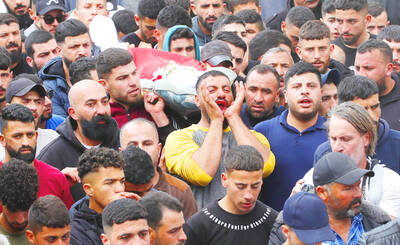
IN PURSUIT: Israel’s defense minister said the revenge attacks by Israeli settlers would make it difficult for security forces to find those responsible for the 14-year-old’s death Israeli Prime Minister Benjamin Netanyahu on Saturday condemned the “heinous murder” of an Israeli teenager in the occupied West Bank as attacks on Palestinian villages intensified following news of his death. After Benjamin Achimeir, 14, was reported missing near Ramallah on Friday, hundreds of Jewish settlers backed by Israeli forces raided nearby Palestinian villages, torching vehicles and homes, leaving at least one villager dead and dozens wounded. The attacks escalated in several villages on Saturday after Achimeir’s body was found near the Malachi Hashalom outpost. Agence France-Presse correspondents saw smoke rising from burned houses and fields. Mayor Amin Abu Alyah, of the
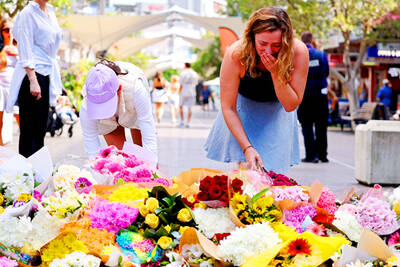
Australian police yesterday said a 40-year-old itinerant with mental illness was behind a Sydney shopping center stabbing rampage that killed six people, including a new mum whose nine-month-old baby is still in hospital with serious wounds. New South Wales Police Assistant Commissioner Anthony Cooke said the assailant — who was shot and killed by a senior police officer at the scene on Saturday — was Queensland man Joel Cauchi. Five women and one male security guard were killed in the attack as Cauchi roved through a packed shopping center in the city’s Bondi Junction neighborhood with a large knife. Twelve more people
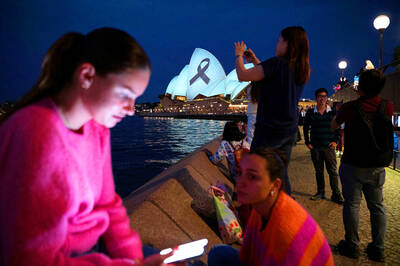
A prominent Christian leader has allegedly been stabbed at the altar during a Mass yesterday in southwest Sydney. Bishop Mar Mari Emmanuel was saying Mass at Christ The Good Shepherd Church in Wakeley just after 7pm when a man approached him at the altar and allegedly stabbed toward his head multiple times. A live stream of the Mass shows the congregation swarm forward toward Emmanuel before it was cut off. The church leader gained prominence during the COVID-19 pandemic, amassing a large online following, Officers attached to Fairfield City police area command attended a location on Welcome Street, Wakeley following reports a number


 RSS
RSS