


Major storms have battered the Philippines time and again this year. Typhoon Durian was the fourth "super" typhoon in four months to hit the country, swamping the Mayon volcano with so much wind and rain that ash and boulders cascaded down its slopes in walls of mud that swamped entire villages.
More than 200 people were killed, and some 260 were listed as missing. Sadly, the scale of the calamity is far too common.
Doomed by geography and hobbled by poverty, the Philippines has long tried to minimize the damage caused by the 20 or so typhoons that hit the sprawling archipelago every year. Despite a combination of preparation and mitigation measures, high death tolls and destruction persist.
The Philippines' location in the northwestern Pacific puts it right in the pathway of the world's biggest typhoon generator, according to meteorologists.
"We are often the first to experience typhoons before they go to China, Taiwan and Japan," Thelma Cinco, senior weather specialist of the Philippine weather bureau, said.
Durian punched the Bicol region -- which has gained a reputation as the welcome mat for the most destructive cyclones -- with gusts of up to 265kph that blew away roofs, toppled trees, power and communication lines and sent tonnes of rocks and volcanic ash down the slopes of Mayon, the region's most famous landmark.
Nationwide in 2001 to 2005, 2,892 people were killed and 909 others went missing in typhoons and other storms, which caused damage totaling 26.05 billion pesos (US$521 million), the National Disaster Coordinating Council says.
But how can Filipinos deal with all of these typhoons?
"The country would need a big umbrella," Golez quipped.
"Figuratively, that umbrella is the knowledge that we should instill in our people -- knowing about disaster preparedness," he said.
He believes Filipinos should be "bombarded" with disaster information, including stories of the Indian Ocean tsunami two years ago and the February landslide in the central Philippine village of Guinsaugon that killed more than 1,000.
"They have to get scared, or else," he said.
"We have to give them the reality, and it's a sad reality. We have to tell them the truth," he added.
But work should go beyond preparedness, Golez said. Too many people live close to danger zones like mountainsides or riverbanks.
"They are pushed there because they do not have any choice. If you develop their economy, then they would have more options," he said.
Senator Richard Gordon, who heads the Philippine National Red Cross, said better planning is what is required.
"We have to break the cycle of disaster and poverty by being smarter, by being sure we can plan our community smarter," he said.
"The big problem here in our country is we don't plan our communities. It's every man for himself," he added.
Mayor Jessie Robredo of Naga city in Camarines Sur, a province in Bicol often hit by typhoons, said his people are used to the yearly storms and began bracing for Durian a week before it arrived. The result was "zero casualty" this time, he said.
"The people of Naga are very resilient. Typhoons are like a way of life, a part of life. We do not like them, but our attitude is that there is still another day and we will rise again," he said.

Republican US lawmakers on Friday criticized US President Joe Biden’s administration after sanctioned Chinese telecoms equipment giant Huawei unveiled a laptop this week powered by an Intel artificial intelligence (AI) chip. The US placed Huawei on a trade restriction list in 2019 for contravening Iran sanctions, part of a broader effort to hobble Beijing’s technological advances. Placement on the list means the company’s suppliers have to seek a special, difficult-to-obtain license before shipping to it. One such license, issued by then-US president Donald Trump’s administration, has allowed Intel to ship central processors to Huawei for use in laptops since 2020. China hardliners
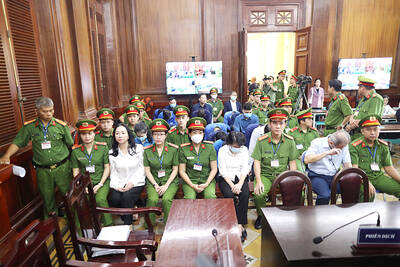
A top Vietnamese property tycoon was on Thursday sentenced to death in one of the biggest corruption cases in history, with an estimated US$27 billion in damages. A panel of three hand-picked jurors and two judges rejected all defense arguments by Truong My Lan, chair of major developer Van Thinh Phat, who was found guilty of swindling cash from Saigon Commercial Bank (SCB) over a decade. “The defendant’s actions ... eroded people’s trust in the leadership of the [Communist] Party and state,” read the verdict at the trial in Ho Chi Minh City. After the five-week trial, 85 others were also sentenced on

Conjoined twins Lori and George Schappell, who pursued separate careers, interests and relationships during lives that defied medical expectations, died this month in Pennsylvania, funeral home officials said. They were 62. The twins, listed by Guinness World Records as the oldest living conjoined twins, died on April 7 at the Hospital of the University of Pennsylvania, obituaries posted by Leibensperger Funeral Homes of Hamburg said. The cause of death was not detailed. “When we were born, the doctors didn’t think we’d make 30, but we proved them wrong,” Lori said in an interview when they turned 50, the Philadelphia Inquirer reported. The
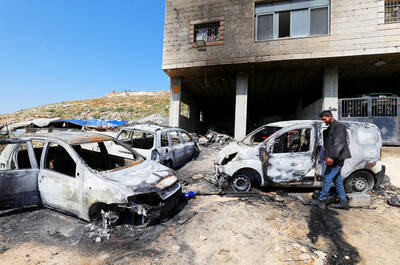
RAMPAGE: A Palestinian man was left dead after dozens of Israeli settlers searching for a missing 14-year-old boy stormed a village in the Israeli-occupied West Bank US President Joe Biden on Friday said he expected Iran to attack Israel “sooner, rather than later” and warned Tehran not to proceed. Asked by reporters about his message to Iran, Biden simply said: “Don’t,” underscoring Washington’s commitment to defend Israel. “We are devoted to the defense of Israel. We will support Israel. We will help defend Israel and Iran will not succeed,” he said. Biden said he would not divulge secure information, but said his expectation was that an attack could come “sooner, rather than later.” Israel braced on Friday for an attack by Iran or its proxies as warnings grew of


 RSS
RSS