


China is relaxing decades-old restrictions on foreign reporters, announcing new regulations yesterday that will give foreign media greater freedom to travel and report in the run up to the 2008 Beijing Olympics.
The regulations, which come into force on Jan. 1, temporarily abolish onerous requirements that currently prohibit foreign reporters from traveling or conducting interviews, even with ordinary Chinese, without government approval. Under the new rules, only the consent of the interview subject is needed.
"It is crystal clear that as long as the interviewee agrees, you can do your reporting," Foreign Ministry spokesman Liu Jianchao (
The new rules mark a surprising step forward in addressing a major concern for the Olympic movement and international media: how China, with its penchant for heavy-handed policing and censorship, will deal with the 20,000 foreign media staff expected in Beijing for the Games.
"In general, this is progress in terms of liberalizing the conditions under which foreign journalists work in China," said Melinda Liu, (劉美遠) president of the Foreign Correspondents Club of China (FCC) and Beijing bureau chief for Newsweek, the US magazine.
Significant questions remain about China's reporting environment. China is the world's largest jailer of journalists, with 32 known journalists in prison as of Jan. 1.
Police retain broad powers to halt coverage by reporters. Foreign reporters have been frequently detained for reporting on a range of topics, from AIDS epidemics in the countryside to protests by urban workers. The new Olympic regulations, as well, contain loopholes and expire on Oct. 17, 2008, a month after the Paralympics end.
In a sign of the severe limits on press freedom, a Beijing court yesterday upheld a three-year prison term for fraud against Zhao Yan (
Zhao was arrested after the Times broke word on Communist Party political maneuvering, though his case has been seen as retribution for his pre-Times career as a crusading investigative reporter.
Still, the new Olympics regulations underscore China's desire to use the Beijing Games as a coming-out party and show the world that it is drawing closer to international practices.
International Olympic Committee officials have privately described arduous negotiations over media rules and credentials. Beijing had repeatedly insisted, for one, that reporters answer questions about their religious affiliation in order to gain accreditation -- an apparent attempt to weed out members of Falun Gong, a spiritual movement that the government has violently suppressed as a cult.
Liu, the Foreign Ministry spokesman, said the government knows that reporters won't limit their coverage to sports. He broadly interpreted the new rules, which cover reporting on the Games "and related matters," to give foreign media expanded license.
"Foreign journalists will not limit their activities to the Games themselves. They will also cover politics, science, technology and the economy," Liu said. "The `related matters' ... actually expands the areas on which foreign journalists can report."
Liu acknowledged that implementation would not be friction-free. He said the Foreign Ministry, starting yesterday afternoon, would begin briefing central and local government departments on the regulations and urged foreign journalists to contact his office when troubles occur.
Though officials should no longer question reporters as they travel in China, Liu said that police would still have the authority to intervene, especially during emergencies, protests and other incidents "that suddenly arise."
"They will not ask what you are doing there unless there are concerns in terms of public interest and social order," Liu said.
Separate rules under discussion by the government could ban reporting on protests, epidemics and natural disasters and levy fines on offending reporters.
"We welcome the new regulations," said Liu from the FCC. "However, we believe that the liberalization should be permanent, not temporary."
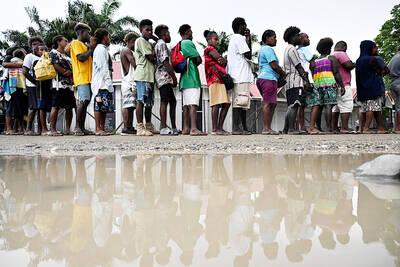
SEEKING CHANGE: A hospital worker said she did not vote in previous elections, but ‘now I can see that maybe my vote can change the system and the country’ Voting closed yesterday across the Solomon Islands in the south Pacific nation’s first general election since the government switched diplomatic allegiance from Taiwan to Beijing and struck a secret security pact that has raised fears of the Chinese navy gaining a foothold in the region. The Solomon Islands’ closer relationship with China and a troubled domestic economy weighed on voters’ minds as they cast their ballots. As many as 420,000 registered voters had their say across 50 national seats. For the first time, the national vote also coincided with elections for eight of the 10 local governments. Esther Maeluma cast her vote in the
Nearly half of China’s major cities are suffering “moderate to severe” levels of subsidence, putting millions of people at risk of flooding, especially as sea levels rise, according to a study of nationwide satellite data released yesterday. The authors of the paper, published by the journal Science, found that 45 percent of China’s urban land was sinking faster than 3mm per year, with 16 percent at more than 10mm per year, driven not only by declining water tables, but also the sheer weight of the built environment. With China’s urban population already in excess of 900 million people, “even a small portion

UNSETTLING IMAGES: The scene took place in front of TV crews covering the Trump trial, with a CNN anchor calling it an ‘emotional and unbelievably disturbing moment’ A man who doused himself in an accelerant and set himself on fire outside the courthouse where former US president Donald Trump is on trial has died, police said yesterday. The New York City Police Department (NYPD) said the man was declared dead by staff at an area hospital. The man was in Collect Pond Park at about 1:30pm on Friday when he took out pamphlets espousing conspiracy theories, tossed them around, then doused himself in an accelerant and set himself on fire, officials and witnesses said. A large number of police officers were nearby when it happened. Some officers and bystanders rushed

HYPOCRISY? The Chinese Ministry of Foreign Affairs yesterday asked whether Biden was talking about China or the US when he used the word ‘xenophobic’ US President Joe Biden on Wednesday called for a hike in steel tariffs on China, accusing Beijing of cheating as he spoke at a campaign event in Pennsylvania. Biden accused China of xenophobia, too, in a speech to union members in Pittsburgh. “They’re not competing, they’re cheating. They’re cheating and we’ve seen the damage here in America,” Biden said. Chinese steel companies “don’t need to worry about making a profit because the Chinese government is subsidizing them so heavily,” he said. Biden said he had called for the US Trade Representative to triple the tariff rates for Chinese steel and aluminum if Beijing was


 RSS
RSS